Quanzhou
Qingjing Mosque, Quanzhou: History and Visit Guide (2026)
Qingjing Mosque in Quanzhou
Qingjing Mosque gives you a direct look at the Arab-Islamic communities connected with Quanzhou during its centuries as an international port. Founded in 1009 and historically called Masjid al-Ashab, it is one of the earliest Islamic edifices in China. The remains are not a complete medieval mosque frozen in time. Gateways, roofless walls, inscriptions, later halls and restoration records reveal how the complex changed while its religious role continued.
UNESCO includes Qingjing Mosque within the serial World Heritage property Quanzhou: Emporium of the World in Song-Yuan China, inscribed in 2021. This wider context matters. The mosque was part of a maritime city linked to overseas trade and communities from beyond China, not an isolated imported monument.
Why is Qingjing Mosque important?
The mosque was established in 1009, during the Northern Song period. Quanzhou’s municipal heritage account says its original site stood just outside the eleventh-century city gate, beside the moat and within the principal residential area for foreigners during the Song-Yuan era. Major repairs in 1310 helped shape the layout visible today.
UNESCO identifies the mosque as one of China’s earliest Islamic buildings and places it within Quanzhou’s network of religious, commercial, production and transport sites. Reading the mosque alongside that network explains why Islamic architecture appeared here: Quanzhou participated in a maritime system that connected the Chinese interior with trading routes across Asia.
Do not treat the UNESCO label as the only reason to visit. The site’s strongest quality is its physical evidence. Stone arches, Arabic inscriptions, an open prayer-hall enclosure and later Chinese-period additions let you examine continuity and loss within a compact religious complex.
What should you look for inside?
Use this checklist to slow down and read the surviving structures:
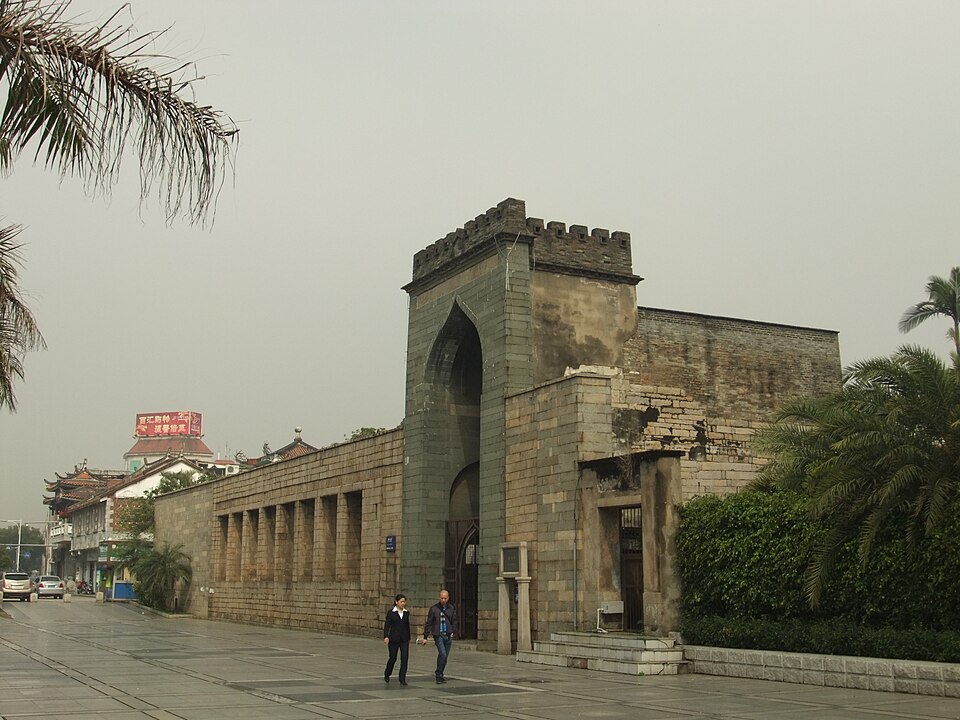
- The gate tower: The entrance uses stone construction and pointed arches associated with Islamic architecture. Look through each opening instead of photographing only the façade; the repeated arches create the clearest visual introduction to the complex.
- The former Prayer Hall: The historic Fengtian prayer space survives mainly through its enclosing stone walls after the roof collapsed during the Ming period. Remaining bases help indicate the earlier interior arrangement.
- The mihrab area: On the western wall, a tall pointed niche marks the direction of prayer. The official municipal description records Arabic Qur’anic inscriptions here.
- Mingshan Hall: This hall was built in 1567 and became a prayer space after the earlier hall lost its roof. Its different architectural language helps you see how the mosque adapted over time.
- Steles and inscriptions: Several stones preserve evidence of the mosque’s history, including repair records and an imperial edict issued in 1407 to protect the mosque and Islam.
- The ancient well: Listed among the surviving elements by Quanzhou’s official heritage account, the well is easy to overlook beside the larger stone structures.
The most useful question is not which part looks oldest. Ask how each element served worship, memory or repair. That approach prevents the visit from becoming a quick collection of arch photographs.
How should you interpret the architecture?
The stone entrance supplies the site’s strongest Arab-Islamic visual vocabulary, while later halls record local rebuilding and continued use. This is not a simple story of two styles placed side by side. The complex changed after repairs, structural losses and new construction, so its present form is a historical sequence.
Begin at the gate and note the progression from street to enclosed religious space. In the former Prayer Hall, use the remaining walls and niche to reconstruct the direction and scale of worship without imagining a fully preserved building. Then compare that space with Mingshan Hall. The contrast makes the mosque’s adaptation easier to understand than a list of dynastic dates does.
The mosque also clarifies Quanzhou’s UNESCO designation. The World Heritage property combines religious buildings with docks, bridges, pagodas, administrative remains and production sites. Qingjing Mosque represents the social and cultural communities that accompanied maritime trade.
Where is Qingjing Mosque, and how do you get there?
Qingjing Mosque stands on Tumen Street in central Quanzhou. For maps, taxis and accommodation desks, search for Qingjing Mosque or Qingjing Mosque, Quanzhou. Confirm that the result is in Quanzhou’s historic urban center before setting out.
The central setting makes the mosque suitable for a walking-based old-city itinerary, but choose the order of your stops from your actual map rather than relying on an old transport route. Street access and local traffic arrangements can change.
What are the tickets and opening hours?
This guide does not quote a price or daily timetable because no current dated official visitor notice was available during verification. Check the entrance notice or ask a local visitor-information desk on the day you go. This is safer than planning around undated listings, which disagree about both admission and opening times.
If access is limited when you arrive, do not pressure staff or enter a space marked for worshippers. The historic gateway and its relationship to Tumen Street still provide useful context from the public approach.
What is the best time to visit?
Choose a dry day if possible because important parts of the former prayer complex are open to the sky. Softer morning or late-afternoon light can make the depth of the stone arches easier to photograph, while overcast light is useful for inscriptions. These are photographic preferences, not guaranteed access periods.
Avoid building a tightly timed schedule around the mosque. Leave enough flexibility to read entrance information, observe any access restrictions and walk through the site without interrupting others.
How do you visit respectfully?
Qingjing is both protected heritage and a place connected with a living religious tradition. Wear clothing that covers shoulders and knees, keep conversations quiet and follow posted instructions. Ask before photographing worshippers or staff. Do not touch inscriptions, climb on stonework or use the remains as portrait props.
A respectful visit is also a better historical visit. Pausing at the prayer niche, later hall and restoration steles helps you understand the site as a religious institution shaped by centuries of change, not merely an unusual backdrop.
Frequently asked questions
Is Qingjing Mosque part of a UNESCO World Heritage Site?
Yes. It is a component of Quanzhou: Emporium of the World in Song-Yuan China, a serial property inscribed in 2021.
When was Qingjing Mosque built?
The mosque was founded in 1009. Major repairs took place in 1310, when the basis of its present layout began to form.
Is the original prayer hall intact?
No. The historic Fengtian prayer hall lost its roof during the Ming period, leaving its stone enclosure and other surviving elements. Mingshan Hall later served as a prayer space.
What should I search for on a map?
Search for Qingjing Mosque or Qingjing Mosque, Quanzhou, and confirm that the result is in Quanzhou’s historic urban center.
Can non-Muslim travelers visit?
Visitor access should be confirmed at the entrance on the day of your visit. Follow any separation between heritage-viewing areas and spaces reserved for religious use.
Highlights
- Founded in 1009 under its historical name, Masjid al-Ashab
- One of China’s earliest Islamic edifices and a component of Quanzhou’s UNESCO World Heritage property
- Stone gate tower with pointed arches and a strong Arab-Islamic architectural character
- Roofless former Prayer Hall with a surviving mihrab and Arabic Qur’anic inscriptions
- Mingshan Hall, ancient well and historical steles recording the mosque’s continued development
Travel Tips
Save the Chinese name
Search for Qingjing Mosque or Qingjing Mosque, Quanzhou; confirm that the result is in central Quanzhou.
Verify access on arrival
Check the entrance notice for the current timetable, admission policy and any areas reserved for religious use.
Read the site in sequence
Start at the gate, continue to the former Prayer Hall and mihrab, then compare those remains with Mingshan Hall.
Photograph respectfully
Ask before photographing people, keep equipment away from worship areas and never climb on or touch the historic stonework.
More to see in Quanzhou
Tianjin Tianhou Palace: Hours and Address
Quanzhou Tianhou Temple: World Heritage Visit Guide (2026)
Quanzhou Maritime Museum: Hours, Galleries & Visit Guide (2026)
Quanzhou Kaiyuan Temple: Free Entry, Twin Pagodas & Visit Guide (2026)
Quanzhou Kaiyuan Temple 2026: Free Entry, Hours and Visit Tips