Beijing to Qingdao Train: Time, Price and Which Station to Use (2026)
Quick answer: The fastest Beijing to Qingdao bullet train takes just under 3 hours (the quickest G-trains run 2h59m to 3h05m), though most of the 20-plus daily services take 3 to 5 hours depending on how many stops they make. Second class runs about CNY 290-380 (roughly $41-53), first class CNY 480-600 ($68-84), and business class CNY 980-1,200 ($138-169). Trains leave from Beijing South and land at one of two different Qingdao stations, which matters more than most guides admit.
You can book straight through 12306, the official China Railway site and app. It works, it's free of markup, and it's how most Chinese travelers buy tickets. The catch is that the English version is limited, it wants a passport number entered exactly as printed, and payment can be awkward if your bank card isn't linked to a Chinese account. If you want an English interface, real-time seat availability, and a card that just works, this is the option most readers on this site end up using instead:
Book Beijing to Qingdao train tickets
English checkout, live seat maps, no Chinese bank account needed
Some links are affiliate links; we may earn a commission at no extra cost to you.
For step-by-step guidance on registering, choosing between 12306 and Trip.com, and boarding with only your passport, see our complete guide to booking China's high-speed trains.
How long the Beijing to Qingdao bullet train takes
The route runs north out of Beijing South on the Beijing-Shanghai high-speed line, peels off at Jinan, then continues east on the Jinan-Qingdao high-speed railway, a 308 km, 350 km/h-design line that opened at the end of 2018. It's a through service, so you don't change trains at Jinan even though the ticket effectively covers two different HSR lines end to end.
Total distance works out to somewhere around 780 km of track (a few booking sites round it up toward 820 km, others cite a shorter figure closer to 660-690 km depending on which stations they're measuring between). In a straight line, Beijing and Qingdao are only about 570 km apart, so the rail route does some genuine bending to follow the Jinan interchange rather than cutting a direct diagonal.
The fastest trains, like G209 and G211, cover that distance in under 3 hours by making only two or three stops. Most other G-trains stop at Cangzhou, Dezhou, Jinan, Zibo, and Weifang along the way, which stretches the ride to 4 or sometimes close to 5 hours. If travel time matters more than price, check the stop count before booking rather than assuming every G-train is equally fast, because the difference between a 3-hour and a 5-hour ticket can be the same price.
What a ticket costs
| Class | Price (CNY) | Price (approx. USD) |
|---|---|---|
| Second class seat | 290-380 | $41-53 |
| First class seat | 480-600 | $68-84 |
| Business class | 980-1,200 | $138-169 |
Prices shift slightly by train number and how far in advance you book, since some services (and some seat classes on those services) sell out on weekends and around Chinese holidays. Second class is a normal airline-style seat with a fold-down tray. First class gives noticeably more legroom and 2+2 seating instead of 3+2. Business class on the fastest G-trains is closer to a business-class plane seat, with a handful of nearly-flat recliners per carriage. For a 3-hour ride, most people find second class perfectly comfortable and skip the upgrade.
Beijing South, and how the line gets to Qingdao
Nearly every Beijing to Qingdao bullet train departs from Beijing South Railway Station in Fengtai district, reachable by Subway Lines 4 and 14. A handful of overnight or slower D-category trains use other Beijing stations, but if you're booking a G-train (the fast, frequent option), Beijing South is where you're headed. Arrive with real time to spare: Beijing South is large, security lines can be slow at peak hours, and the walk from the entrance to a far platform takes longer than it looks on the departure board.
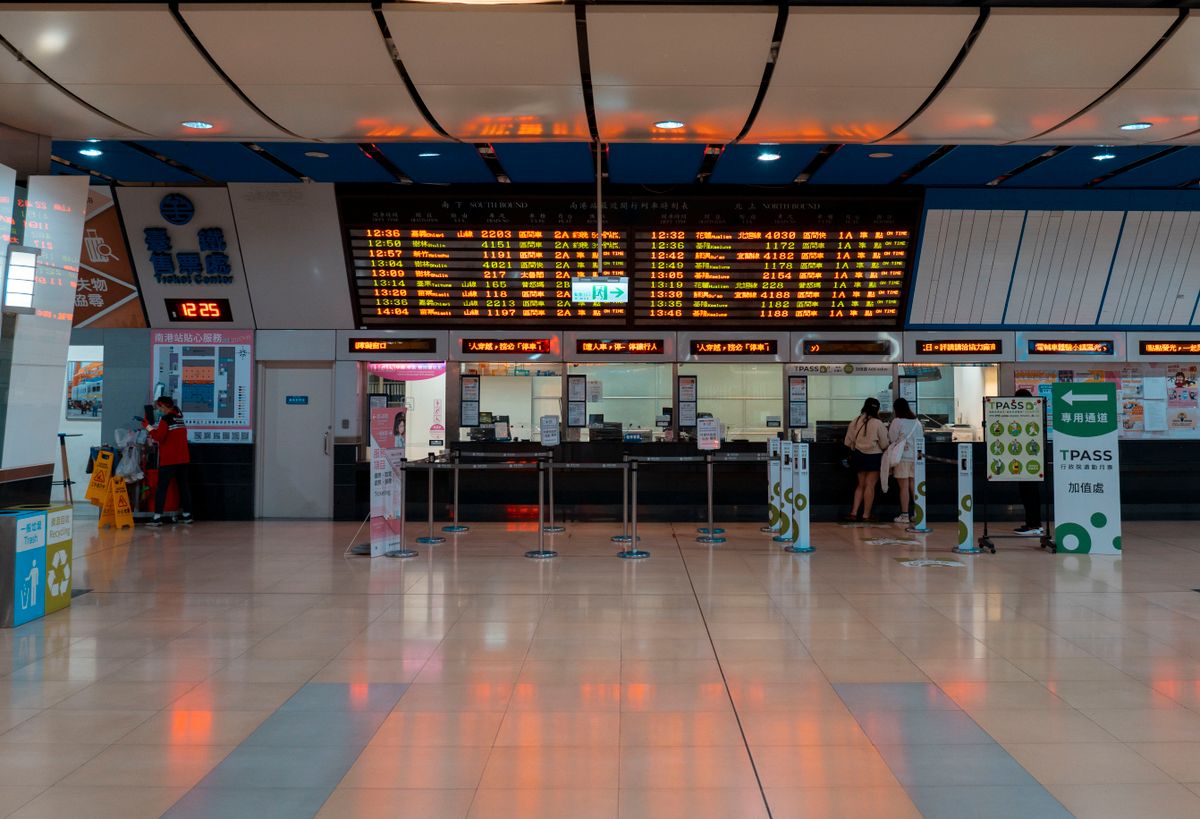
A China Railway high-speed train at a busy departures hall with an electronic timetable board
Qingdao Railway Station or Qingdao North: pick the right one
This is the part that trips people up most. Qingdao has three stations, but two matter for this route:
- Qingdao Railway Station sits right in the historic core, about a 10-15 minute walk from Zhanqiao Pier, the German colonial quarter, and close to the Tsingtao Brewery Museum. If your hotel is anywhere in Shinan District, this is the station you want.
- Qingdao North Railway Station is the city's main HSR hub, handling the bulk of fast trains to Beijing, Jinan, Shanghai, Hangzhou, and Tianjin. It sits well outside downtown, and getting from there to the pier or old town takes 35 to 55 minutes by Metro Line 3 plus a walk, or a longer taxi ride in traffic.
Both stations get direct Beijing South to Qingdao service, so this isn't a case of one station being HSR-only and the other being the "downtown" fallback. When you search tickets on 12306 or a booking app, the arrival station is listed next to each train number, and it's worth checking it rather than booking the first departure time that fits your schedule. Landing at Qingdao North when you've booked a hotel near Zhanqiao Pier adds close to an hour of extra travel you didn't plan for.
How to book Beijing to Qingdao train tickets
Tickets go on sale 15 days before departure through 12306 (the system most travel agencies and apps pull from anyway). If you're comfortable with a passport-based Chinese account and a Chinese-compatible payment method, 12306 costs nothing extra. If you'd rather book in English without wrestling with the interface, Trip.com pulls from the same real-time inventory and issues an e-ticket linked to your passport, which is what you tap at the gate instead of a paper ticket. Either way, print or screenshot your booking confirmation and keep your passport handy: gates scan the passport, not a printed itinerary.
Mistakes people make booking this route
- Assuming "Qingdao" on the ticket means downtown. It might mean Qingdao North instead. Read the arrival station name on the ticket, not just the city name.
- Booking the cheapest departure time without checking stop count. A train scheduled an hour later can arrive nearly 90 minutes sooner if it skips three intermediate stations.
- Forgetting the ticket is passport-linked. There's no physical paper ticket to lose, but there's also no boarding without the exact passport used at booking. A photo of the passport on your phone isn't accepted at the gate; you need the actual document.
- Cutting arrival time too close at Beijing South. This station is enormous, and a 20-minute buffer that works at a smaller station can leave you jogging for the platform here.
- Confusing this route with the older, slower Jiaoji line trains. The historic Qingdao-Jinan railway (built by the Germans in the early 1900s to move goods, including the beer trade, inland) still carries some slower services. The G-trains covered in this guide run on the newer, dedicated 2018 high-speed line, not that original corridor, which is part of why journey times vary so much between train numbers.
Bullet train vs flying vs the airport train
Flights between Beijing and Qingdao take about 1.5 to 2 hours in the air, with roughly a dozen daily departures. Once you add checking in, security, and getting to and from two airports well outside each city center, total door-to-door time ends up close to what the bullet train takes anyway, especially if your Beijing hotel is nearer Beijing South than the airport, or your Qingdao plans center on downtown rather than the airport side of the city. The train also skips the baggage-weight stress and lets you board minutes before departure instead of an hour early. Unless you're connecting through Qingdao Liuting airport as part of a longer flight itinerary, the train is usually the simpler call for this specific city pair.
Who this route makes sense for
This works well if you're doing a loop through eastern China: Beijing for the capital sights, then southeast to Qingdao for the seafront, the German colonial architecture, and the Tsingtao Brewery, before continuing on to Shanghai or back north. It's a comfortable single-day trip either direction, with enough daily departures that you're rarely locked into one specific time.
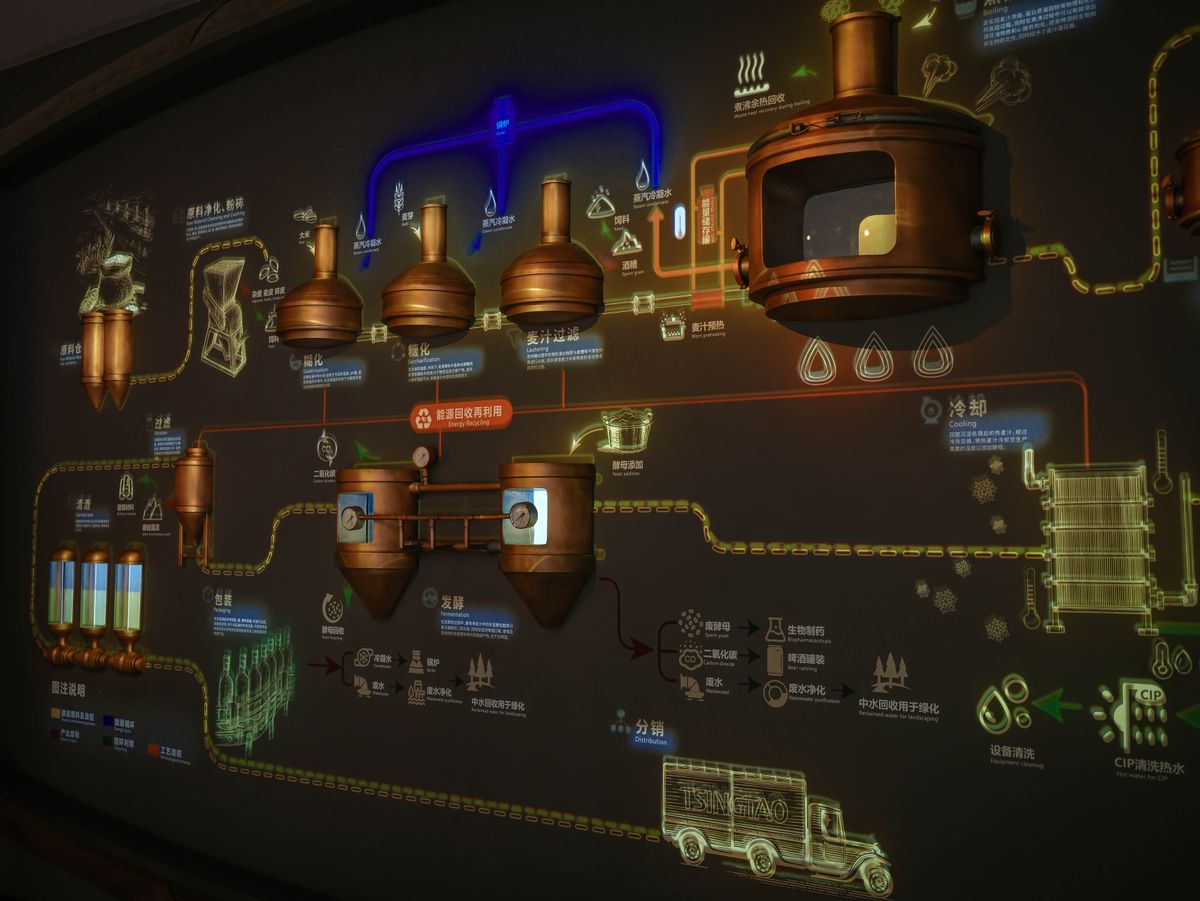
An illuminated interactive display explaining the brewing process at the Tsingtao Beer Museum in Qingdao
It makes less sense if Qingdao is a quick overnight stop bolted onto a packed itinerary; the beach, the brewery tour, and the old town genuinely deserve two full days, and a 3-hour train ride each way eats into a one-night visit fast. If you're short on time and mainly want the brewery and the pier, weigh whether a shorter regional trip elsewhere might fit your schedule better than a same-day round trip here.
FAQ
How long does the Beijing to Qingdao high-speed train take? The fastest direct G-trains take just under 3 hours (2h59m to 3h05m). Most daily services run 3 to 5 hours depending on how many intermediate stations they stop at along the way.
How much is a Beijing to Qingdao train ticket? Second class costs roughly CNY 290-380 ($41-53), first class CNY 480-600 ($68-84), and business class CNY 980-1,200 ($138-169), with slight variation by train number and how close to departure you book.
Which station do Beijing to Qingdao trains arrive at? Both Qingdao Railway Station (downtown, near Zhanqiao Pier and the German quarter) and Qingdao North Railway Station (the main HSR hub, further from downtown) receive direct trains from Beijing South. Check the arrival station listed on your specific ticket before booking.
Is there a direct train from Beijing to Qingdao, or do I need to change at Jinan? It's a through service. The train runs on the Beijing-Shanghai high-speed line to Jinan, then continues on the Jinan-Qingdao high-speed line without a change of train.
Is it faster to fly from Beijing to Qingdao? The flight itself is shorter at 1.5 to 2 hours, but once you add airport transfers, check-in, and security on both ends, total travel time is close to the train's 3 to 5 hours, and the train stations tend to be more central than the airports.