China Train Luggage Allowance 2026: Weight and Size Limits Explained
You show up at Beijing South with two 28-inch suitcases and a backpack, and the security guard barely glances at them. That is normal. China's railway system, 12306, publishes a clear luggage limit, but enforcement on the ground is loose almost everywhere except during the Spring Festival travel rush. Here is what the rule says, what happens if you go over it, and how to move a large suitcase through a station that can be a 15-minute walk from the entrance to your platform.
Most of this guide assumes you already have a ticket. If you don't, Trip.com sells China train tickets in English and takes foreign cards, drawing straight from the same 12306 system that's free to book directly if you're comfortable with a Chinese-only interface.
Book China Train Tickets
Search and book in English, no Chinese ID card needed
Some links are affiliate links; we may earn a commission at no extra cost to you.
How Much Luggage You Can Bring
China Railway's official rule, set by 12306, limits adult passengers to 20 kg of carry-on luggage. Children travel with a 10 kg allowance. The size limit is measured as the sum of length, width, and height, and it changes depending on the train.
On high-speed trains (G, D, and C series), that dimension sum cannot exceed 130 cm. On regular-speed trains (K, T, and Z series, the overnight sleepers and slower long-haul services), the limit is 160 cm, giving you more room for an oversized duffel or a second suitcase. Rod-shaped items such as fishing rods, tripods, or ski bags get their own rule: up to 200 cm in length, regardless of train type. If you are carrying a power bank, keep it under 100 Wh; anything larger is barred from the train entirely, the same rule airlines use.
| Train type | Adult weight limit | Child weight limit | Max size (L+W+H) |
|---|---|---|---|
| High-speed (G/D/C) | 20 kg | 10 kg | 130 cm |
| Regular speed (K/T/Z) | 20 kg | 10 kg | 160 cm |
| Rod-shaped items (any train) | n/a | n/a | 200 cm length |
In practice, station staff rarely pull out a scale or a measuring tape unless a bag is obviously huge or you are traveling during a peak holiday window like Chinese New Year or National Day. A 24-inch checked-style suitcase, a carry-on, and a day bag is a completely normal load for one adult and draws no attention.
There's No Checked-Luggage Counter, Only Carry-On
This is the part that trips up first-time riders coming from air travel: China's domestic trains do not have a baggage hold. Everything you bring goes on board with you and rides in the same carriage you sit in. There is no tag-your-bag-at-check-in step, no baggage carousel at the other end, and no "gate check" option for an oversized item.
If you genuinely have more stuff than you can carry (a long stay, souvenirs, moving between apartments), the practical fix is a courier, not a train service. China Railway has partnered with SF Express and JD Logistics at a growing number of stations, letting you book a hotel pickup and have a box or suitcase delivered to your next hotel, often for the equivalent of a few hours' hotel-taxi fare. It's slower (1-3 days) but removes the weight from your hands entirely. For everything else, plan around carrying your own bags, and read how to ride China's high-speed trains for the full boarding sequence.
What Happens If Your Bag Is Oversized
If a bag is clearly over the line, staff at the security checkpoint or the conductor on board can ask you to send it as freight through the station's separate cargo/parcel office, pay a small excess fee, or in rare cases decline to let it on the train until it is repacked into two smaller pieces. Large sporting equipment (bicycles, surfboards, oversized boxes) usually needs to be disassembled or boxed to fit the size rule, and some stations have a dedicated oversized-luggage window near the ticket hall for exactly this. None of this is common for a typical tourist with two suitcases and a backpack; it mostly affects people moving house or hauling commercial goods.
Seat class also affects how much room you realistically have for your bags near your seat. Second class has a shared overhead rack with less depth; first class and business class carriages tend to have more room per passenger and lower overall crowding. If you are traveling with more than one large suitcase, it's worth reading China train classes and seats explained before you book, so your seat choice matches how much luggage you're hauling.
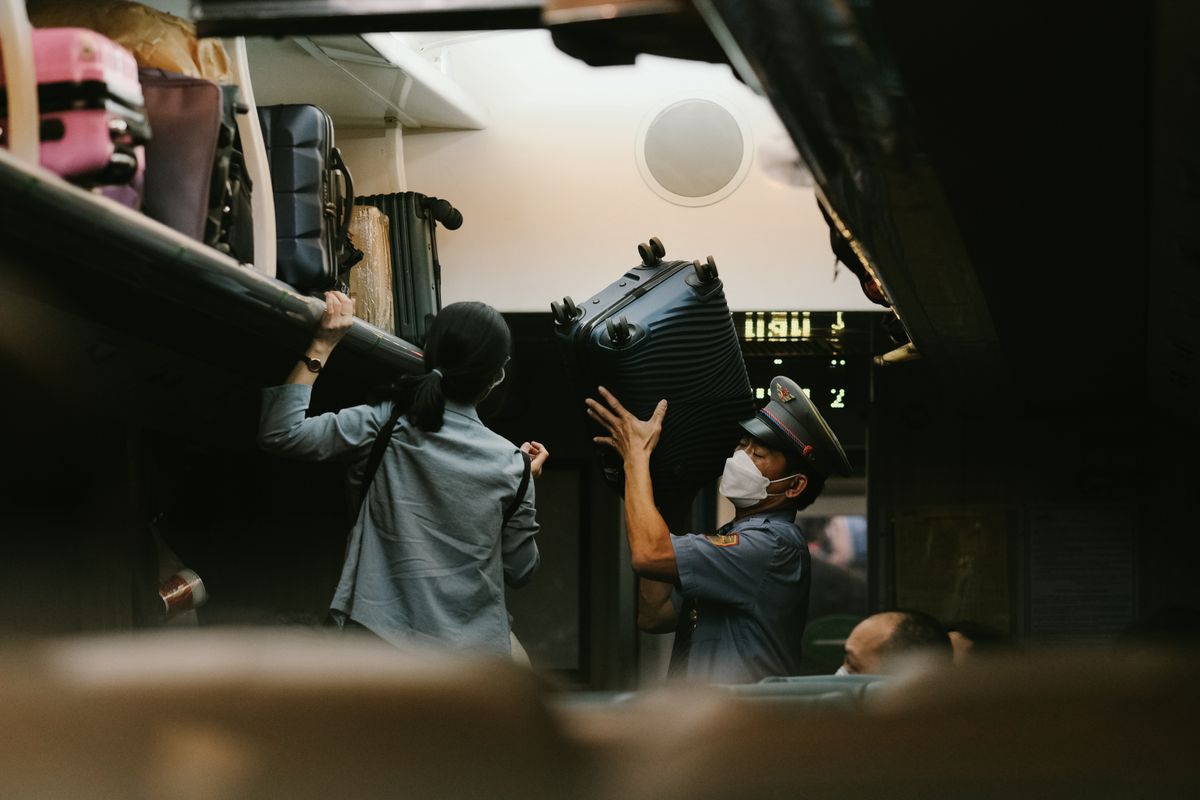
Train conductor and passenger loading a large suitcase onto an overhead luggage rack
Luggage Racks and Where Your Bag Goes
Every carriage has three places for luggage. Small suitcases, backpacks, and duffels go on the overhead rack running above the seats on both sides of the aisle; it fits a 20 to 24-inch case but not much bigger. Full-size suitcases go on the large open racks at the end of each carriage, near the doors, stacked by whoever boards first, which is one more reason to be at your car number early. A small daypack or shopping bag can also sit in the footwell between your legs or under the seat in front of you.
Doors open for roughly 2 to 5 minutes at smaller stops on a fast train, less at times of high traffic, so have your bag off the rack and yourself standing near the door at least one stop before you need to get off. If you boarded with a big suitcase at the far end of the carriage from your seat, budget extra time to retrieve it before your station is called.
Left-Luggage Storage at Major Stations
Major hubs like Beijing South, Beijing West, Shanghai Hongqiao, and Guangzhou South run left-luggage counters or self-service lockers, most open long hours and some 24/7. Pricing is usually tiered by locker size and by time: a typical small locker runs around 10-15 yuan for the first several hours and 25-40 yuan for a full 24-hour block, with large lockers costing more. Staffed counters work the same way but let you store an oversized bag that wouldn't fit a locker door.
Either way, expect to show your passport (the same ID rule that applies to ticket purchase applies here) and have your bag pass through an X-ray scanner before it's accepted, identical to the security check at the station entrance. Keep your claim ticket or code; you'll need it, plus ID, to collect your bag later.
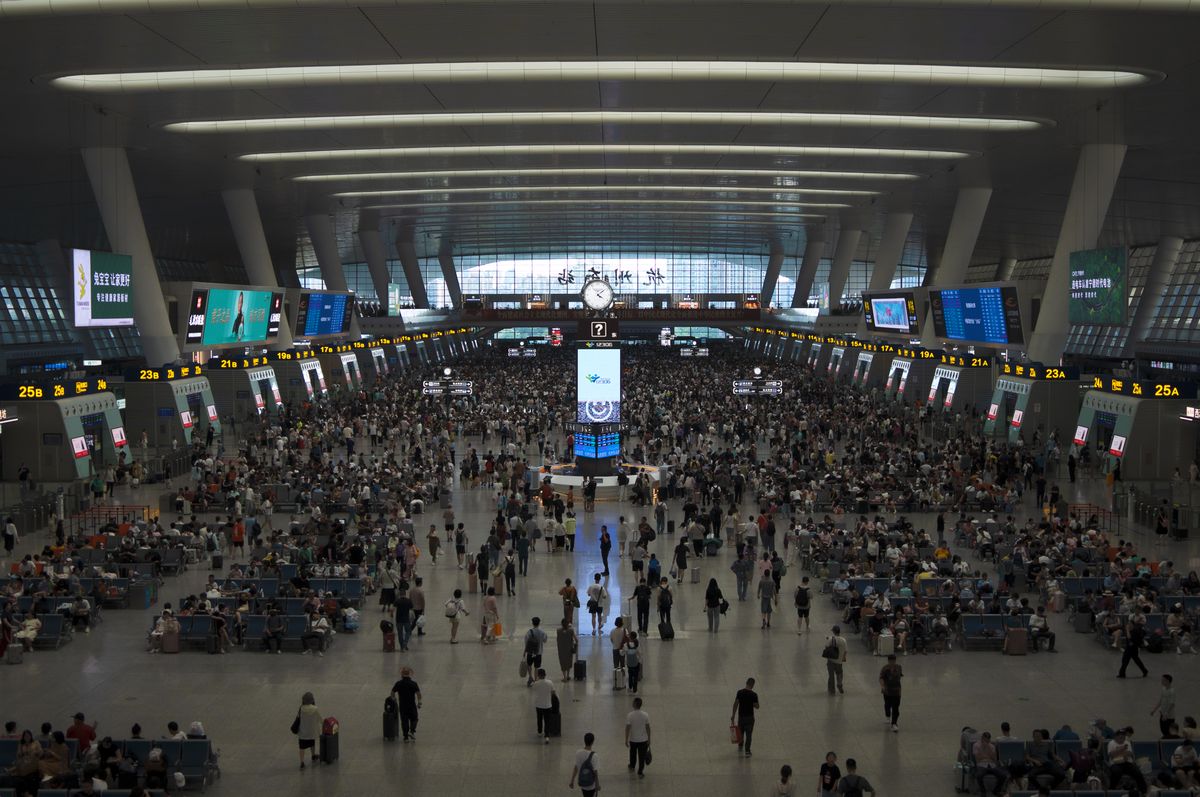
Wide view of a crowded China railway station waiting hall with departure boards
Getting a Big Suitcase Through the Station
China's newest mega-stations (Beijing South, Shanghai Hongqiao, Guangzhou South, Chengdu East) are enormous, and the walk from the entrance security check to your platform can run 10 to 15 minutes at a normal pace, longer if you're navigating with a heavy case. A few things make this easier:
- Escalators are the default, running in both directions between the concourse and the platforms; elevators exist for accessibility but are fewer in number and less clearly marked, so if you need one, look for wheelchair-access signage near the main stairs rather than assuming one is nearby.
- Some stations provide free luggage trolleys near the main entrances and taxi drop-off points; they don't go down to platform level, so use them to get from the door to the escalators, then carry your bag from there.
- Arrive with a buffer. For a normal weekday, 45-60 minutes before departure is enough at a small or mid-size station; at a mega-hub like Beijing South or Shanghai Hongqiao, or during a holiday period, budget 90 minutes. Ticket gates typically close 5 to 10 minutes before departure and will not reopen for a late arrival.
- Security-to-platform is usually the longest leg, not the security check itself. Once you're through the X-ray, follow the departure boards to your gate letter, then your platform number; the gate-to-train walk on the platform itself is short.
For a full first-timer walkthrough of the whole process, from buying a ticket to finding your seat, see how to ride China's high-speed trains; if you haven't booked yet, booking China trains covers the ticketing side.
The Practical Takeaway
Pack to the 20 kg / 130 cm high-speed limit if you can (160 cm on regular trains), know that there is no checked-bag service so everything travels with you, use the end-of-carriage racks for anything over 24 inches, and give yourself 45 to 90 minutes at the station depending on its size. If you're carrying more than that, a hotel-to-hotel courier through SF Express or JD Logistics is the standard workaround, not trying to force an oversized case past the rule.
FAQ
Can you bring a large suitcase on a Chinese high-speed train? Yes. A standard 24 to 28-inch checked-style suitcase is normal and rarely questioned, as long as the three dimensions add up to roughly 130 cm or less on a G/D/C train (160 cm on a K/T/Z train) and it weighs under 20 kg.
Is there a weight limit for China train luggage? Yes, 20 kg per adult passenger and 10 kg per child, set by 12306. In practice, staff rarely weigh bags unless one is obviously overloaded or you're traveling during a major holiday.
Can you check luggage on China trains like a plane? No. Domestic Chinese trains have no baggage hold or checked-luggage counter. Every bag rides in the passenger carriage with you. If you have too much to carry, book a courier pickup (SF Express or JD Logistics operate at many stations) instead.
What happens if my luggage is too big or heavy? Nothing happens for a typical tourist load. For genuinely oversized items, staff may direct you to a separate cargo window, ask for a small excess fee, or ask you to split it into smaller pieces. Bicycles and similar large items usually need to be boxed first.
Where can I store luggage before or after my train in China? Major stations (Beijing South and West, Shanghai Hongqiao, Guangzhou South, and most other big hubs) have left-luggage lockers or staffed counters, priced by size and duration, usually 10-40 yuan depending on how long you store the bag. You'll need your passport and your bag will go through an X-ray scan.