Fastest Train in China 2026: Fuxing's 350 km/h Record Explained
A Fuxing G17 train pulls out of Beijing South at 6:20 a.m., clears the city limits, and settles into a 350 km/h cruise for most of the run to Shanghai. Four hours and eighteen minutes later it stops at Shanghai Hongqiao, 1,318 km away. That is the fastest scheduled train ride in China you can buy a ticket for today. It is not, however, the fastest train China has ever run on rails. A prototype called CR450 hit 453 km/h on a test track, and a lot of headlines blur the line between "fastest train tested" and "fastest train you can buy a ticket to ride." This guide separates the two, gives you the real routes and numbers, and tells you how to book a seat on the one that's real.
For step-by-step guidance on registering, choosing between 12306 and Trip.com, and boarding with only your passport, see our complete guide to booking China's high-speed trains.
What is the fastest train in China right now?
The Fuxing (Hao) series, built by CRRC, is China's flagship high-speed train and the fastest one in regular commercial service. Two main variants run at full speed: the CR400AF (blue accent stripe) and the CR400BF (gold/red accent stripe). Both cruise at 350 km/h on their fastest-rated lines, with a design margin that lets them run safely above that if a schedule ever calls for it.
The flagship route is the Beijing-Shanghai high-speed line (Jinghu HSR), 1,318 km end to end. The fastest G-class Fuxing services cover it in about 4 hours 18 minutes; slower G-trains with more stops take 5 to 6 hours. In June 2024, China Railway put a longer 17-car version, the CR400AF-BS, into service on this line, adding capacity without giving up the 350 km/h cruising speed.
For scale: a 4.5-hour Beijing-Shanghai train ride covers roughly the same distance as Los Angeles to San Francisco, and it beats flying once you count airport time on both ends.
Has the CR450 already replaced it?
Not yet, and this is the fact most searches get wrong. The CR450AF and CR450BF prototypes were shown publicly in late 2024, with the first trainset (CR450AF-0201) rolled out that November. During test runs, a CR450 set reached 453 km/h, the highest speed ever recorded for a conventional wheel-on-rail passenger train, beating the previous test record set by a French TGV in 2007.
That number is a test-track result, not a ticket you can buy. As of mid-2026, CR450 is still working through a mandated 600,000 km test-running program before series production and passenger certification can begin. China State Railway Group has said design finalization is targeting 2026, with the train expected to enter commercial service on busy corridors such as Beijing-Shanghai or Shanghai-Chengdu once testing wraps and manufacturing scales up. No passenger ticket date has been confirmed yet.
So the practical answer for anyone booking a trip this year: every seat you can reserve right now sits on a Fuxing CR400 train topping out at 350 km/h. The 400 km/h CR450, once it enters service, is expected to keep that same 350 km/h ceiling on most existing lines anyway, because track curvature and signal spacing were built around that number. Its extra speed will matter more on new lines engineered for 400 km/h from the start.
Which routes run at the full 350 km/h?
Not every high-speed line in China allows the full 350 km/h. Track curvature near cities, shared freight corridors, and older concrete-slab sections cap plenty of "high-speed" routes at 300, 250, or even lower. The lines where you'll genuinely feel the top speed include:
- Beijing-Shanghai (Jinghu HSR): the benchmark line, 350 km/h cruise, fastest G-trains at 4h18m.
- Beijing-Tianjin Intercity: 120 km covered in around 30 minutes, one of the first lines built for 350 km/h back in 2008.
- Beijing-Guangzhou (Jingguang HSR), northern section: Fuxing trains hit 350 km/h on the flatter stretches near Beijing and Shijiazhuang.
- Beijing-Zhangjiakou: built for the 2022 Winter Olympics, the first line in the world certified for 350 km/h autonomous-driving operation.
Mountain routes tell a different story. Xi'an-Chengdu, for example, crosses the Qinling range through dozens of tunnels and is capped around 250 km/h regardless of train model, because the terrain, not the train, sets the limit.
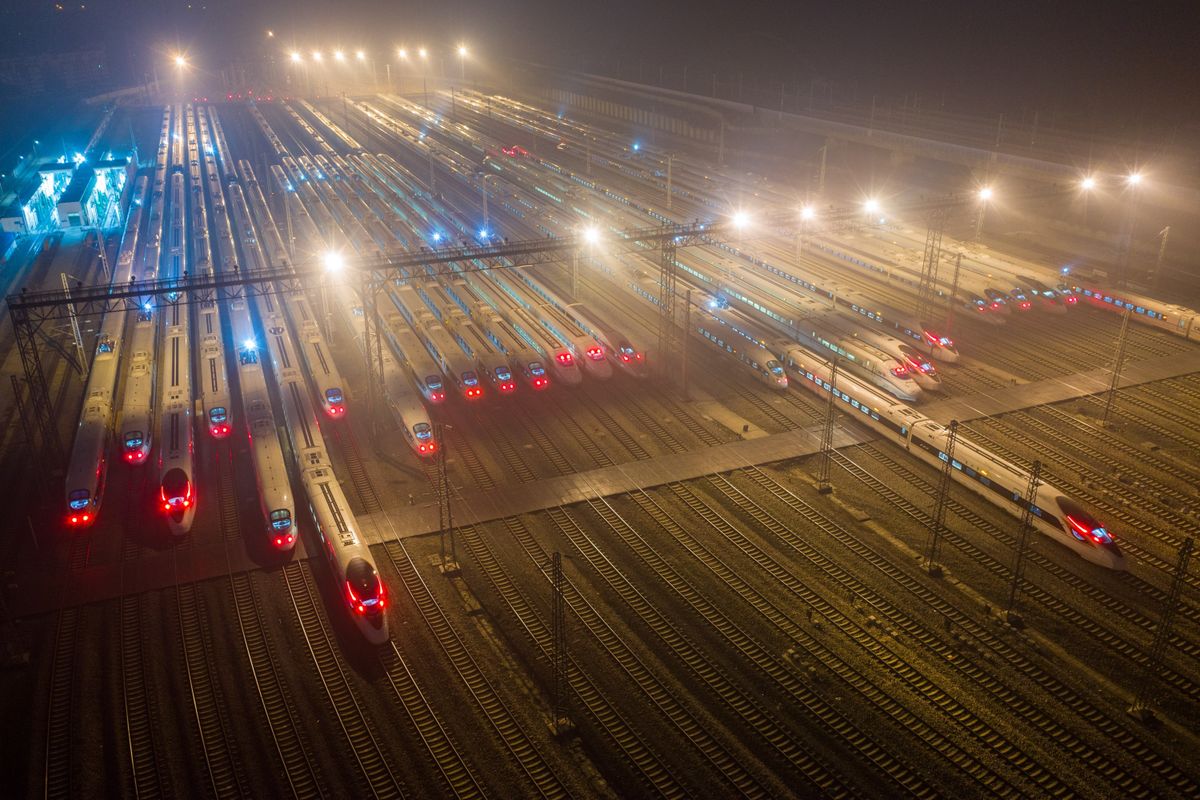
Aerial night view of high-speed trains lined up at a railway depot in China
Fuxing vs Hexie vs CR450: how do China's bullet trains compare?
| Train model | Top commercial speed | Status in 2026 | Where you'll ride it |
|---|---|---|---|
| Fuxing CR400AF / CR400BF | 350 km/h | In daily commercial service | Beijing-Shanghai, Beijing-Tianjin, Beijing-Guangzhou (north), Beijing-Zhangjiakou |
| Hexie CRH380A / CRH380B | 300-310 km/h in service (350 km/h design speed, operationally capped) | Still running, mostly on older or secondary corridors | Regional HSR lines, backup rolling stock on busy routes |
| CR450AF / CR450BF (prototype) | 400 km/h planned; 453 km/h recorded in testing | Testing only, no ticket sales | None yet; expected on flagship lines after 2026 certification |
The Hexie series was China's first generation of domestically-assembled high-speed trains, introduced in the late 2000s. Many were originally rated for 350 km/h too, but after a fatal 2011 collision near Wenzhou, China Railway capped commercial operating speeds network-wide, and Hexie trains have run at reduced speeds ever since. Fuxing, developed afterward with a fully domestic design, restored the 350 km/h ceiling in 2017.
How does China's fastest train compare to Japan's Shinkansen?
Japan's Shinkansen network tops out around 320 km/h in regular service, on sections of the Tohoku Shinkansen using the E5/E6 series trains. China's Fuxing runs 30 km/h faster at its 350 km/h cruise, giving it the edge in raw commercial speed among trains you can currently book a ticket on anywhere in the world.
The comparison isn't only about top speed. The Shinkansen has run since 1964 with an extraordinary safety and on-time record, and its network reaches deep into smaller cities with frequent, tightly-scheduled departures. China's network is younger but far larger by track length, and it's still adding new 350 km/h corridors every year. Both systems are worth riding for different reasons: Shinkansen for reliability and frequency, Fuxing for outright speed and newer rolling stock.
How do you book a seat on a Fuxing train?
Look for the train number first. Fuxing's fastest scheduled services carry a G prefix (for example G17, G39, G1 on Beijing-Shanghai). D-class trains are also high-speed but often run at 250-300 km/h and stop more. C-class trains are shorter intercity services, usually slower still. Booking a G-train on a confirmed 350 km/h corridor like Jinghu is the surest way to get the fastest ride.
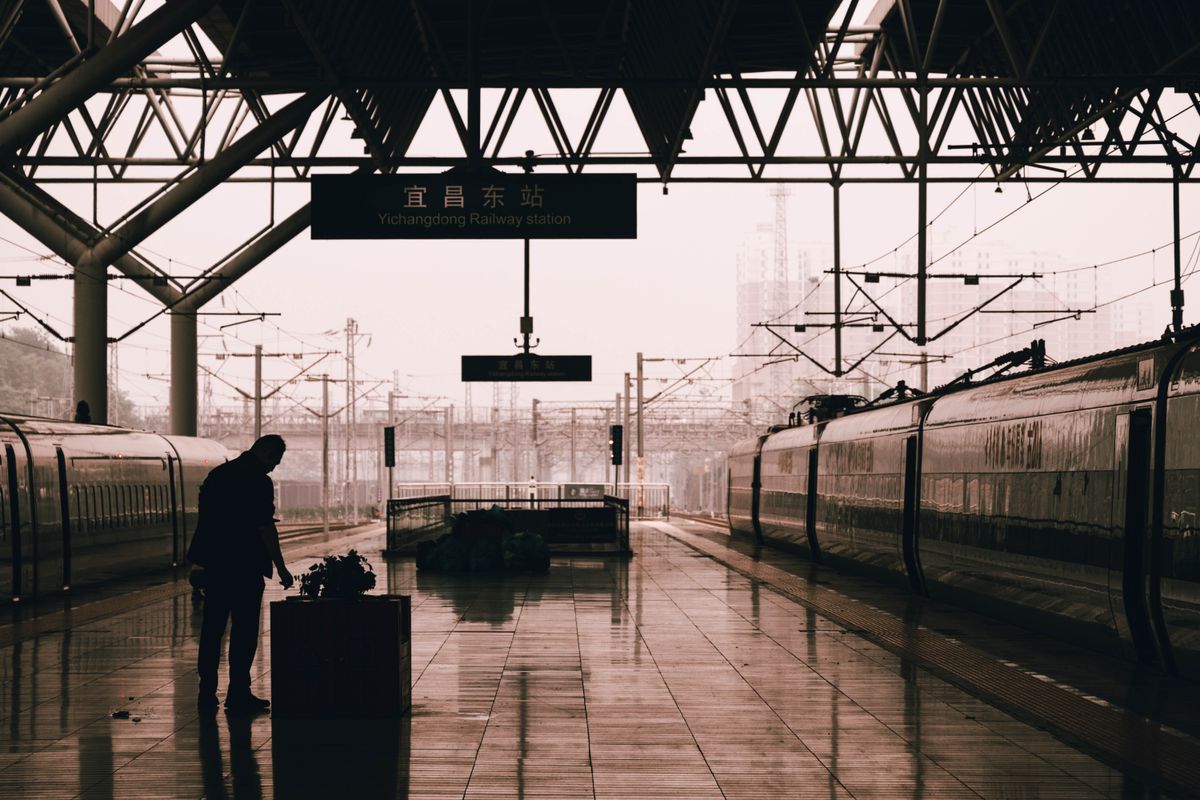
Passenger waiting on a platform under the Yichangdong Railway Station sign in China
Book Fuxing Bullet Train Tickets
Compare seat classes and times in English
Some links are affiliate links; we may earn a commission at no extra cost to you.
The free official channel is 12306 (the China Railway ticketing site and app). Foreign travelers can register with a passport number, buy tickets directly, and collect them at the station with the same passport, no separate paper ticket needed. It's entirely free beyond the ticket price, but the interface is mostly in Chinese, seat maps can be confusing on a first try, and tickets for peak travel windows (Spring Festival, National Day week) can sell out within minutes of release. Trip.com's rail booking tool runs on the same 12306 inventory but adds an English interface, saved passport details, and customer support, for a small service fee. Either way, book 3-5 days ahead for normal travel and as early as the ticket release window allows (usually 15 days out) for holiday periods.
When you book, check three things: the train number starts with G, the departure and arrival stations match the main HSR terminal (not a smaller regional station with the same city name), and the seat class fits your budget (second class is comfortable and the most affordable; business class gets you flat, rotating seats and quieter cars for a real premium).
Practical tips before you ride
- Arrive at least 30 minutes early. Chinese HSR stations use airport-style security and gated boarding, and gates close a few minutes before departure with no exceptions.
- Bring the passport you booked with. Station staff scan it at security and again at the gate; a mismatched document can block boarding.
- Pack light for the overhead racks. Fuxing trains have less oversized luggage space than older trains, especially in second class.
- Download offline maps or a translation app before you go. Onboard wifi exists on many Fuxing trains but coverage in tunnels and rural stretches is inconsistent.
FAQ
What is the fastest train in China in 2026? The Fuxing CR400AF and CR400BF, cruising at 350 km/h in commercial service. The fastest scheduled run is Beijing to Shanghai in about 4 hours 18 minutes.
Is the CR450 already carrying passengers? No. As of mid-2026 it is still in its test-running phase after hitting 453 km/h on a test track. No commercial ticket date has been confirmed.
Is China's fastest train faster than Japan's Shinkansen? Yes, on paper. Fuxing's 350 km/h commercial cruise beats the Shinkansen's roughly 320 km/h top service speed. The Shinkansen still leads on punctuality track record and network density into smaller cities.
Can tourists ride the Fuxing train? Yes. No permit or special registration is required beyond a valid passport. Book through 12306 directly or through Trip.com for an English-language interface, then board like any other passenger.
Why don't all "high-speed" trains in China hit 350 km/h? Track geometry and terrain set the ceiling as much as the train does. Mountain routes with heavy tunneling, shared freight corridors, and dense urban approaches often cap speeds at 250-300 km/h regardless of which train model runs on them.