Shanghai to Lhasa Train 2026: 45-Hour Direct Sleeper or Break It in Xi'an?
Z164 pulls out of Shanghai Railway Station at 18:33 and does not stop moving toward Tibet for two nights and most of a day. That is the direct option. But most travelers coming from Shanghai never ride the full 4,373 km in one seat, because Xi'an and Chengdu sit almost exactly on the way, and both cities run their own, much shorter trains up onto the plateau. The real planning question is not "how long is the train," it's "do I ride straight through, or fly partway and pick up a shorter connection." Here is what happens on each option, what it costs, and the Tibet Travel Permit paperwork you cannot skip either way.
For step-by-step guidance on registering, choosing between 12306 and Trip.com, and boarding with only your passport, see our complete guide to booking China's high-speed trains.
How long is the Shanghai to Lhasa train, really
The single through train is Z164, departing Shanghai Railway Station (not Hongqiao) daily at 18:33 and arriving in Lhasa at 15:30 two days later. That is a scheduled run of about 45 hours and 3 minutes, covering 4,373 km across eight provinces. It is a genuine through train: one car, no transfer, no changing platforms at 3 a.m. The return working is Z166, leaving Lhasa at 11:50.
Along the way it calls at Suzhou, Wuxi, Nanjing, Bengbu, Xuzhou, Zhengzhou, Luoyang, Xi'an, Xianyang, Baoji, Lanzhou, Xining, Golmud, Amdo and Nagchu before Lhasa. That list matters because Xi'an (about 15 hours in) and, further off the direct line, Chengdu, are the two cities where travelers realistically restart the journey instead of finishing it on Z164.
One correction to a claim you'll see repeated on booking sites and forums: this is not a "48 hour plus" trip. It's a hair over 45 hours. Round it up in your head to two full days, not three.
Should you ride straight through, or break the trip at Xi'an or Chengdu?
You cannot legally hop off Z164 partway and reboard a different train using the same ticket. What people mean by "breaking the journey" is booking it as two separate legs: Shanghai to an intermediate city (by air or high-speed rail), then a fresh ticket from that city's own Lhasa train.
| Option | Total travel time | Approx. one-way fare | Trade-off |
|---|---|---|---|
| Direct Z164 sleeper, Shanghai to Lhasa | ~45h (no transfer) | Hard sleeper ~CNY 793.5 / Soft sleeper ~CNY 1,262.5 | Cheapest total cost, zero logistics, but two full nights in one berth |
| Fly Shanghai to Xi'an, then Xi'an-Lhasa train | ~2h flight + ~30h train | Flight ~CNY 600-900 + sleeper ~CNY 600-900 | Cuts total sleeper time by 15h, breaks up the trip, costs more |
| Fly Shanghai to Chengdu, then Chengdu-Lhasa train (Z322) | ~3h flight + ~34h train | Flight ~CNY 700-1,000 + sleeper ~CNY 700-1,000 | Adds a panda/hotpot stop, but Chengdu-Lhasa trains run every other day, so timing needs slack |
| Fly Shanghai to Xining, then Xining-Lhasa train | ~3.5h flight + ~20h train | Flight ~CNY 800-1,200 + sleeper ~CNY 500-700 | Shortest total train time and best altitude acclimatization stop, since Xining sits at 2,200m |
| Fly Shanghai to Lhasa direct (via Xi'an or Chengdu layover on the plane) | ~7-8.5h total | CNY 1,800-3,500+ | Fastest by far, skips the scenery, still needs the same permit |
For most first-time visitors with a week or less in China, the Xining break is the better trade: you land at 2,200m, sleep one night to start acclimatizing, then take the shortest and most scenic Lhasa-bound sleeper (about 20 hours, crossing the famous Tanggula Pass in daylight if timed right). If you have more time and want the classic experience without an extra flight, riding Z164 straight through from Shanghai is the simplest version, one ticket, one berth, no connections to miss.
Book Your China Train Tickets
Compare Shanghai-Lhasa routes and lock in sleeper berths before they sell out
Some links are affiliate links; we may earn a commission at no extra cost to you.
For the standard, no-fee route, book directly through 12306.cn (China Railway's official site and app, available in English) once tickets release, usually 15 days before departure for this route. See the 12306 English booking guide for the step-by-step setup, or read Trip.com vs 12306 if you'd rather pay a small fee for an English support line. Tibet-bound sleepers sell out fast in peak season (June to September); check how far in advance to book and set a calendar reminder for the release date rather than checking sporadically. If your dates are already sold out, these workarounds can still get you a berth.
What a Shanghai to Lhasa ticket costs
Prices below are net fares for Z164; expect a service fee on top when booking through an agent or app, since demand for Tibet sleepers regularly outstrips supply.
- Hard sleeper (6-berth open compartment): around CNY 793.5
- Soft sleeper (4-berth closed compartment): around CNY 1,262.5
- Upper, middle and lower berths are priced slightly differently within each class; lower berths cost a little more and are easier for older travelers or anyone worried about altitude discomfort at night.
- Dining car meals run roughly CNY 30-50 per dish; most travelers also pack instant noodles and snacks, since every carriage has hot water taps.
There is no second-class seat option for a 45-hour run. Everyone books a sleeper berth; see China train seat classes explained if you're unsure what separates hard sleeper from soft sleeper.
Do you need a Tibet Travel Permit?
Yes, and this is not optional or something you sort out on arrival. Every foreign passport holder needs a Tibet Travel Permit in addition to a standard Chinese visa before boarding any train, plane, or bus into the Tibet Autonomous Region. Chinese citizens and holders of a Chinese ID card do not need it; everyone else does.
Here is how it works:
- You cannot apply for the permit yourself. It must be arranged by a licensed Tibet tour operator on your behalf.
- Send the operator scanned copies of your passport photo page and your valid Chinese visa, plus your planned itinerary and train or flight dates.
- Processing typically takes 15-20 working days, so send your documents at least three weeks before departure, longer in peak season.
- The permit arrives as two sheets: one listing your group and travel dates, the other a Travel Group List. You need both physical copies to board the train or plane and to check into Tibet hotels.
- Booking a licensed tour does not mean joining a rigid bus tour. Most operators offer permit-only or permit-plus-driver-guide packages that still let you explore Lhasa independently once you land.
Build in the permit lead time before you lock in a non-refundable Z164 ticket. Book the permit process first, then buy the train ticket once your dates are confirmed.
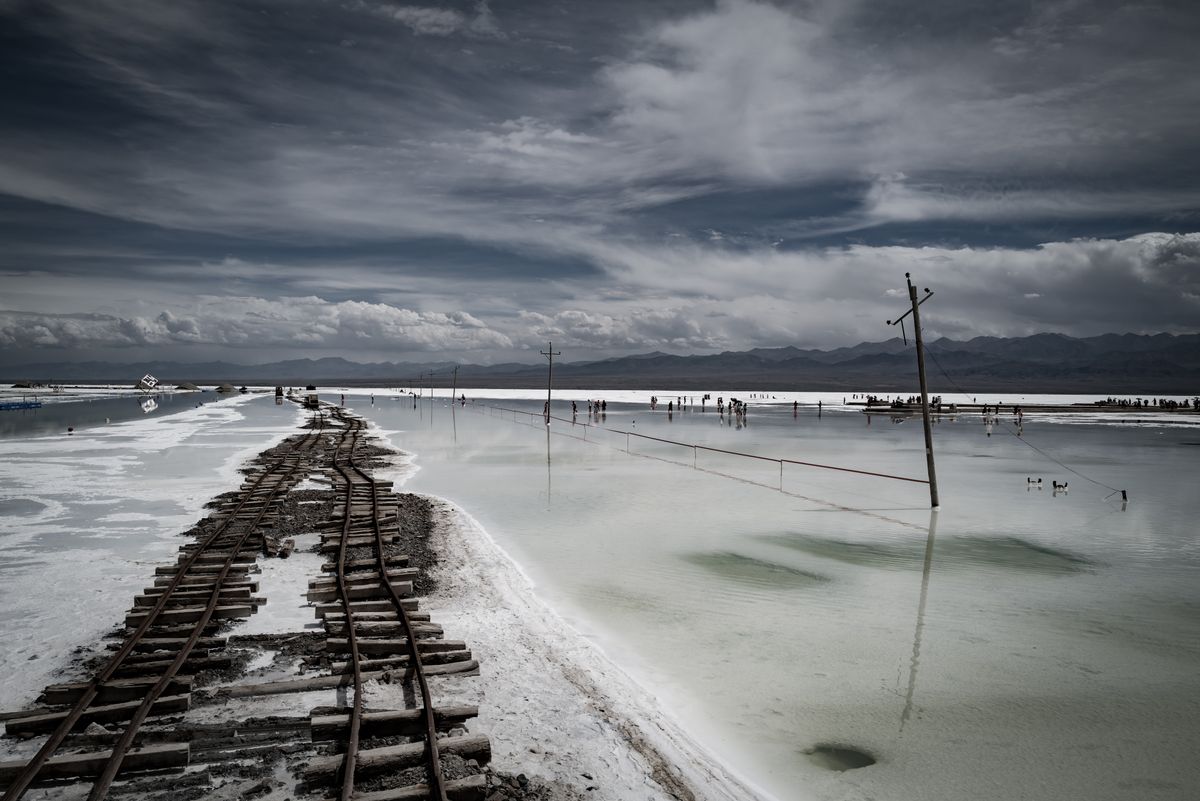
Salt flat railway tracks crossing a high-altitude Qinghai plateau lake
What to expect on board the 45-hour train
The Qinghai-Tibet sections of this route run above 4,000m in places, and Z164's carriages are pressurized and sealed for altitude, similar to an aircraft cabin. Each car has two independent oxygen systems, a dispersion system that raises ambient oxygen levels once the train passes Golmud, and individual oxygen ports at every berth if you need direct supply.
Practical notes for the ride:
- Bring a portable charger; sockets exist but are shared and can queue up in peak season.
- Pack layers. Carriages are heated, but platform stops at Golmust and Amdo can be near freezing even in summer.
- Altitude sickness (mild headache, breathlessness) is common on day two as you cross the Tanggula Pass at over 5,000m. Drink water, avoid alcohol, and tell the conductor if you feel unwell, they carry oxygen and basic supplies.
- The best scenery, the Kunlun mountains and Kekexili grassland, runs during Golmud to Nagchu, generally daylight hours on day two if you catch the standard departure time.
Which stopover city fits your trip
If you have extra days, both Xi'an and Chengdu work well as a planned overnight break rather than a rushed connection:
- Xi'an adds the Terracotta Army and the old city wall. Trains onward to Lhasa from Xi'an run close to daily and take about 30 hours.
- Chengdu adds pandas and Sichuan food, and its Lhasa train (Z322) runs on alternating days, so check the schedule before you commit to this stopover, since a mistimed arrival can mean a two-day wait.
Either city also lets you split the long haul so nobody in your group does back-to-back 45-hour sleepers on the way in and out. If Chengdu fits your route better, see the Chengdu to Lhasa train guide for the Z322 schedule, and check the Xining to Lhasa train guide for the shortest plateau leg. Coming from Xi'an first, the Xi'an to Chengdu train page covers that leg if you want to compare both gateway cities before choosing.
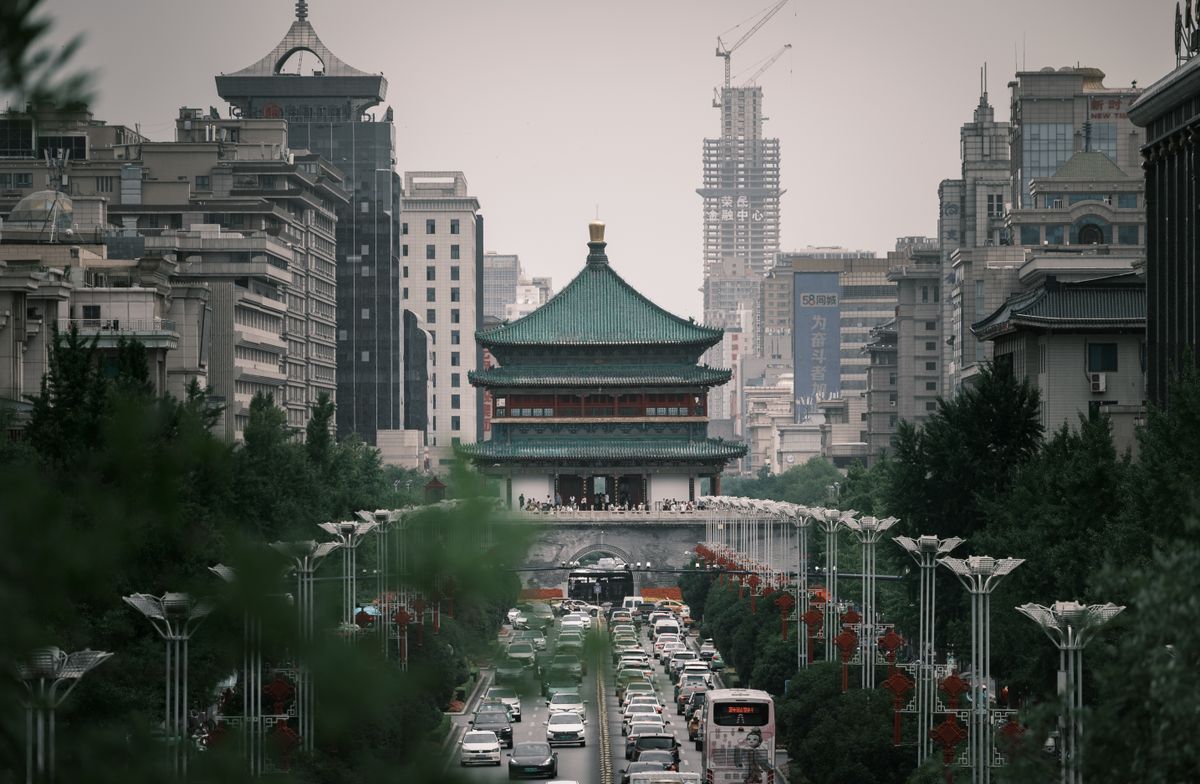
Bell Tower and Xi'an city street at dusk, a common stopover en route to Lhasa
FAQ
Is there a bullet train from Shanghai to Lhasa? No. There's no high-speed rail line to Lhasa yet from any direction. Z164 is a conventional sleeper train, not a bullet train, and it's the only through service linking Shanghai directly to Lhasa.
How much does the Shanghai to Lhasa train cost? Hard sleeper runs about CNY 793.5 and soft sleeper about CNY 1,262.5 net fare, plus a booking service fee if you use an agent instead of 12306 directly.
Can I book a Shanghai to Lhasa train ticket without a Tibet Travel Permit? No. You need the permit in hand (or confirmed and en route to you) before the railway will let you board, since staff check it alongside your passport and visa at the station.
Is 45 hours on a train bearable? Most travelers find soft sleeper comfortable enough for two nights, especially with the oxygen supply and dining car. Hard sleeper is fine too but less private. Bringing snacks, a charger, and something to read or download offline helps a lot since signal drops out for long stretches on the plateau.
Should I fly instead of taking the train? Flying (about 7-8.5 hours via a Xi'an or Chengdu layover) is faster but skips the gradual altitude adjustment the train gives you and costs several times more. Many travelers who skip acclimatization by flying direct into Lhasa (3,650m) feel worse in the first 24 hours than those who took even a partial train route.
Booking checklist
- Confirm your travel dates and start the Tibet Travel Permit application with a licensed operator, 3 weeks minimum lead time.
- Decide: direct Z164 from Shanghai, or break the trip via Xi'an, Chengdu, or Xining.
- Watch the 12306 release window (about 15 days out) and book the moment tickets open in peak season.
- Pack layers, a charger, and snacks; bring your permit paperwork and passport to the station, not just your phone screenshot.