Quanzhou
Luoyang Bridge, Quanzhou 2026: History, Highlights & How to Visit
Luoyang Bridge makes more sense when you see it as working infrastructure, not an isolated monument. The bridge stands at the mouth of the Luoyang River, about 10 kilometers northeast of central Quanzhou. Its original name was Wan’an Bridge, taken from the ferry crossing that occupied the site before the stone bridge was built. It later became an important land connection between Quanzhou, northern Fujian, and inland China. (Quanzhou Municipal People’s Government)
Why is Luoyang Bridge part of Quanzhou’s World Heritage site?
UNESCO inscribed Quanzhou: Emporium of the World in Song-Yuan China on the World Heritage List in 2021. The serial property explains how religious sites, production centers, administrative buildings, docks, pagodas, and bridges formed a connected maritime trade system between the 10th and 14th centuries. Luoyang Bridge represents the land-transport side of that system. It carried people and goods north after they had reached the Quanzhou area through its ports and waterways. (UNESCO World Heritage Centre)
This context changes what you should look for. The bridge is impressive for its length, but its historical value lies in the connection it created between a seaport and inland markets. Its position at the river mouth also explains why its builders needed methods suited to moving water, tides, and a soft riverbed.
What survives from the historic bridge?
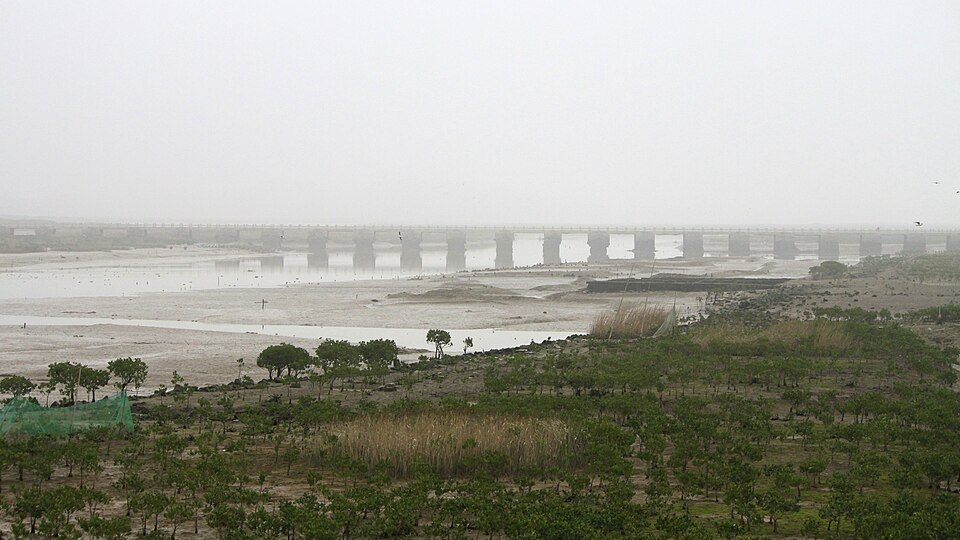
Construction began in 1053 and finished in 1059. The surviving bridge measures about 731 meters long and 4.5 meters wide, with 47 spans and 45 piers. It crosses a small natural island in the middle of the river. Large granite strips form the horizontal beams, while pointed, boat-shaped piers divide the current below. (Quanzhou Municipal People’s Government)
Look beyond the main deck. Municipal heritage records identify stone towers, protective stone generals, inscriptions, pavilions, and shrines associated with the bridge. Their dates and degrees of restoration differ, so treat the site as a historic ensemble that changed through repeated repairs rather than as a structure frozen in 1059. (Quanzhou Municipal People’s Government heritage record)
How did the Song builders construct it?
The engineering becomes easier to read from an angled view near either bank. Builders deposited stones across the riverbed to create a supporting dyke, then constructed pointed piers on that base. Modern descriptions compare the resulting support to a raft-shaped foundation. The pointed ends reduced the direct force of moving water against the masonry. (Quanzhou Municipal People’s Government)
Official municipal accounts also describe two other techniques associated with the project. Oyster growth helped bind stones around the foundations, while boats and tidal movement helped position heavy granite beams. These methods used the river’s natural conditions as part of the construction process. (Quanzhou Municipal People’s Government attraction record)
Cai Xiang is closely associated with Luoyang Bridge, but the common shorthand that he built it alone misses part of the story. Municipal records state that Wang Shi and other local participants began the stone bridge in 1053. Cai Xiang later supervised the project while serving in Quanzhou, bringing it to completion in 1059. (Quanzhou Municipal People’s Government attraction record)
What is the best walking order?
A south-to-north walk gives the clearest introduction:
- Begin on the southern side and locate the Cai Xiang Shrine before stepping onto the main bridge.
- Look for the Wan’an Bridge Record associated with Cai Xiang. The municipal heritage account describes two 153-character stone inscriptions in the shrine, including a later copy. (Quanzhou Municipal People’s Government heritage record)
- Walk onto the granite deck and compare the massive horizontal beams with the narrow joints between them.
- From a safe position, study the alignment of the pointed piers rather than concentrating only on the skyline.
- Pause around the natural island and central structures, where the bridge’s two-part crossing is easiest to understand.
- Continue to the opposite bank for a lengthwise view, then return if your onward transport is waiting on the southern side.
Do not climb towers, statues, railings, or exposed masonry for photographs. They form part of a protected heritage site, and a lower camera angle from the deck usually gives a better view of the stonework.
How do you get to Luoyang Bridge from Quanzhou?
The bridge is outside Quanzhou’s old-city core, at the boundary area between Qiaonan Village in Luojiang District and Luoyang Town in Hui’an County. (Quanzhou Municipal People’s Government heritage record) For a first visit, a taxi or app-based car is the simplest option because it avoids route and transfer confusion.
Enter Luoyang Bridge and add Quanzhou in a Chinese map or ride-hailing app. Check that the destination is in Fujian, since the name Luoyang can otherwise be confused with Luoyang city in Henan. If you prefer public transport, check a live local map on the day of travel instead of relying on an old route number.
When should you visit?
Choose daylight and dry conditions so that the deck, inscriptions, and pier shapes remain easy to examine. Flat shoes with a secure sole are sensible on the long granite surface. The site is exposed beside the river, so carry sun protection or a light rain layer according to the day’s forecast.
No current, dated, item-specific official visitor notice was identified for fixed admission charges, opening hours, or reservation rules. Do not build your plan around figures copied from an undated blog. Check official Quanzhou notices, local mapping platforms, and signs at the entrance before visiting.
Frequently asked questions
Is this bridge in Luoyang city?
No. This Luoyang Bridge crosses the Luoyang River in Quanzhou, Fujian. Use the Chinese destination Luoyang Bridge(Quanzhou) when searching.
Is the entire bridge unchanged since the Song dynasty?
No. The bridge has undergone repairs across several historical periods. UNESCO’s assessment values the surviving location, functions, materials, technical evidence, records, and connected setting, not an assumption that every visible stone dates from one construction campaign. (UNESCO World Heritage Centre)
Why are the piers pointed?
Their boat-like profiles help divide the flow and reduce the water’s direct impact on the masonry. They also make the bridge’s construction logic visible from the riverbanks.
Is Luoyang Bridge worth leaving central Quanzhou for?
Yes, especially if you want to understand how Quanzhou’s maritime trade network operated beyond temples and docks. The visit adds the missing land-transport chapter to the city’s World Heritage story.
Highlights
- Cross a granite bridge completed between 1053 and 1059 at the mouth of the Luoyang River.
- Inspect 47 spans and 45 pointed piers along the surviving 731-meter structure.
- See how raft-shaped foundations, tidal transport, and oyster growth contributed to the bridge’s engineering.
- Read the bridge as part of the transport network behind UNESCO-listed Song-Yuan Quanzhou.
- Find stone towers, protective figures, inscriptions, pavilions, and the Cai Xiang Shrine around the crossing.
- Use views from both banks to understand the bridge’s full scale and two-part alignment.
Travel Tips
Search with the Chinese name
Enter Luoyang Bridge and add Quanzhou in your map or ride-hailing app so you are directed to the Quanzhou bridge rather than Luoyang city in Henan.
Check live visitor information
No current item-specific official notice confirms fixed hours, admission charges, or reservation rules. Check official Quanzhou notices and entrance signs before traveling.
Study the bridge from the banks
An angled view from either riverbank reveals the pointed piers and long granite beams more clearly than a photograph taken only from the center of the deck.
Protect the stonework
Stay on the walking surface and do not climb towers, statues, railings, or exposed masonry. Wear shoes with a secure sole on the granite deck.
More to see in Quanzhou
Tianjin Tianhou Palace: Hours and Address
Quanzhou Tianhou Temple: World Heritage Visit Guide (2026)
Quanzhou Maritime Museum: Hours, Galleries & Visit Guide (2026)
Quanzhou Kaiyuan Temple: Free Entry, Twin Pagodas & Visit Guide (2026)
Quanzhou Kaiyuan Temple 2026: Free Entry, Hours and Visit Tips