Qingdao
May Fourth Square, Qingdao: Metro, Waterfront & Lights (2026)
May Fourth Square is Qingdao’s modern waterfront landmark, centered on the red spiral sculpture called Wind of May. Most travelers can see the principal sights in 60–90 minutes, or stay longer to follow the waterfront toward the Qingdao Olympic Sailing Center.
Do not plan an evening visit around an old light-show timetable. Fushan Bay’s illuminated skyline remains an active attraction in 2026, but presentation times can change for holidays, public events, weather, or maintenance. Check a current Qingdao municipal notice on the day you visit.
| Visitor detail | Practical answer |
|---|---|
| Admission | The cited current municipal sources do not publish an admission policy |
| Opening | Check current Qingdao municipal notices for access changes or event controls |
| Reservation | The cited current municipal sources do not confirm a reservation policy |
| Nearest metro | May Fourth Square Station, Wusi Guangchang Station |
| Metro lines | Lines 2 and 3 |
| Suggested visit | 60–90 minutes by day; longer if combining the waterfront and evening lights |
| Main landmark | Wind of May, Wuyue de Feng |
Why is it called May Fourth Square?
The square commemorates the May Fourth Movement and its connection with the dispute over sovereignty in Qingdao. The Qingdao Municipal Government’s attraction profile says the square was built in 1996 and covers 100,000 square meters.
Donghai Road divides it into two main sections. The northern side contains lawns and a central fountain, while the southern side includes an open-air stage, fountain installations, the waterfront platform, and Wind of May. This arrangement matters when navigating: reaching the first lawn does not mean you have reached the red sculpture or the sea.

Wind of May sculpture at May Fourth Square
Photo: HOUYIMIN, Wikimedia Commons, CC BY-SA 4.0.
What should you see at May Fourth Square?
Wind of May
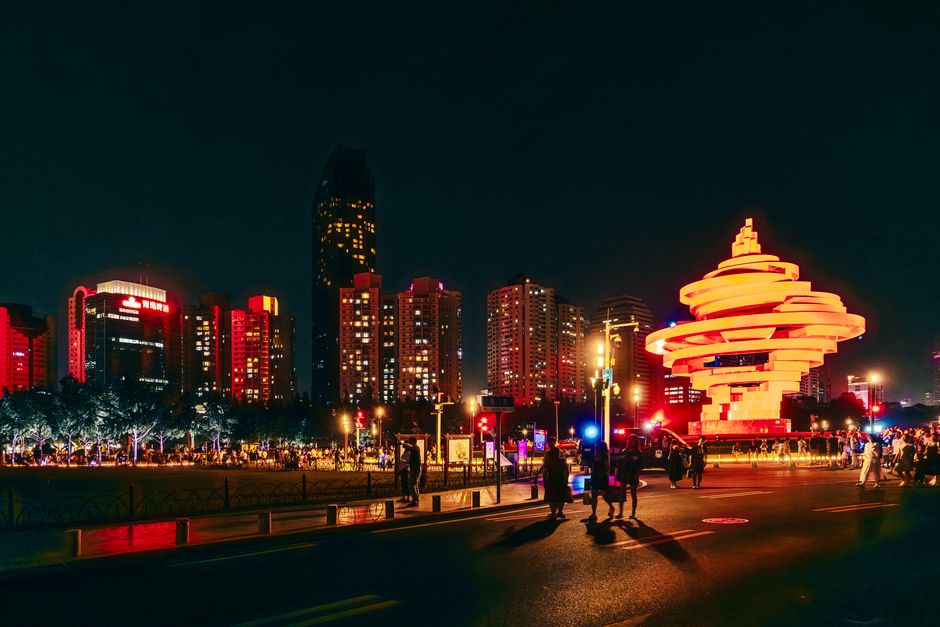
The red steel spiral is the square’s focal point. Its rising, circular form suggests moving wind and gives the open plaza a clear visual anchor. Walk around the sculpture before choosing a photograph: one side places the sea behind it, while another frames it against Qingdao’s modern skyline.
The north-to-south axis
Start near the northern lawns and continue south across Donghai Road toward the sculpture and viewing platform. This short route reveals the square’s full design, rather than treating Wind of May as an isolated photo stop. Traffic separates the two sections, so use the designated crossing and follow local signals.
The Fushan Bay waterfront
Beyond the sculpture, the waterfront opens onto Fushan Bay. The promenade works well for a slow walk, skyline photographs, and views across the water. A 2026 Qingdao government itinerary links May Fourth Square with the Olympic Sailing Center and other sights along the bay, making the square a useful starting point rather than a stand-alone stop.
The illuminated skyline
After dark, building façades around Fushan Bay become part of a coordinated light display. Qingdao’s 2025 city-management report reported daily presentations, and a May 2026 municipal update confirms that the themed show continues to operate.
Do not treat those references as a fixed performance schedule. The city has published separate timetables for particular holidays, including a dated 2023 holiday notice. Use the latest city notice, not a time copied from an older travel post.

May Fourth Square and Fushan Bay at twilight
Photo: Kiddokidoki, Wikimedia Commons, CC BY 3.0.
Are tickets or reservations required?
The cited Qingdao municipal sources identify May Fourth Square as an attraction and include it in a 2026 sightseeing route, but they do not explicitly publish its admission fee, daily opening hours, or reservation policy. Check the latest Qingdao municipal attraction information before visiting instead of relying on an unofficial listing.
Performances, civic ceremonies, crowd-management measures, and maintenance can temporarily occupy or close an area. Any paid cruise, organized tour, restaurant, or attraction nearby is a separate service and should not be confused with access to the square.
How do you reach May Fourth Square by metro?
Take Qingdao Metro Line 2 or Line 3 to May Fourth Square Station, shown in Chinese as Wusi Guangchang Station. Qingdao Metro’s official Line 2 opening notice identifies the station as an interchange between Lines 2 and 3.
Exit numbers and pedestrian diversions can change, so follow the station’s current signs for Wusi Guangchang rather than relying on an old exit recommendation. Once outside, orient yourself toward the waterfront and the red Wind of May sculpture. Keep the Chinese name saved on your phone in case you need to ask station staff or a driver.
Line 3 also connects the corridor containing Qingdao Railway Station and Qingdao North Railway Station, while Line 2 serves the east-west urban corridor. Check the current metro map before departure if engineering work or a special event affects service.
When is the best time to visit?
Choose the time according to what you want to see:
- Morning: softer activity levels and a straightforward daylight view of the sculpture.
- Late afternoon: enough light to explore both halves of the square before sunset.
- Dusk: the easiest way to combine the sculpture, bay, and illuminated skyline in one visit.
- After dark: best for city-light photographs, but often busier during weekends and public holidays.
The square is exposed to coastal conditions. Check the local forecast and carry an extra layer when wind or falling evening temperatures are expected. Rain, fog, or safety measures may affect outdoor events and light presentations.
A simple 60–90 minute route
- Begin at the northern lawns and look south along the square’s central axis.
- Cross Donghai Road using the marked pedestrian route.
- Circle Wind of May for sea-facing and skyline-facing photographs.
- Continue to the waterfront platform for views across Fushan Bay.
- If time allows, follow the coastal route toward the Olympic Sailing Center.
- For an evening visit, wait near an open waterfront viewpoint while checking the current light-show notice.
This plan is a suggested allocation, not an official tour duration. Add time if you are traveling with children, using mobility aids, or continuing farther along the bay.
Practical tips for first-time visitors
- Save Wusi Guangchang and Wuyue de Feng on your phone. The Chinese names are more useful than an English pronunciation when asking for directions.
- Verify current access information through Qingdao municipal sources before paying for any product presented as square admission.
- Keep away from the roadway when moving between the northern and southern sections.
- Photograph Wind of May in daylight before waiting for evening illumination. Fog or an event change can alter the later view.
- Pair the stop with the Qingdao travel guide and the Olympic Sailing Center area to avoid making a separate cross-city journey for one photograph.
Frequently asked questions
Is May Fourth Square free?
The cited current Qingdao municipal sources do not explicitly publish an admission policy. Check the latest official attraction information rather than relying on an unofficial visitor guide.
Is May Fourth Square open 24 hours?
The cited current municipal sources do not confirm 24-hour access. Temporary controls can also apply during ceremonies, maintenance, severe weather, or crowded events.
Which metro line goes to May Fourth Square?
Both Qingdao Metro Line 2 and Line 3 stop at May Fourth Square Station, Wusi Guangchang Station.
Does the Fushan Bay light show run every night?
Municipal sources confirm that the show remains active, but exact times and temporary changes are published separately. Check the latest official notice instead of assuming an old schedule is current.
Is the square worth visiting during the day?
Yes. Daylight gives the clearest view of Wind of May, the square’s north-to-south layout, and Fushan Bay. Dusk is better if you also want to see the illuminated skyline.
Highlights
- See Wind of May, the red spiral sculpture that serves as the square’s visual centerpiece.
- Walk the full axis from the northern lawns to the southern waterfront platform.
- Photograph Fushan Bay and Qingdao’s modern skyline from the open promenade.
- Combine a daylight visit with the bay’s illuminated buildings after dusk.
- Continue along the waterfront toward the Qingdao Olympic Sailing Center.
- Reach the area directly through May Fourth Square Station on Metro Lines 2 and 3.
Travel Tips
Check the light-show notice
Presentation times can change for holidays, events, weather, or maintenance. Use a current Qingdao municipal notice rather than an old travel timetable.
Save the Chinese names
Keep Wusi Guangchang for the square and Wuyue de Feng for the sculpture on your phone when asking station staff or drivers for directions.
Verify access information
The cited current municipal sources do not explicitly state the square’s admission, opening, or reservation policy. Check the latest official attraction information before visiting.
Visit in two light conditions
Arrive in late afternoon to photograph the sculpture clearly, then stay for the illuminated Fushan Bay skyline if the current show is operating.