China Golden Week 2026: How to Avoid the Biggest Travel Crowds
Quick answer: China's 2026 National Day Golden Week runs Thursday, October 1 through Wednesday, October 7 (Saturday, October 10 is a paid-back workday). Roughly 800 million to 900 million domestic trips happen in that single week, so trains sell out weeks ahead, famous sights hit visitor caps by mid-morning, and hotel rates near landmarks can double. If you can shift your trip to late September or mid-October instead, do it. If you're locked into that week, book trains and reserved-entry tickets the moment they open and pick a second-tier city over a first-tier icon.
Most first-time visitors have no idea this week exists until they land in Shanghai and can't get a train ticket anywhere. Golden Week isn't a marketing term, it's the result of the government bundling National Day (October 1) with mandatory make-up workdays on the surrounding weekends to create one long holiday block. Everyone in China gets the same seven days off at once, and a huge share of a 1.4 billion-person country decides to travel in that window.
Why this week is different from any other Chinese holiday
China has several public holidays, but none compress travel demand like National Day. Labor Day (early May) and Dragon Boat Festival are shorter, and Spring Festival (Chinese New Year) sends people home to family rather than sightseeing, which spreads the load differently. National Day lands in comfortable early-autumn weather across most of the country, school is in session so families plan around it months ahead, and the full seven days off means people book multi-city itineraries instead of a quick weekend trip.
The scale shows up in the numbers each year. During the 2025 National Day and Mid-Autumn holiday period (which ran eight days because the two festivals overlapped), China's national railway operator recorded 23.13 million passenger trips on the single busiest day, and the Ministry of Transport logged roughly 1.24 billion cross-regional trips by all transport modes in just the first half of the holiday. 2026's National Day break reverts to a standalone seven-day week (Mid-Autumn Festival falls earlier, September 25-27), but the domestic tourism volume during the National Day stretch has consistently landed in the 800-900 million trip range in recent years, and there's no reason to expect 2026 to be lighter.
The exact 2026 dates and the make-up workday
Mark these on your calendar before you book anything:
| Date | Status |
|---|---|
| Thursday, October 1 | Public holiday (National Day) |
| Friday, October 2 | Public holiday |
| Saturday, October 3 | Public holiday |
| Sunday, October 4 | Public holiday |
| Monday, October 5 | Public holiday |
| Tuesday, October 6 | Public holiday |
| Wednesday, October 7 | Public holiday |
| Saturday, October 10 | Make-up workday (offices and many businesses open) |
The make-up workday matters for travelers because it means the holiday ends cleanly on Wednesday night. Trains and flights on October 7 and the morning of October 8 get crushed with people racing home before work resumes, so if your own schedule is flexible, leaving on October 8 in the afternoon or on October 9 is noticeably calmer than fighting the Wednesday exodus.
Which places get hit hardest, and which don't
Not every destination suffers equally. Attractions inside major cities with limited physical capacity are the worst, because there's a hard ceiling on how many people can physically fit, and demand blows past it by 9am.
Places to expect the worst crowding:
- The Great Wall at Badaling (the section closest to Beijing) regularly sees single-day visitor surges of several hundred percent above normal during Golden Week, with lines for cable cars and even for walking sections stretching for over an hour.
- West Lake in Hangzhou has no ticket barrier at all, so it absorbs whatever crowd shows up, and photos from Golden Week routinely show the lakeside paths packed shoulder to shoulder.
- Zhangjiajie National Forest Park caps daily entries at around 53,000 and now requires advance reservations, which helps with overcrowding inside the park but means same-day tickets simply don't exist during the holiday.
- The Bund and Nanjing Road in Shanghai, Tiananmen Square and the Forbidden City in Beijing, and Chunxi Road in Chengdu all see foot traffic that turns a 10-minute walk into a 40-minute shuffle.
- High-speed rail corridors between major cities (Beijing-Shanghai, Beijing-Guangzhou, Shanghai-Chengdu) sell out their entire October 1-3 inventory within minutes of tickets releasing, which is 15 days before departure.
Places that stay comparatively bearable:
- Smaller cities one tier down from the headline destinations, like Kaifeng instead of Xi'an, or Dali instead of Lijiang, still get busier but rarely hit gridlock.
- Attractions requiring a longer transfer from a major airport, since a chunk of domestic travelers stick to trips reachable by car or a short train ride.
- Mountain and rural destinations without a single famous "must-see" viewpoint, since crowds concentrate at photo-op spots rather than spreading evenly.
- Museums and indoor sights with hard daily caps and mandatory online booking, ironically, because the cap itself limits how bad the crowd gets once you're inside (getting a slot is the hard part).

West Lake in Hangzhou at dusk with a lakeside pavilion and visitors along the shore
Common mistakes
- Assuming you can book a same-week train ticket. Chinese high-speed rail tickets release exactly 15 days before departure, and Golden Week routes between major cities sell out within minutes. Set a calendar reminder for 15 days before your travel date, not the week before.
- Picking a Golden Week itinerary built around one iconic sight. If your whole trip hinges on getting into the Forbidden City or up Badaling on October 2, a sold-out reservation system can derail the entire plan. Build in backup attractions.
- Booking hotels near famous landmarks at the last minute. Rooms within walking distance of major sights routinely double or triple in price during Golden Week and sell out entirely by mid-September.
- Not checking whether an attraction requires advance reservation. Zhangjiajie, the Forbidden City, and many other sites now require booking a timed entry slot online days or weeks ahead; walk-up tickets may not exist at all during the holiday.
- Underestimating road travel. Road trips account for the largest share of Golden Week trips, and expressways connecting major cities can turn into multi-hour standstills, especially near tunnel entrances and toll gates.
- Traveling October 1-3 or October 5-7 by choice. These are the peak travel days at both ends of the holiday. The middle days (October 3-5) are comparatively calmer once people have already arrived at their destinations.
Who this is for
Golden Week travel makes sense if: you already have Chinese friends or family to stay with and won't be relying on public transport or ticketed attractions as much, you're specifically drawn to festival energy and don't mind crowds as part of the experience, or your trip is anchored in a smaller city or region that doesn't attract the domestic tourism wave.
Golden Week travel is a poor fit if: this is your first trip to China and you want to see headline sights like the Great Wall or the Terracotta Army without fighting crowds, you're traveling with young kids or have mobility limitations where standing in hour-long lines is a dealbreaker, you're on a budget and can't absorb hotel prices that double or triple, or your itinerary depends on booking trains or attraction tickets less than two weeks out.
How to plan around it
If your dates are flexible, shift your trip to the week before (last week of September) or the two weeks after (mid-to-late October), when weather is nearly identical, prices drop back to normal, and crowds thin out substantially. If October 1-7 is fixed, here's what helps:
- Book trains the instant tickets release (15 days ahead) using the official 12306 app or Trip.com, which mirrors the same inventory with an English interface.
- Reserve timed-entry tickets for capped attractions (Zhangjiajie, the Forbidden City, many museums) as early as their booking window opens, sometimes a week or more ahead.
- Book accommodation in early-to-mid September, not late September, since Golden Week rooms near major sights disappear roughly three weeks out.
- Consider a second-tier base city and day-trip from there rather than staying inside the most crowded core, since transport hubs slightly outside the center are less mobbed.
- Travel on October 3-5 rather than the first or last two days, when the initial surge and the return rush have both passed.
- Have a backup plan for every ticketed attraction in case same-day capacity is full, so one sold-out reservation doesn't sink your whole day.
Is Golden Week worth it for a first-time visitor?
Honestly, for most first-timers, no, not by choice. The crowding isn't an exaggeration, and it affects exactly the sights people fly to China to see. If you have any flexibility at all, moving your trip outside October 1-7 gets you the same attractions, similar weather, and a fraction of the people. That said, if Golden Week is your only available window, it's still doable. Millions of domestic travelers manage it every year. You just need to book earlier than feels necessary and accept that spontaneity isn't much of an option that week.
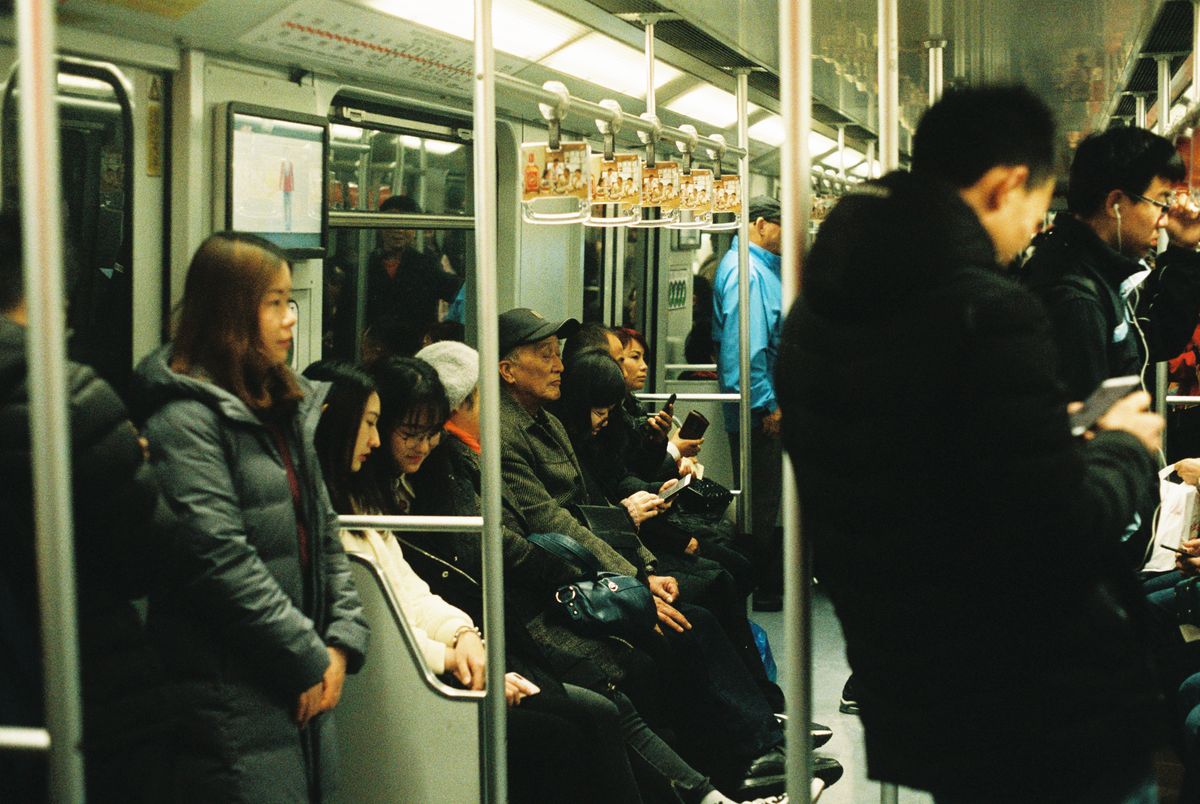
Packed metro carriage with standing passengers during a busy travel period in China
Quieter alternatives if you want fewer crowds
If your travel dates are flexible, these windows offer similar scenery and weather without the Golden Week crush: the first half of September (before Mid-Autumn Festival travel picks up), the back half of October after the Golden Week crowds disperse, or late April before the Labor Day holiday rush begins in early May. Early June, right after Dragon Boat Festival, is another quiet stretch with good weather in most regions.
FAQ
What are the exact Golden Week 2026 dates? Thursday, October 1 through Wednesday, October 7, 2026. Saturday, October 10 is a make-up workday, so the holiday itself is a clean seven days.
Is Golden Week the same as Mid-Autumn Festival in 2026? No. In 2026 the two holidays are separate: Mid-Autumn Festival falls September 25-27, and National Day Golden Week runs October 1-7. They don't overlap the way they did in 2025, when a shared calendar created an eight-day super-holiday.
How many people travel during Golden Week? Domestic tourism trips during the National Day holiday period have run in the 800-900 million range in recent years, with railways alone carrying tens of millions of passengers on the single busiest days.
Should I avoid visiting China entirely during Golden Week? Not necessarily, but you should avoid depending on last-minute trains, tickets, or hotel rooms. If you can shift your trip by even a week or two, you'll have a much easier time.
Which attractions are least crowded during Golden Week? Smaller cities, rural and mountain destinations without one single famous viewpoint, and attractions a longer drive from a major airport tend to stay more manageable than headline sights like the Great Wall or West Lake.
Sources
- State Council Notice on 2026 Public Holiday Arrangements (国务院办公厅关于2026年部分节假日安排的通知) · The State Council of the People's Republic of China (gov.cn)
- China's public holidays for 2026 · The State Council of the People's Republic of China (English)