Where to Stay in Huangshan: Summit Hotel or Tangkou Town? (2026)
If you only remember one thing about sleeping near Huangshan: the mountain itself and the town at its base, Tangkou, are two completely different bases, and which one you pick depends on whether you want sunrise over the sea of clouds or a good night's sleep at a normal price.
Stay on the summit and you wake up two minutes from the viewing platforms, in time for the moment the fog burns off Guangming Ding (Bright Peak) and the granite spires below it. Stay in Tangkou, at the mountain's foot, and you save more than half the money, sleep in a real bed instead of a cramped mountain dorm, and still make it up by cable car before the first tour buses arrive. Neither is wrong. Here is how to pick, and the practical logistics (cable cars, hiking times, and the train ride in from Shanghai) that make the decision easier.
Book Huangshan hotels on Trip.com
Free cancellation on most stays · compare neighborhoods
Some links are affiliate links; we may earn a commission at no extra cost to you.
On the Mountain or in Tangkou? The Quick Answer
| Stay on the summit | Stay in Tangkou | |
|---|---|---|
| Best for | Sunrise/sunset chasers, photographers, 1-night-on-mountain itineraries | Budget travelers, families, anyone doing Huangshan as a day trip |
| Typical price | ¥1,000-2,000 for a standard double; ¥250-300 for a dorm bed | ¥150-450 for a comfortable double |
| Getting to bed | Cable car up, then a 15-40 minute walk with your bag | Walk from the bus station or a 5-10 minute taxi |
| Trade-off | Small rooms, thin walls, food and water cost more, book 1-2 months ahead in peak season | You lose the sunrise unless you ride the first cable car up |
Staying Overnight on the Summit
This is the option people mean when they search "where to stay in Huangshan mountain": a real hotel bed above 1,600 meters, inside the scenic area gates, so you don't have to rush a cable car at dawn.
The three hotel clusters worth knowing:
- Xihai Hotel, near Paiyun Pavilion by the West Sea Grand Canyon: the closest thing to upscale on the mountain, roughly ¥1,200-2,000 a night. Book this if you want the short walk to Dawn Pavilion for sunrise over the canyon's rock towers.
- Baiyun Hotel, down in Tianhai at about 1,740 meters, from roughly ¥1,140: it faces Lotus Peak, Heavenly Capital Peak, and Feilai Stone, and it's a calmer, less crowded option than Beihai.
- Shilin Hotel and the Beihai-area hotels near Guangming Ding: the shortest possible walk to the classic sunrise spot at Monkey Watching the Sea. Rooms here sell out first in October and around Chinese New Year.
Budget travelers shouldn't rule the summit out entirely. Bai'e Villa and a couple of other simpler guesthouses rent dormitory beds for around ¥250-300, which is the actual way most backpackers manage a night on the mountain without paying resort prices.
A few things worth knowing before you commit: mountain hotels don't run on city standards. Hot water can be lukewarm in early morning, a bottle of water costs 3-4 times what it does in Tangkou because everything is carried up by porters, and checkout is early (usually 8-9am) since rooms turn over fast. Check in typically opens around 2pm, and if you arrive by cable car in early afternoon you'll have time to explore before dinner. Book at least 4-6 weeks ahead for October and Chinese New Year weeks; a normal weekday in April or November you can often book a week out.
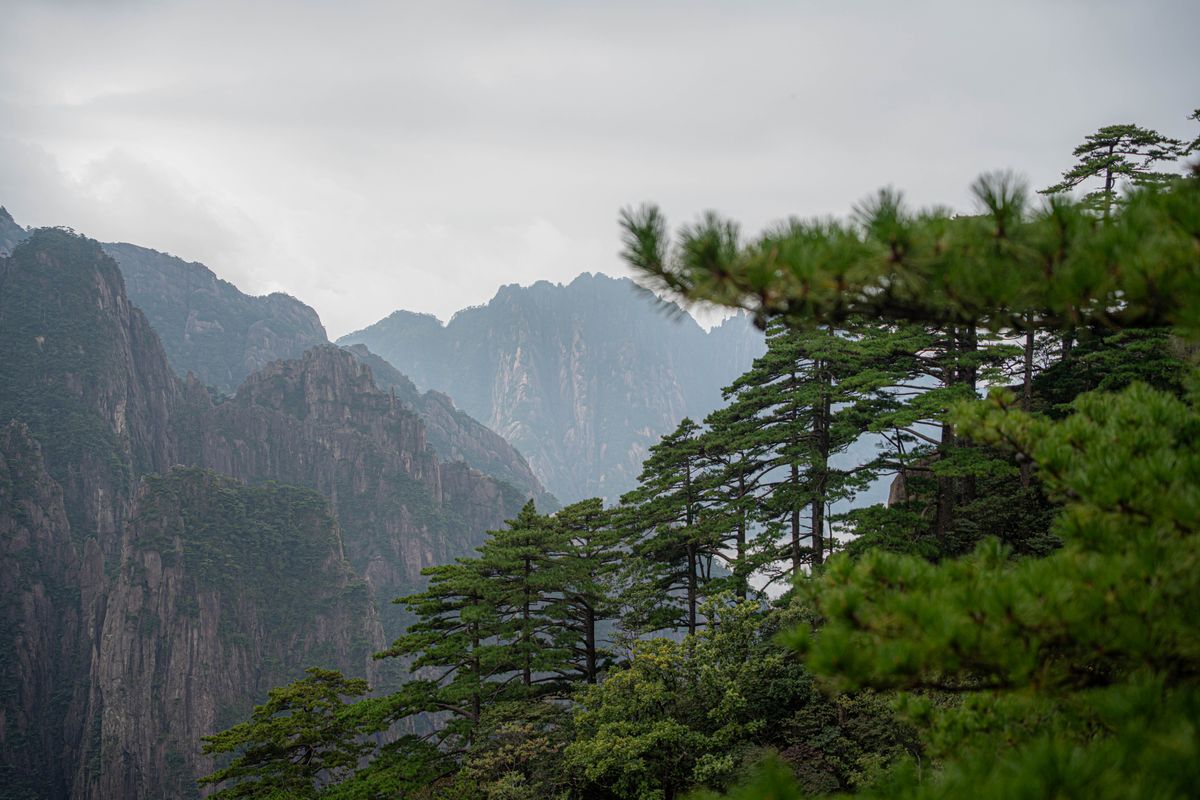
Misty granite peaks of Huangshan framed by pine trees at dawn
Staying Down in Tangkou
Tangkou sits at the southern foot of the mountain and is the real transit hub for Huangshan: buses from Huangshan North Railway Station and Tunxi (Huangshan City) arrive here, and both the Yungu and Yuping cable car stations are a short shuttle ride from town.
The case for Tangkou is mostly financial and practical. A clean double room in a Tangkou guesthouse or midrange hotel runs ¥150-450 a night, a fraction of the summit price, and you get normal plumbing, real breakfast options, and restaurants that don't charge mountain markup. Luggage storage is easy here too, useful if you're doing Huangshan as a one-day loop and don't want to haul a suitcase up in a cable car cabin.
The trade-off is time. To catch sunrise from the summit while staying in Tangkou, you need to be on the first cable car up, which usually starts running around 6:30-7am depending on season, then hike or walk briskly to a viewpoint before the light show is over. It's doable but tight, and it means skipping a relaxed breakfast. Families with young kids, travelers with heavy luggage, or anyone who just wants Huangshan as a half-day stop between Shanghai and Hangzhou or Jiangxi tend to be happiest based here rather than juggling an overnight bag up the mountain.
Which Cable Car Should You Take Up?
Three cable cars and one canyon ropeway serve the scenic area, and picking the right one matters more than people expect:
- Yungu Cable Car (back mountain): runs from Yungu Temple station up to Baie Ridge. This is the most popular way up, and pairs well with walking down through Yuping on the way out.
- Yuping Cable Car (front mountain, near the south/Tangkou gate): the classic route past Yingke Pine (the mountain's most photographed tree) and Bright Peak. It cuts out roughly 3 hours of stone-step climbing.
- Taiping Cable Car (north gate): useful if you're arriving from Taiping/Huangshan North side rather than Tangkou, and want to skip Tangkou entirely.
- Xihai/West Sea Canyon ropeway: a shorter connector inside the scenic area itself, mainly for covering ground between Beihai and the West Sea Grand Canyon without a long walk.
2026 peak-season (March-November) single tickets run ¥80 for Yungu and Taiping, ¥90 for Yuping, and ¥100 for the Xihai ropeway; winter (December-February) prices drop to roughly ¥65-80. The single most common route: ride up Yungu, spend the day or overnight near Beihai/Xihai, then walk down through Yuping, which lets you see Yingke Pine on the way out instead of rushing past it on the way in.
Hiking the whole mountain on foot, gate to summit, without any cable car, typically takes 3-4 hours up the Yuping route and adds real leg-burn on stone steps that were literally carved into the cliff face centuries ago. Most first-time visitors, and almost everyone carrying an overnight bag, take a cable car at least one direction.
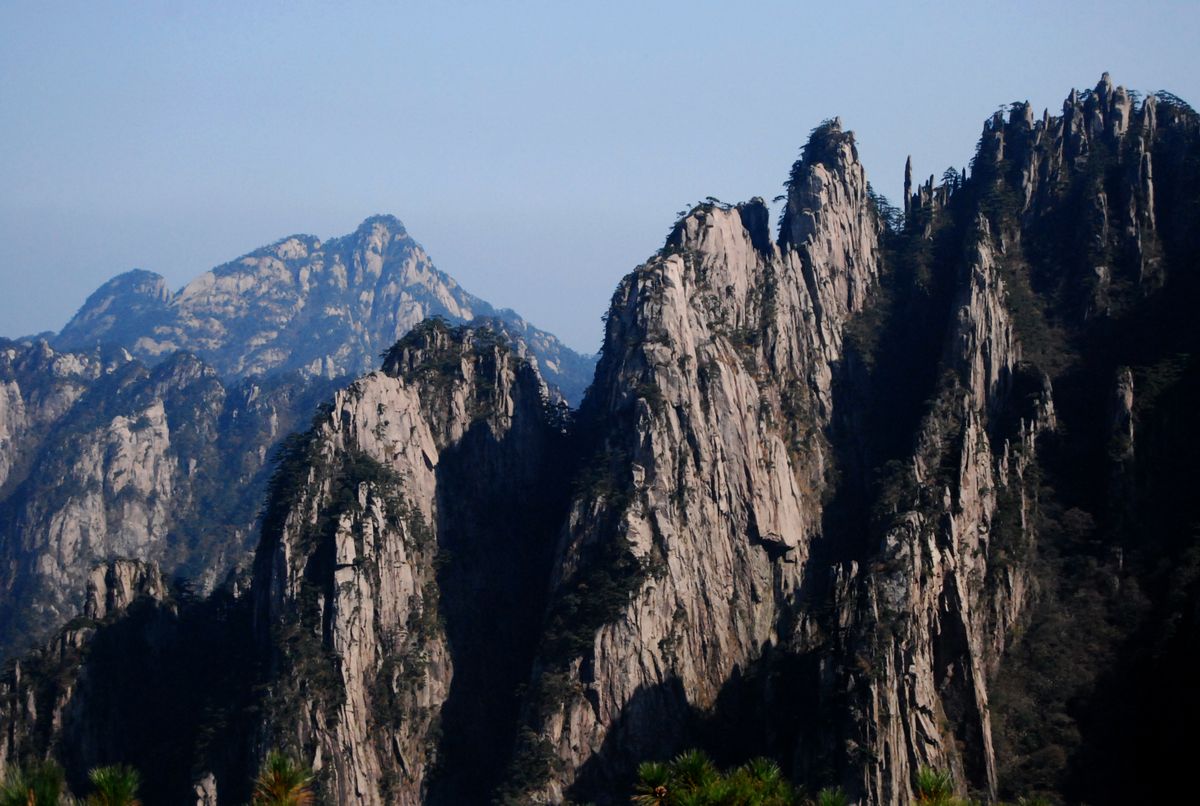
Sharp granite spires of Huangshan seen from a hiking trail
How to Get to Huangshan from Shanghai
Direct high-speed trains connect Shanghai Hongqiao Railway Station to Huangshan North Railway Station in about 2 to 3.5 hours, depending on the train, with second-class fares typically ¥180-230. There are more than a dozen direct services a day, so unless you're traveling around a major holiday you rarely need to book more than a few days ahead, though booking a week out gives you a wider pick of departure times.
From Huangshan North Station, it's another 45km to Tangkou: a shuttle bus takes about 50-65 minutes and costs ¥23-33, running roughly every 30-60 minutes from around 8am to 8pm in peak season. A taxi or ride-hail covers the same distance in 40-45 minutes for roughly ¥120-150, worth it if you're traveling with kids or arrive late in the day. Skip the older advice about going through Tunxi/Huangshan Airport unless you're flying in; the North Railway Station route is faster and simpler for anyone coming by train from Shanghai, Hangzhou, or Nanjing.
If you're building a wider route, our Huangshan destination guide covers the surrounding old towns and best seasons to visit, our Huangshan 2-day itinerary lays out a full plan for the mountain plus a day in the old town, and our guide to riding China's high-speed trains covers station procedures and ticket rules if this is your first bullet-train trip.
Is It Worth Staying Overnight on Huangshan?
If sunrise or sunset over the sea of clouds is the reason you're visiting Huangshan at all, yes: photos from the summit at dawn look nothing like the same view at 11am once the clouds burn off and the tour groups arrive, and paying ¥800-1,000 more for one night is cheap compared to a flight to China in the first place. If you're short on time, traveling with small kids, or Huangshan is one stop on a longer loop through Anhui or Jiangsu, staying in Tangkou and riding the first cable car up gets you 80% of the experience for a fraction of the cost and hassle.
A few practical closing tips:
- Pack a headlamp and a warm jacket even in summer; summit temperatures at dawn regularly run 10-15°C cooler than Tangkou.
- Bring cash or make sure your phone payment apps work; some mountain guesthouses still prefer WeChat Pay or Alipay over cards.
- Reserve your cable car ticket for the same time slot as your entrance ticket online in advance during October and Chinese New Year, when both sell out.
- If staying on the summit, bring your own snacks; food prices onsite reflect the cost of carrying everything up by hand.
- Check the weather forecast the morning of, not days ahead; Huangshan's sea of clouds depends on humidity and temperature swings that are only predictable a day out.
For a full look at lodging options across the rest of the country, see our general guide to where to stay in China.
FAQ
Is it worth staying overnight on Huangshan? Yes if you want sunrise or sunset over the sea of clouds; the mountain looks completely different at dawn than at midday, and one night on the summit, even in a basic room, is the only reliable way to catch it.
How many days do you need for Huangshan? Most travelers need 2 days: one to ride up, explore Xihai Grand Canyon or the western loop, and stay overnight, then a half-day for sunrise and the walk down. A rushed one-day trip is possible if you take the first cable car up and skip the summit hotels.
How do you get to Huangshan from Shanghai? Take a high-speed train from Shanghai Hongqiao to Huangshan North Station (about 2-3.5 hours, ¥180-230 second class), then a shuttle bus or taxi to Tangkou (45km, 40-65 minutes).
Which cable car should I take up Huangshan? Yungu Cable Car up and Yuping Cable Car down is the most popular combination, since it lets you see Yingke Pine on the descent instead of rushing past it climbing up.
Is Tangkou or the summit better for families? Tangkou. Normal hotel rooms, easier bathrooms, and no need to carry small children through cable car queues or up mountain steps at dawn. Families can still do a day trip to the summit and be back down by evening.
Sources
- Huangshan Scenic Area Overview and Services · Huangshan Scenic Area Management Committee
- Huangshan White Cloud Hotel · Huangshan Municipal People’s Government
- Transportation · Huangshan Municipal People’s Government
- Announcement on Huangshan Scenic Area Opening and Operating Hours · Huangshan Municipal People’s Government Office