WeChat Pay vs Alipay for Tourists in China (2026): Which Should You Use?
Most first-time visitors ask this the wrong way round: "which app do I need," when the real question is "which app do I reach for at the register." Alipay and WeChat Pay both work for foreigners in 2026, both verify with a passport instead of a Chinese ID, and both charge the same 3% fee on card-linked purchases over ¥200. The differences that matter are in onboarding friction, where locals expect you to tap, and what happens when you hit a transaction cap mid-trip.
This is not another setup walkthrough. If you need the sign-up steps themselves, our Alipay setup guide and the Alipay Tour Pass guide cover those in detail, and our general guide to paying in China covers cards and cash alongside the apps. Here we put WeChat Pay and Alipay side by side and tell you which one to open first.
Which one should you use
For a first trip to China, install Alipay before you fly. It verifies with a passport scan and a selfie in a few minutes, the international card binding flow is the most tourist-tested of the two, and its interface carries English menus in more places (train tickets, translation, ride-hailing) than WeChat Pay's mini-program system does. Use it as your default at restaurants, convenience stores, taxis and attractions.
Add WeChat Pay if you are traveling with, or meeting, people already on WeChat: a tour guide, a homestay host, colleagues, or friends who want to split a bill or send you money for a shared taxi. WeChat Pay is also the only option for certain mini-programs (some bike-share unlocks, some hospital queue and metro top-up flows, and WeChat-based restaurant ordering systems that never show a card-payment terminal at all).
If you only want one app, Alipay is the safer single choice for a pure tourist itinerary. If you are staying more than a week or spending real time with local contacts, carry both. They cost nothing to hold side by side.
Alipay vs WeChat Pay: quick comparison
| Alipay | WeChat Pay | |
|---|---|---|
| Passport verification | Facial scan + passport, no local guarantor needed | Facial scan + passport, no local guarantor needed since the 2023-24 rule change |
| Foreign cards accepted | Visa, Mastercard, JCB, Discover, Diners Club | Visa, Mastercard, JCB, Discover |
| Fee on purchases over ¥200 | 3% of the full amount | 3% of the full amount |
| Purchases under ¥200 | Fee-free | Fee-free |
| New-user promotions | None publicized broadly | 60-day waiver on daily spend under ¥1,000 for first-time linked cards |
| Typical verified limits | Around ¥35,000 per transaction, ¥100,000 per month, ¥500,000 per year | Around ¥35,000 ($5,000) per transaction, $50,000 per year |
| Strongest for | Restaurants, taxis, small shops, older vendors | Mini-programs, splitting bills with local contacts, messaging-linked payments |
| Onboarding for pure tourists | Slightly smoother, wider English support | Much improved since 2023, still a step behind for pure sightseeing use |
Limits and promotions shift as both platforms compete for the inbound tourism market, so treat these figures as a ballpark and check the in-app limit screen (under your card settings) before a big purchase like a hotel deposit or a bulk souvenir order.
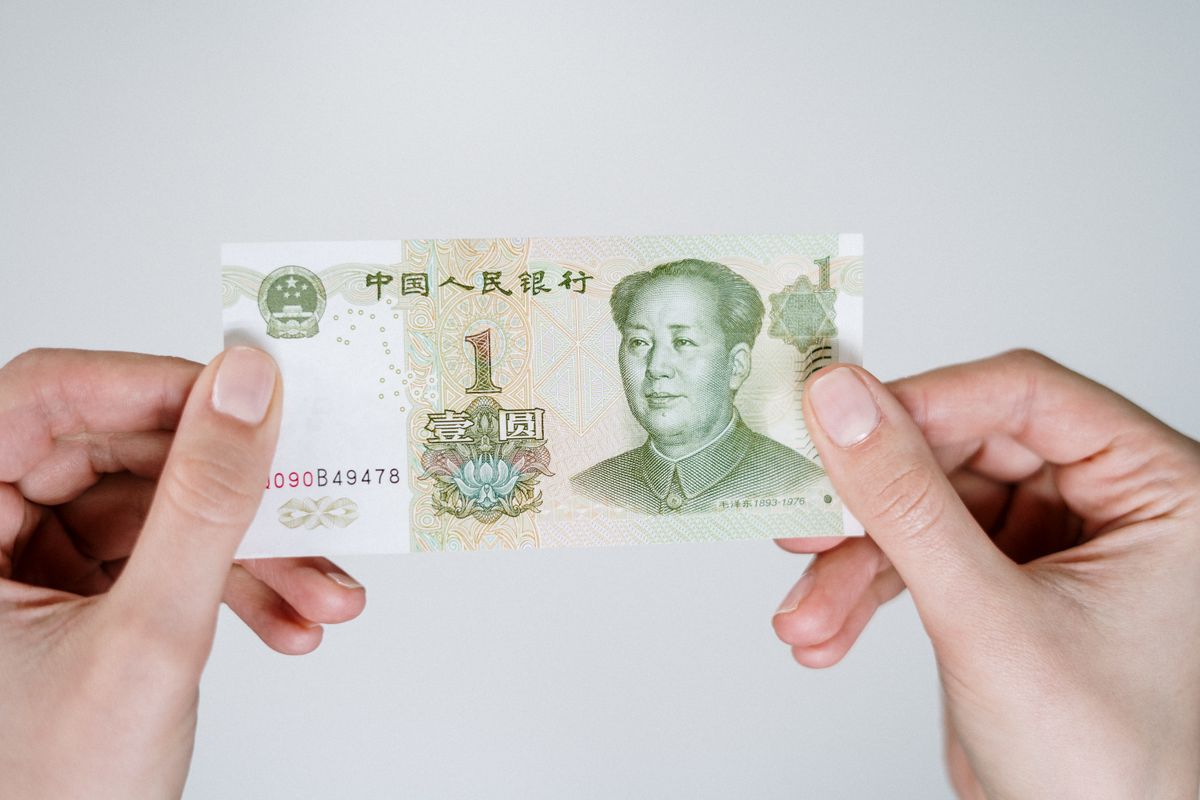
Close-up of hands holding a Chinese yuan banknote
Fees and transaction limits explained
Both apps run the same basic rule for tourists: link a foreign Visa, Mastercard, JCB or similar card, and every purchase over ¥200 costs 3% of the total amount, not just the amount above ¥200. A ¥1,000 dinner costs an extra ¥30. A ¥180 lunch costs nothing extra. Some travelers ask staff to split a large bill into two payments under ¥200 to dodge the fee. It works technically, but it slows down the queue and most cashiers will not want to run your card twice for one coffee order.
WeChat Pay adds a wrinkle worth knowing: the first time you link an international card, you get 60 days where daily spending under ¥1,000 is fee-free, not just single purchases under ¥200. That helps in the first two months of a long stay, and matters less on a one or two week trip.
On limits, expect a single-transaction cap somewhere around ¥35,000 on either app for a verified account, with monthly and annual ceilings stacked on top. Those numbers matter if you are paying a large hotel bill, buying jewelry or electronics, or covering a group's costs upfront. If a purchase sits close to the limit, split it across a linked card and a backup method (a second card, or cash) rather than finding out at the register that the app declined a ¥40,000 payment.
Merchant acceptance: where each app wins
In big cities (Shanghai, Beijing, Shenzhen, Chengdu, Guangzhou), most restaurants, chain convenience stores, metro stations and tourist sites take either app without trouble. The gap shows up at the edges:
- Older, independent vendors, street food stalls and some taxi drivers lean on Alipay more consistently. It has had a longer runway with China's older self-employed merchant base.
- Mini-programs (small apps that live inside WeChat) run some bike-share unlocks, hospital queue systems, and local delivery or ordering flows that assume you already have WeChat open. If a venue hands you a phone-based ordering system instead of a menu, it is almost always WeChat-based.
- Splitting a bill, paying back a friend, or covering a taxi with someone you just met is a WeChat Pay habit in China. Locals default to WeChat transfers for anything personal; Alipay transfers between individuals are far less common socially.

Street food vendor preparing a snack at an outdoor stall in Shenzhen
Do you need both, and do you still need cash
Carry both apps if your trip runs longer than a week, involves local contacts, or mixes big cities with smaller towns and rural stops. Having a second option ready means one declined card or one app outage does not strand you mid-purchase.
Keep ¥200 to ¥500 in cash regardless. Reasons this still matters in 2026: your phone battery dies, a rural vendor or older market stall has no card-linked QR setup at all, your bank flags the transaction and blocks the card temporarily, or you hit a daily or per-transaction cap on a big purchase. Cash is the fallback that does not depend on network signal, app verification, or your card issuer's fraud filters. Our general guide to paying in China covers card networks, ATMs and how much cash to carry by trip length.
Common tourist mistakes
- Opening a personal account without full verification. A WeChat or Alipay account set up without the passport-plus-facial-scan step will not let you bind an international card at all, or will cap you at amounts too low to be useful. Complete verification before you fly, not at the airport with jet lag.
- Assuming card binding equals full account access. Binding a foreign card gives you payment ability, not the same account privileges as a Chinese-registered user (some transfers, some mini-programs, and some higher limits stay tied to local verification).
- Hitting the per-transaction cap on a big purchase. Hotel deposits, bulk souvenir buying and large electronics purchases are the most common places tourists get declined. Check your limit before you commit to a purchase near ¥30,000-35,000.
- Not knowing about the ¥200 fee threshold. Getting surprised at checkout that a ¥250 purchase cost 3% more than expected is common and avoidable once you know the rule.
- Relying on one app with no backup. A single declined card, a dead battery, or an app outage during a payment leaves you stuck if you carry no second app and no cash.
- Skipping cash entirely. Small, older vendors and rural stops are the places digital payments most often fail. A small cash buffer solves this in seconds.
Before you fly: verify one app (Alipay is the easier first step), bind an international card, screenshot your limit settings, and pack ¥200-500 in cash as backup. Add WeChat Pay once you land if you find yourself splitting bills or relying on mini-programs.
FAQ
Can foreigners use WeChat Pay in China? Yes. Foreign travelers verify with a passport and facial scan, then bind an international Visa, Mastercard, JCB or Discover card directly, no Chinese bank account or local guarantor required since the eligibility rules changed in 2023-24.
Does WeChat Pay have fees for foreign cards? Yes, 3% on the full amount of any single purchase over ¥200, calculated the same way Alipay calculates its own fee. Purchases under ¥200 are fee-free, and first-time linked cards get a temporary 60-day waiver on daily spend under ¥1,000.
Can tourists use WeChat Pay in China without a Chinese phone number or bank account? Yes. A foreign phone number and passport verification are enough to set up the app and bind an international card. A Chinese bank account is not required.
Alipay vs WeChat Pay for tourists, which is better? For a first trip, Alipay is the easier single choice: smoother verification, wider English support, and slightly broader acceptance among older and independent vendors. WeChat Pay earns its place if you are around local contacts who default to WeChat transfers, or on a longer trip where mini-programs matter.
Do I need both Alipay and WeChat Pay in China? Not for a short, city-only trip. For anything longer than a week, or a trip that mixes big cities with smaller towns, carrying both gives you a backup if one card gets declined or one app has an outage, and it covers the merchant and social-payment gaps each app has on its own.