Beijing to Shanghai Train 2026: Fastest Times, Fares, and Best Trains
Quick answer: The fastest Beijing to Shanghai train takes about 4 hours 18 minutes on select G-trains, with most fast services running 4.5 to 5 hours; second class starts around ¥553 one way.
Beijing and Shanghai sit 1,318 km apart, and the Jinghu high-speed line connecting them is the busiest long-distance rail corridor in China. More than 40 direct G-trains run each direction daily, mostly between Beijing South Railway Station and Shanghai Hongqiao Railway Station, while a handful of slower D-trains and overnight sleepers use Beijing Railway Station and Shanghai Railway Station instead.
This guide covers journey times, 2026 fare classes, which station to use, and how to book, so you can pick the right train for a same-day business trip, a daytime ride with scenery, or an overnight sleeper that skips a hotel night.
For step-by-step guidance on registering, choosing between 12306 and Trip.com, and boarding with only your passport, see our complete guide to booking China's high-speed trains.
How long does the Beijing to Shanghai train take?
The fastest scheduled train, usually numbered G1 or G2, covers the 1,318 km route in about 4 hours 18 minutes at speeds up to 350 km/h. Most other G-trains take 4.5 to 5 hours, and a few slower G and D services that stop at Nanjing, Xuzhou, Jinan, and other cities along the way stretch to 6 or 7 hours.
| Option | Journey time | How often it runs |
|---|---|---|
| Fastest G-train (e.g. G1/G2) | 4h18m-4h30m | A handful of departures per day |
| Standard G-train (more stops) | 4h45m-6h | Most of the 40+ daily direct departures |
| Overnight D/Z sleeper | 10-12h (evening departure, morning arrival) | 2-4 trains per night |
| Flight (air time only) | About 2h-2h25m | Dozens of flights daily |
The overnight sleeper is slower in raw hours, but it runs while you sleep, so it effectively costs zero extra travel time against your daytime schedule. Flying looks fastest on paper, but once you add airport check-in, security, and the taxi ride to a city-center hotel on each end, door-to-door time often lands close to the daytime G-train, sometimes longer.
What are the fare classes and prices on the Beijing to Shanghai train?
G-trains on this route sell three seat classes, and overnight D/Z trains add sleeper berths. Prices below are one-way, per adult, and vary by exact train and how far ahead you book (holiday periods run higher).
| Class | Approx. 2026 price | What you get |
|---|---|---|
| Second class | ¥553-673 | Standard airline-style seat, 5 across, most common class |
| First class | ¥933-1,064 | Wider seat, 4 across, extra legroom and a power outlet at every seat |
| Business class | ¥1,748-2,728 | Fully reclining seat, 3 across, free meal, lounge access at major stations |
| Hard sleeper (overnight D) | ~¥400-500 | 6-berth open compartment, no door |
| Soft sleeper (overnight D/Z) | ~¥650-800 | 4-berth compartment with a door |
| Deluxe soft sleeper (select Z-trains) | ~¥900-1,500 | 2-berth private compartment, sink, hotel-grade bedding |
Business class only has a few dozen seats per train (three per row instead of five), so it sells out first on popular departures. Note that a fare adjustment took effect on May 26, 2026: some of the fastest flagship trains now charge roughly 20% more than the standard fare shown above for the same class, so always check the exact price for your chosen train number before assuming the lowest figure applies. For a full breakdown of what each class feels like onboard, see China train classes and seats explained.
Which Beijing and Shanghai stations does this train use?
Almost all G-trains depart from Beijing South Railway Station, a large station in the south of the city with its own subway interchange (Lines 4 and 14). A smaller number of slower trains and the overnight D/Z sleepers use Beijing Railway Station (Beijing Zhan), which sits closer to the city center near Wangfujing.
On the Shanghai end, most G-trains arrive at Shanghai Hongqiao Railway Station, which is attached to Hongqiao Airport's Terminal 2 and connects to metro Lines 2, 10, and 17. Overnight sleepers and some slower trains use Shanghai Railway Station instead, a more central station near People's Square with its own metro interchange.
If your hotel is downtown Shanghai, check which station your train uses before booking. Hongqiao sits about 13 km from People's Square (30-40 minutes by metro or taxi), while Shanghai Railway Station is only 15-20 minutes from the same area. Give yourself extra buffer if you're unfamiliar with boarding procedure at either station, since security and ID checks add 10-15 minutes beyond what a European or North American train station requires.
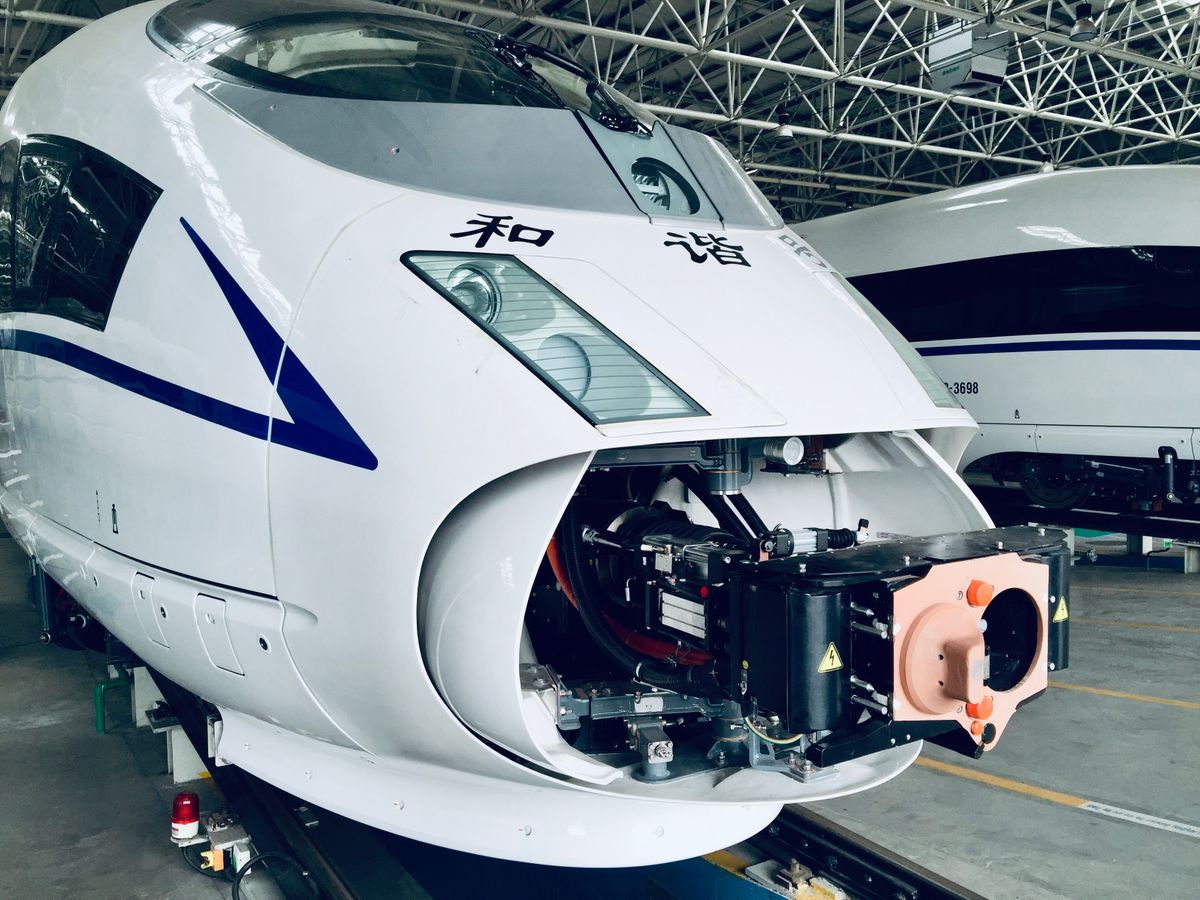
CRH high-speed train nose close-up inside a maintenance depot in China
How do you book Beijing to Shanghai train tickets?
Tickets go on sale 15 days before departure and this route sells out fast, especially second class on weekday morning and Friday evening departures.
Book Beijing-Shanghai Tickets
Compare G-trains and sleepers on Trip.com
Some links are affiliate links; we may earn a commission at no extra cost to you.
Trip.com shows the full daily schedule in English, lets you filter by class and departure window, and issues an e-ticket you redeem with your passport at any station gate, no separate paper ticket needed.
The free official alternative is 12306 (https://www.12306.cn/en/), China Railway's own booking site and app. It has the same inventory and no markup, but the English interface is less forgiving for first-time users and payment sometimes requires a Chinese bank card or a supported international card. Either way, both platforms draw from the same seat pool, so availability is identical; the choice comes down to how much you value convenience versus a small booking fee. If you are new to Chinese train booking generally, the Trip.com vs 12306 comparison goes deeper on account setup and payment methods for both platforms.
Because this corridor is so popular, book as early as the 15-day window allows if you're traveling on a fixed date. See how far in advance to book China train tickets for a season-by-season breakdown of how much buffer you need.
Is the overnight sleeper train worth it on this route?
The overnight D-train (commonly D311, D313, or similar numbering) leaves Beijing around 19:30-21:00 and arrives in Shanghai before 08:00, or vice versa. It runs on the same high-speed track as the daytime G-trains, just at a slower average speed with a longer dwell time, so the ride is smooth even in a moving berth.
A hard sleeper puts you in an open 6-berth compartment, fine for a single night if you don't mind limited privacy. Soft sleeper closes the compartment to 4 berths with a door that locks, worth the upgrade for lighter sleepers or anyone traveling with a partner. Deluxe soft sleeper, available on only a few Z-category trains, adds a private sink and real bedding for close to hotel-level comfort, at a price that starts to rival a one-way flight.
The math that matters: an overnight sleeper ticket plus zero hotel nights often costs less than a daytime G-train ticket plus one Beijing or Shanghai hotel night, and you arrive with a full day still ahead of you. The tradeoff is a night of imperfect sleep on a moving train, and slightly less schedule flexibility since only 2-4 sleeper departures run per night versus 40+ daytime options.
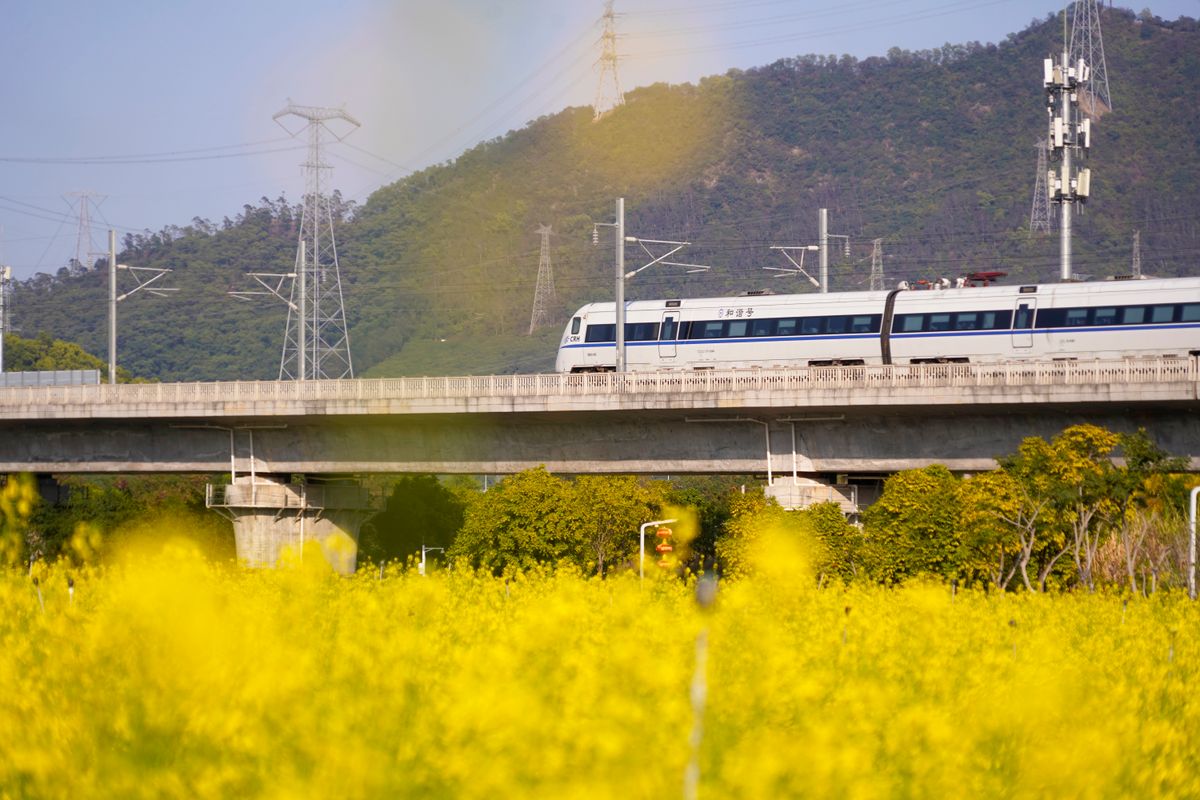
High-speed train crossing a bridge through rural fields along the Jinghu corridor between Beijing and Shanghai
Common mistakes
- Booking Hongqiao when your hotel is near People's Square, or vice versa. Confirm which Shanghai station your specific train uses before booking a hotel, since Hongqiao and Shanghai Railway Station are 13 km apart with no direct rail link between them.
- Assuming every G-train takes 4.5 hours. Only a handful of daily departures hit the fastest 4h18m-4h30m timing; many G-trains on the same route make more stops and take 5.5-6 hours. Check the specific train number's duration, not just the route.
- Waiting until the last few days to book second class on a Friday evening or Monday morning departure. These are the most contested slots on the busiest domestic corridor in China and sell out well before the 15-day booking window closes.
- Assuming business class is always available. With only about three business seats per row versus five in second class, business class capacity is a fraction of the train and disappears first on holiday weekends.
- Ignoring the May 2026 fare adjustment. Some flagship trains now cost roughly 20% more than the base fares quoted for the same class; check the live price for your exact train and date rather than assuming the lowest published figure.
Who this is for
A fast daytime G-train fits business travelers doing a same-day round trip, or anyone who wants to see the Yangtze River Delta countryside pass by in daylight. First class is worth the upgrade on this specific route if you're working on a laptop for the full 4.5 hours, since the extra table space and quieter cabin make a real difference over a short second-class seat.
The overnight sleeper suits budget travelers happy to trade a bit of comfort for a free night's lodging, plus travelers who prefer arriving at first light with a full day ahead rather than losing an afternoon to a daytime ride. It's a poor fit for light sleepers or anyone with an early meeting the next morning who needs guaranteed rest.
Flying makes sense mainly if you're connecting through Beijing Capital or Shanghai Pudong on an international itinerary and the rail transfer doesn't line up, or if you've found a fare cheaper than business class. For a standalone Beijing-Shanghai trip, the train wins on reliability and city-center convenience for most travelers.
Bring a printed or digital copy of your passport-linked ticket confirmation, arrive at least 30 minutes before departure for security and the walk to the platform, and check China train luggage allowance rules if you're carrying more than a couple of suitcases, since overhead space fills up fast on a route this popular.
FAQ
Do I need to print my ticket for the Beijing to Shanghai train? No. Since 2020, foreign passport holders can board with just their passport, which the gate scanner reads directly against your booking. No paper ticket or app screenshot is required, though keeping the booking confirmation on your phone as backup is a good habit.
Which is better, Beijing South or Shanghai Hongqiao station? Neither is objectively better; they're simply the two ends of the main G-train route. Beijing South serves the south side of Beijing with a subway interchange, and Shanghai Hongqiao sits next to the airport with its own metro lines. Pick your train based on which departure time and class fit your schedule, then plan your city transfer around whichever station that train uses.
Can I stand or buy a ticket without a seat if second class sells out? Yes, "no-seat" tickets exist and cost the same as second class, but you'll be standing or sitting in the vestibule for the full journey. On a 4.5-6 hour ride this is uncomfortable; it's a last resort, not a real option for this route.
Is the Beijing to Shanghai train worth it compared to flying? For most travelers, yes. Door-to-door time is similar or better once you count airport transfer and security time, the ride is more comfortable than economy class, and delays are rarer since high-speed rail doesn't compete with air traffic control congestion.
How far in advance should I book for a specific date? Tickets release 15 days before departure. Book the moment the window opens if you're traveling on a fixed date, especially for Friday evenings, Monday mornings, or any date near a national holiday.