China Visa for Indian Citizens: Fees, CVASC Locations & How to Apply (2026)
Quick answer: Indian citizens always need a visa for mainland China (no e-visa, no visa-on-arrival). Where you apply depends on where you currently live, not just your passport: in India you go through a CVASC in Delhi, Mumbai, or Kolkata (₹2,900 visa fee plus a ₹2,107-₹3,106 service fee for a single entry); in the US or Germany you apply at the Chinese consulate with jurisdiction over your city of residence, and you must show proof you live there legally.
Indian citizens are visa-required for mainland China under every circumstance, including short tourist trips, transit outside the 144/240-hour visa-free transit programs, and family visits. There is no Chinese e-visa and no visa-on-arrival option for Indian passport holders, so the application always goes through a Chinese Visa Application Service Centre (CVASC) or an embassy/consulate visa office, and a physical appearance is required for biometrics and passport submission even where an online pre-application portal exists.
The part that trips up most Indian applicants living outside India is jurisdiction. A Chinese consulate will only accept your application if you are physically present and legally resident in its consular district, regardless of your citizenship. That means an Indian techie on an H-1B in Texas, an Indian student in Berlin, and an Indian family still in Mumbai are all filing genuinely different applications, at different offices, with different proof-of-residence documents attached.
How much does a China visa cost for Indian citizens in 2026?
Applying inside India through a CVASC breaks the cost into two separate line items: the visa fee itself (set by the Chinese government) and the CVASC service fee (set by the outsourced visa centre operator). Per the official CVASC Delhi fee schedule:
| Visa type | Visa fee (INR) | Regular service fee | Express service fee |
|---|---|---|---|
| Single entry | ₹2,900 | ₹2,107 | ₹3,106 |
| Double entry | ₹4,400 | ₹2,107 | ₹3,106 |
| 6-month multiple entry | ₹5,900 | ₹2,107 | ₹3,106 |
| 1-year+ multiple entry | ₹8,800 | ₹2,107 | ₹3,106 |
That puts a standard single-entry tourist visa at roughly ₹5,000 with regular processing or ₹6,000 with express. Both fees are quoted in rupees because they float slightly with the exchange rate and are adjusted quarterly, so treat the numbers above as accurate for 2026 but worth reconfirming on the CVASC site before you pay. The service fee is charged whether or not your visa is approved, and it is not refundable if the application is rejected. Applicants filing from the US or Germany pay in local currency (USD or EUR) at their consulate's own published rate, which is usually close to, but not identical to, the CVASC rupee schedule converted.
Where you apply depends on where you live, not just your citizenship
This is the single most misunderstood rule for Indian nationals living abroad. Chinese consulates will not process a visa application from someone who is only visiting their consular district; you need to be a legal resident there, evidenced by a valid visa, work permit, residence permit, green card, or a document like a US I-20 (student) or I-94 (arrival/departure record).
| Current residence | Where to apply | Proof of residence needed | Typical processing time |
|---|---|---|---|
| India | CVASC Delhi, Mumbai, or Kolkata (by home-state jurisdiction) | Aadhaar/address proof, no extra residence document needed | 4 working days (express) to 6 working days (regular) |
| United States | Chinese embassy/consulate-general covering your state of residence | Green card, valid US visa, I-20, or I-94 | Around 4 business days regular, 2-3 days express |
| Germany | CVASC Berlin, Frankfurt, Munich, Hamburg, or Dusseldorf (by state) | Valid German residence permit, student enrollment, or work permit | Typically 4-6 working days, longer for peak season |
| Elsewhere abroad | Consulate covering that country/city | Proof of legal stay in that country | Varies by mission; confirm locally |
If you are simply passing through a country on vacation, that country's consulate will usually decline your application outright and point you back to India or your actual country of residence.
Applying from India: CVASC Delhi, Mumbai, or Kolkata
Indian residents apply through the Chinese Visa Application Service Centre network, not the embassy directly. Jurisdiction is split by home state:
- New Delhi CVASC covers most of northern, central, and northeastern India and any state not explicitly assigned to Mumbai or Kolkata.
- Mumbai CVASC covers Maharashtra and Karnataka.
- Kolkata CVASC covers West Bengal, Bihar, Jharkhand, Odisha, and Chhattisgarh.
The standard flow: complete the online Form V.2013, upload passport and photo scans, book an appointment slot, then attend in person to submit your physical passport, printed form, photo, and supporting documents (flight itinerary, hotel bookings or a formal invitation letter for business travel, and a bank statement for tourist visas in some cases). From December 2025 the process added a step where you first select your applying city (Delhi, Mumbai, or Kolkata) online and get redirected to create an account before booking, but the in-person passport drop-off and biometrics step has not gone away.
Applying from the US: use the consulate that covers your state, not your hometown in India
Indian nationals living in the US file at the Chinese embassy or consulate-general with jurisdiction over their state of residence, exactly as any other foreign national in the US would. The Washington embassy's consular district, for example, spans a large block of southern, central, and mid-Atlantic states, while the New York consulate-general covers the northeastern states, and there are additional consulates-general covering the West Coast, Midwest, and South separately. You'll need to check the jurisdiction map on the relevant consulate's website, because filing at the wrong office gets your application rejected outright rather than forwarded.
The documents are close to what you'd submit in India, plus one addition: proof you're legally present in the US. A green card, a valid US visa page, an I-20 (F-1 students), or an I-94 arrival record all work. Processing at US missions runs close to 4 business days for regular service, with express options at some locations bringing it to 2-3 days.
Applying from Germany or elsewhere in Europe: the CVASC network again
Germany runs its own CVASC offices in Berlin, Frankfurt, Munich, Hamburg, and Dusseldorf, each assigned a set of German states, similar to how India splits jurisdiction three ways. An Indian citizen on a German work visa, Blue Card, or student residence permit applies at the CVASC covering their registered address (their Anmeldung), not wherever feels most convenient. The consulate will ask for your residence permit or visa page as proof you're legally resident in Germany, on top of the usual passport, photo, and travel documents.
If you're an Indian citizen living somewhere else in Europe without a CVASC of their own, contact the Chinese embassy or consulate-general for that specific country. The core rule is identical everywhere: legal residence in the country, not a tourist stay, is what unlocks the local application route.
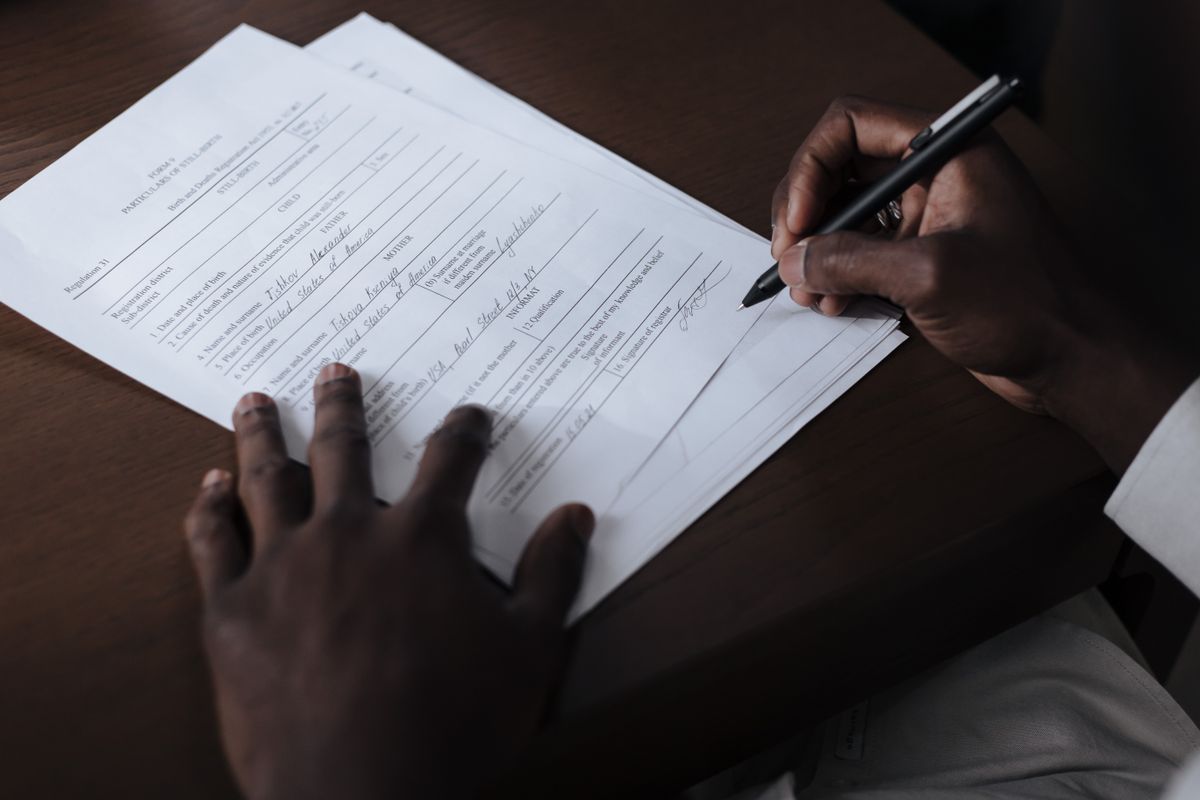
Person signing a visa application form
Documents every Indian applicant needs, wherever they apply
- Passport valid for at least 6 months beyond your planned trip, with at least 2 blank visa pages.
- Completed Form V.2013 (the standard Chinese visa application form), signed.
- One recent passport-style photo meeting the Chinese visa photo spec (plain light background, no glasses glare).
- Round-trip flight itinerary or booking confirmation.
- Hotel reservations for the full stay, or a formal invitation letter from a Chinese host/company for business travel.
- Proof of legal residence in your application country, if you're applying outside India (green card, work/residence permit, student enrollment document).
- Previous Chinese visas or passports, if you have any, to show travel history.
Common mistakes Indian applicants make
- Assuming an e-visa exists. It doesn't, for any nationality, on mainland China's standard visa track. If a website offers you an instant "China e-visa," it is not a genuine mainland China product; it may be confusing you with Hainan's separate visa-free scheme or a Hong Kong e-visa, which are not the same thing.
- Filing at the wrong consulate. Applying in a country where you're only vacationing, or at a US/German office outside your actual jurisdiction, gets the application turned away rather than processed slowly.
- Not accounting for Arunachal Pradesh, Jammu & Kashmir, or Ladakh origin. Chinese missions have historically issued "stapled visas" (a loose paper rather than a stamp in the passport) to applicants whose origin is listed as one of these regions, and Indian immigration does not accept stapled visas for departure. If your passport lists a place of birth or permanent address in these areas, check with the consulate directly before applying, since the standard process described here may not apply cleanly to your case.
- Underestimating passport validity. Six months of remaining validity is the practical minimum most missions want to see; renew first if you're close to that line.
- Forgetting the service fee is separate and non-refundable. Rejection does not get you the CVASC service fee back, only the visa fee itself in some cases, and even that depends on the mission's own policy.
- Skipping proof of residence when applying abroad. A tourist visa page or a short-stay Schengen visa in your passport does not count as proof of legal residence for a third-country China visa application; you need an actual residence/work/study document tied to the country you're filing in.

Departure information board at an international airport terminal
Who this is for
This guide is built for:
- Indian passport holders applying for a standard tourist (L) or business (M) China visa, whether from India or from a country where they currently live and work or study.
- Indian professionals on US work visas (H-1B, L-1) or green card holders who want to visit China while based in the US.
- Indian students or workers in Germany on a residence permit, Blue Card, or student visa who want to add a China trip.
- NRIs and Indian families planning a first China trip and unsure which office has jurisdiction over their case.
This guide is not the right fit for:
- Travelers who only need a visa-free transit stopover in China (check the 144-hour or 240-hour transit rules instead, which don't require a visa application at all for eligible routes and stays).
- Anyone traveling only to Hong Kong or Macau, which run separate entry rules from mainland China.
- Applicants whose passport shows an origin in Arunachal Pradesh, Jammu & Kashmir, or Ladakh, who should confirm directly with the relevant Chinese mission first given the stapled-visa history noted above.
FAQ
Can I apply for a China visa from a country other than India? Yes, as long as you are legally resident there. Chinese consulates process visa applications from foreign nationals, including Indian citizens, based on where the applicant lives, not their passport's issuing country. You'll need proof of that residence (visa, permit, green card, or similar) alongside the standard documents.
Which CVASC should I use if I live in India? It depends on your home state. Delhi covers most of the country by default, Mumbai handles Maharashtra and Karnataka, and Kolkata handles West Bengal, Bihar, Jharkhand, Odisha, and Chhattisgarh.
How long does a China visa take to process for Indian citizens? In India, regular CVASC service runs about 6 working days and express about 4 working days. At US and German missions, regular processing is typically around 4-7 working days, with express options available at extra cost in some locations. Public holidays at either end aren't counted.
Do Indian citizens need a separate visa for Hong Kong or Macau? Yes, entry rules for Hong Kong and Macau are handled separately from mainland China visas, with their own eligibility and application process; check the Hong Kong/Macau entry requirements before assuming your mainland China visa covers them.
Is there a China e-visa or visa-on-arrival for Indian passport holders? No. Mainland China does not offer a general e-visa or visa-on-arrival to Indian citizens. Every application goes through a CVASC or the relevant embassy/consulate visa counter, with in-person passport submission required.
Not sure if you even need a visa?
Check your China visa-free eligibility →
Sources
- Visa Fees - Chinese Visa Application Service Centre, New Delhi · Chinese Visa Application Service Centre (visaforchina.cn)
- Requirements and Procedures for Chinese Visa Application · Embassy of the People's Republic of China in the United States of America