Arriving in China: Entry, Immigration & Customs Guide (2026)
Quick answer: File the free China Digital Arrival Card (CDAC) online within about 72 hours of landing, expect ten fingerprints and a facial photo at immigration if you're roughly 14 to 70, then take the green customs channel only if you have nothing to declare, leaving fresh food, meat and plants at home and declaring cash near the US$5,000 / RMB 20,000 thresholds.
The moment you land in China, three checkpoints stand between you and the arrivals hall: the digital arrival card you should have filed before takeoff, an immigration counter that scans your face and takes your fingerprints, and a customs channel that punishes indecision. None of it is complicated once you know the sequence, and the process runs faster than its old paper-form reputation suggests. This guide walks through what happens at each stage, current as of mid-2026, plus exactly what you're not allowed to bring in your bags.
If you're still sorting out paperwork before your trip, start with our hub on whether you need a China visa, then come back here for what happens at the border itself.
Before you land: the China Digital Arrival Card
Since 20 November 2025, China's National Immigration Administration (NIA) has run an online China Digital Arrival Card (CDAC), which replaced the old paper arrival slip for most foreign travelers entering by air, land or sea. According to the NIA, the service is free of charge, any website asking you to pay is not official.
You can complete the card through several official channels:
- The NIA's official website and government service platforms
- The "NIA 12367" mobile app
- WeChat or Alipay mini-programs
- A QR code displayed at the port of entry (as a backup)
Not everyone needs to file one. Current NIA guidance exempts seven groups: green-card (permanent resident) holders; non-Chinese holders of a Hong Kong or Macao travel permit; travelers on a group visa or group visa-free arrangement; passengers transiting airside for under 24 hours without leaving the restricted zone; cruise passengers arriving and departing on the same ship; travelers pre-enrolled in a fast-track lane; and foreign crew on the transport vehicle itself. If none of those apply to you, which covers nearly all first-time visitors, plan to fill in the card.

Modern airport baggage claim hall with a single traveler waiting at carousel one
Travel and embassy advisories widely report that you should fill in the card within roughly 72 hours (three days) before arrival, though the NIA's own notice does not always state a fixed window, so complete it close to departure to be safe. Once submitted, the system generates a QR code that you (or an on-site officer) scan at immigration; there is no need to print anything. If you cannot complete it in advance, you can still do it on arrival using the airport's self-service kiosks, your phone, or a paper form. Always confirm the current procedure on the official NIA site (en.nia.gov.cn) before you fly.
At immigration: fingerprints, e-channels and queues
After leaving the aircraft you follow signs to Immigration Inspection (sometimes labeled "Border Inspection"). Here an officer checks your passport and visa, scans your arrival-card QR code, and, for most travelers, collects biometric data: your ten fingerprints and a facial photograph.
A few points worth knowing:
- Fingerprinting at the border generally applies to travelers aged roughly 14 to 70. Children under 14 and visitors over 70 are commonly exempt, along with diplomatic travelers and people physically unable to provide prints, but verify your situation, as rules can change.
- This distinction matters more than usual right now: from 17 December 2025 through 31 December 2026, Chinese consulates are waiving the in-person fingerprint requirement for most short-term visa applications (stays of 180 days or less), so plenty of travelers arrive having never been printed before their trip. That waiver applies at the visa office, not the border. The at-arrival biometric capture described above is a separate NIA process and still applies to the roughly 14-70 age band regardless of what happened at your visa appointment. The waiver itself doesn't cover D, J1, Q1, S1, X1 or Z visas, which lead to a residence permit after entry.
- Since November 2025, NIA has also been rolling out facial-recognition "intelligent" self-service lanes at a growing list of ports, including Shanghai Hongqiao, Xiamen's Gaoqi and Wutong ports, several Shenzhen land crossings, and the Hong Kong-Zhuhai-Macao Bridge port. Land at one of these and opt in to digital face-and-fingerprint verification, and you may clear a fast lane instead of a staffed booth, though a staffed counter is still the default most first-timers should expect.
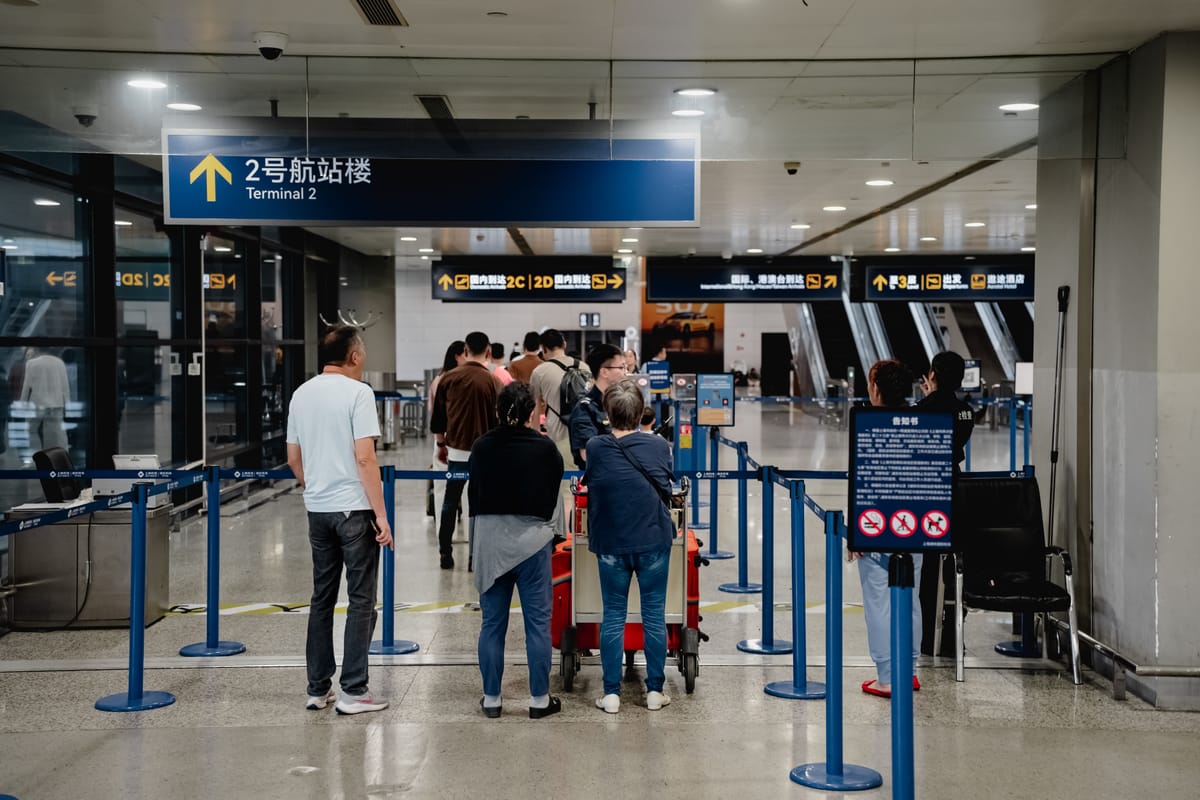
Travelers queuing in line at a Shanghai airport terminal with bilingual arrival signage
Queues can be long after a wave of arrivals, so have your passport and phone (with the arrival-card QR ready) in hand and keep face coverings off when asked, so the camera can match your photo.
Through customs: channels, allowances and currency
With your bag collected, you reach customs. China uses the standard two-channel system:
- Green channel, for travelers carrying nothing that must be declared.
- Red channel, for anyone carrying goods to declare, dutiable items, or cash above the limits.
Choosing the green channel when you should have used the red one is what gets travelers into trouble, so when in doubt, declare. Widely cited current duty-free personal allowances for arriving passengers are:
| Item | Typical duty-free allowance |
|---|---|
| Personal-use goods (non-residents) | Up to about RMB 2,000 in value |
| Personal-use goods (China residents) | Up to about RMB 5,000 in value |
| Cigarettes | 400 cigarettes, or 100 cigars, or 500g tobacco |
| Alcohol | 1,500 ml of drinks at 12%+ ABV |
On currency: travelers are generally expected to declare foreign cash equivalent to US$5,000 or more, and there is a long-standing limit of RMB 20,000 on Chinese banknotes carried in or out. These thresholds are widely reported but can be adjusted, so confirm the latest figures with China Customs (GACC) before you travel. The official China Customs (GACC) website is the final word on declarations.
What you can't bring: prohibited and restricted items
China enforces strict quarantine and customs rules, mainly to protect agriculture and public health. The items most likely to cause problems for ordinary tourists are food and plant products.
Commonly prohibited or restricted items include:
- Fresh fruit, vegetables, fresh or processed meat, dairy, and eggs (including things like beef jerky and homemade preserves)
- Seeds, soil, live plants and cut flowers (subject to agricultural quarantine and declaration)
- Weapons, ammunition and imitation firearms
- Controlled drugs and certain medicines in large quantities
- Counterfeit currency and materials deemed politically or culturally sensitive
On health: China dropped its blanket Entry/Exit Health Declaration requirement back on 1 November 2023, so healthy travelers no longer fill in a separate health form or QR code at the border. The exception is symptoms: if you have a fever, cough, breathing difficulty, vomiting, diarrhea, rash or unexplained bruising under the skin, or you've already been diagnosed with an infectious disease, you're required to voluntarily report it to customs staff and cooperate with any follow-up screening. Travelers with pets should note that animals face strict, sometimes lengthy, quarantine arrangements of their own.
Your quick arrival checklist
- Complete the CDAC online in the days before you fly and keep the QR ready on your phone (unless you fall into one of the seven exempt categories above).
- Expect fingerprints and a photo at immigration if you are aged about 14 to 70, regardless of whether your visa application waived fingerprints.
- Pick the green channel only if you have nothing to declare.
- Leave fresh food, meat and plant material at home, and declare cash near the US$5,000 / RMB 20,000 thresholds.
Rules at the border evolve, so treat this as orientation rather than legal advice, and always cross-check the official NIA and China Customs websites close to your trip. Once you clear the barrier, two more things trip up first-timers fast: communicating without Mandarin (see our guide to handling the language barrier in China), and knowing what to do if you get sick or hurt (see health and safety in China).
Common mistakes
- Paying for the arrival card. The CDAC is free; treating a paid third-party "China arrival card" site as official wastes money and risks your data. Only use the NIA website, the "NIA 12367" app, or the WeChat/Alipay mini-programs.
- Assuming a visa fingerprint waiver gets you out of border biometrics. Many short-term visa applicants are currently exempt from giving fingerprints at the visa office (a waiver running through 31 December 2026), but that has nothing to do with the border: the at-arrival capture is a separate NIA process, so you'll still queue for fingerprints and a photo on landing even if your visa application skipped them.
- Walking the green channel with food. Beef jerky, homemade preserves, fruit and dairy are routinely confiscated and can trigger fines. If you carry any food, plant or seed, use the red channel and declare it.
- Ignoring the cash thresholds. Carrying foreign cash equal to US$5,000+ undeclared, or more than RMB 20,000 in Chinese banknotes, is a declaration failure even if the money is legitimate, declare and use the red channel.
- Keeping a mask or hat on at the camera. Immigration needs a clear facial match; refusing to uncover when asked just slows your own queue.
Who this is for
This guide is for first-time and occasional foreign visitors arriving in mainland China by air, land or sea in 2026 who want to know exactly what happens at the border: the digital arrival card, fingerprinting, and the green/red customs channels.
Skip this if you already hold a Chinese green card, travel on a group visa or group-visa-free tour, transit airside for under 24 hours without leaving the restricted zone, or arrive and depart on the same cruise ship. All seven categories listed above are exempt from the arrival card itself, so your on-the-ground process will look different from what's described here. This guide is also not a substitute for the official NIA and China Customs notices, which are the final word.
Frequently Asked Questions
When should I fill in the China Digital Arrival Card? Travel and embassy advisories generally suggest completing the free China Digital Arrival Card (CDAC) within roughly 72 hours (three days) before you arrive, though the NIA does not always state a fixed window. To be safe, fill it in close to departure and keep the resulting QR code on your phone. If you miss it, you can still complete the card on arrival using airport kiosks, your phone or a paper form. Seven categories of traveler, including green-card holders, group-tour travelers and short airside transits, are exempt entirely. Always confirm the current procedure on the official NIA site (en.nia.gov.cn).
How much cash can I bring into China? Travelers are generally expected to declare foreign cash equivalent to about US$5,000 or more, and there is a long-standing limit of around RMB 20,000 on Chinese banknotes carried in or out. These thresholds are widely reported but can be adjusted, so verify the latest figures with China Customs (GACC) before you travel. When in doubt, declare and use the red channel.
What is the duty-free allowance when entering China? Commonly cited personal duty-free allowances are up to about RMB 2,000 in goods for non-residents (around RMB 5,000 for China residents), plus tobacco of 400 cigarettes, 100 cigars or 500g of loose tobacco, and 1,500 ml of alcoholic drinks at 12% ABV or higher. Anything beyond these limits, or any dutiable goods, should go through the red channel. Because these allowances can change, confirm current figures with China Customs (GACC).
Can I bring food into China? Most fresh and animal-origin foods are prohibited or restricted, including fresh fruit and vegetables, fresh or processed meat (such as beef jerky), dairy and eggs, as well as seeds, soil and live plants. These rules exist mainly to protect agriculture and public health, and they're enforced through customs and quarantine checks. When carrying any food or plant material, declare it and use the red channel rather than risk the green one.
Will I be fingerprinted when entering China? Yes, at immigration most travelers have their ten fingerprints and a facial photograph collected. This biometric capture generally applies to visitors aged roughly 14 to 70; children under 14 and people over 70 are commonly exempt, along with diplomatic travelers and those physically unable to provide prints. It's separate from any fingerprints taken when you applied for your visa, so a current visa-office fingerprint waiver (running through 31 December 2026 for most short-term applications) doesn't change what happens at the border. Rules can change, so verify your situation.
Do I need to fill in a health declaration to enter China? No, not for most travelers. China dropped the blanket Entry/Exit Health Declaration Card on 1 November 2023. You only need to voluntarily declare to customs if you have symptoms of an infectious disease (fever, cough, breathing difficulty, vomiting, diarrhea, rash or unexplained bruising under the skin) or have already been diagnosed with one.
Not sure if you even need a visa?
Check your China visa-free eligibility →
Sources
- China Digital Arrival Card & immigration — National Immigration Administration · National Immigration Administration of the People's Republic of China
- China Customs (GACC) — entry declarations, duty-free & currency · General Administration of Customs of the People's Republic of China
- Notice on Online Arrival Card Filling for Travelling to China · Embassy of the People's Republic of China in the Republic of Singapore
- China drops health declaration requirements for cross-border travelers · The State Council of the People's Republic of China
- Notice on the Extension of the Exemption from Fingerprint Collection for Chinese Visa Applicants · Consulate-General of the People's Republic of China in Manchester