Is China Safe for Solo Female Travelers? A 2026 Safety Guide
Search "China solo female travel" and you get two answers pulling in opposite directions: expat blogs calling it one of the safest countries in Asia to travel alone, and family members warning about a place where you can't read the signs and can't use Google Maps without a VPN. Both are true at once, and neither answers the question that matters before you book a flight: what changes for you specifically, as a woman traveling without a partner, compared to the general safety picture that covers scams, traffic, and petty theft for every traveler?
This guide skips the general stuff. It's about the things that are different when you're alone: who looks at you and why, whether the night train is fine, what a hostel dorm looks like in practice, and what to do if something goes wrong at 11 p.m. in a city where 110 (not 911) is the number to dial.
Quick answer: China is one of the lower-risk countries in Asia for solo women on violent crime and street harassment, largely thanks to heavy CCTV coverage, visible police presence, and a culture where catcalling strangers isn't normalized. The friction you'll run into is staring, phone photos of you (especially outside major cities), language barriers when something goes wrong, and scams aimed at any solo-looking tourist, not gendered violence. Practical precautions still matter: they're about smoothing rough edges, not avoiding a dangerous country.
What's different for a woman traveling alone
Chinese cities run on dense foot traffic, all-night convenience stores, and subway systems that stay busy until close to midnight. That environment favors solo travelers of any gender: you're rarely walking a fully empty street, and staff at a 7-Eleven or a hotel lobby are used to seeing single female guests check in at odd hours. Academic surveys on street harassment in urban China report rates in the range of 12-15% among women researched (an older, frequently cited study), and newer informal polling puts self-reported harassment higher, closer to 75% depending on how "harassment" is defined. That range is wide because street harassment surveys use different definitions and methods across countries, so treat any single number as a rough signal, not a precise ranking. What's consistent across sources: verbal catcalling toward foreign women is much less common in China than it is in cities like Bangkok, Rio de Janeiro, or Buenos Aires, where catcalling surveys report 72-89% of women experiencing it. The friction that does show up is different: unsolicited photos, prolonged staring, and people asking to take a selfie with you, especially outside Beijing, Shanghai, and Guangzhou where foreign faces are less common. It's intrusive, not threatening, and saying "bu yao" (don't want) or just walking on works fine.
The bigger practical risk for any solo traveler, not gendered but worth naming because it targets people traveling alone more than groups, is scams: the tea-house or tea-ceremony scam near tourist sites in Beijing, Shanghai, and Guilin (a "friendly local" invites you for tea, then you're stuck with a bill running into hundreds of dollars), the fake-monk donation scam, and unlicensed "black taxis" that overcharge or take a long way round near airports and train stations. None of these are unique to women, but solo travelers get targeted more often than groups because you're an easier conversation to start.
Night trains, subways, and taxis after dark
Sleeper trains: China doesn't guarantee women-only compartments. A women-only carriage was trialed on the Beijing-Shanghai line back in 2006 and dropped for low demand, and no booking app currently guarantees a female-only berth option. You can ask the ticket counter or conductor informally about grouping with other women when you book, and it sometimes works, but don't count on it. If sharing a compartment with strangers makes you uneasy, book a soft sleeper (four berths, a door that locks) over hard sleeper (open bay of six), and take the upper or middle berth so your bag stays with you overnight.

Woman walking a busy neon-lit street at night in a Chinese city
Subways run under security screening (bags through an X-ray, like an airport) in every major Chinese city, which is one more layer than most metro systems elsewhere have. Trains typically run until around 11 p.m.-midnight depending on the city and line, and platforms stay lit and staffed until close. Late-night solo subway rides are routine here, including for local women.
Taxis and ride-hail: stick to metered taxis or the Didi app (China's Uber equivalent, with English support in the app) rather than drivers who approach you outside stations or airports offering a ride. Screenshot your Didi driver's plate and photo before you get in, and share your trip status with someone if you're using a messaging app that still works locally (see the connectivity section below). Walking alone at night follows the same logic as anywhere: main streets and lit areas are fine, unlit alleys and construction zones are where you use a cab instead.
Where to stay: dorms, neighborhoods, and what to book
Female-only hostel dorms are common in the cities solo travelers visit most. Beijing, Shanghai, Chengdu, Xi'an, and Yangshuo all have hostels with dedicated women-only rooms, bookable through Hostelworld or Hostelz with a filter, and they typically cost the same as mixed dorms. A few things worth checking before you book any dorm, not just the women-only ones:
- Does the room lock from the inside, and does each bed have an individual locker with your own padlock (bring one, or buy one at a local supermarket)?
- Is there 24-hour staff at reception, not just a doorbell after 10 p.m.?
- Reviews mentioning "quiet," "safe," and "helpful staff" from other solo female reviewers are a better signal than star rating alone.
- For neighborhoods, stick to areas with hotel clusters and metro access (around Sanlitun or Gulou in Beijing, the French Concession in Shanghai, Wuhou in Chengdu) rather than the cheapest listing on the edge of town.
Clothing, behavior, and cultural attitudes
There's no dress code for foreign women in Chinese cities. Shorts, tank tops, and skirts draw no more attention on a summer day in Shanghai than they would in most major cities, and you'll see plenty of local women dressed the same way. The exceptions: temples and other religious sites (cover shoulders and knees, as you would anywhere), and smaller rural towns where modest dress just draws less attention generally, since standing out as a foreigner is already unavoidable there. Public affection and loud conversation get more notice than clothing does.
One cultural point that matters more than clothing: directness reads differently here. Firmly saying no, walking away mid-conversation, or ignoring someone who won't stop talking to you isn't rude by local standards the way it might feel in your home country, it's a normal way to end unwanted contact. You don't need to soften a refusal to be polite.
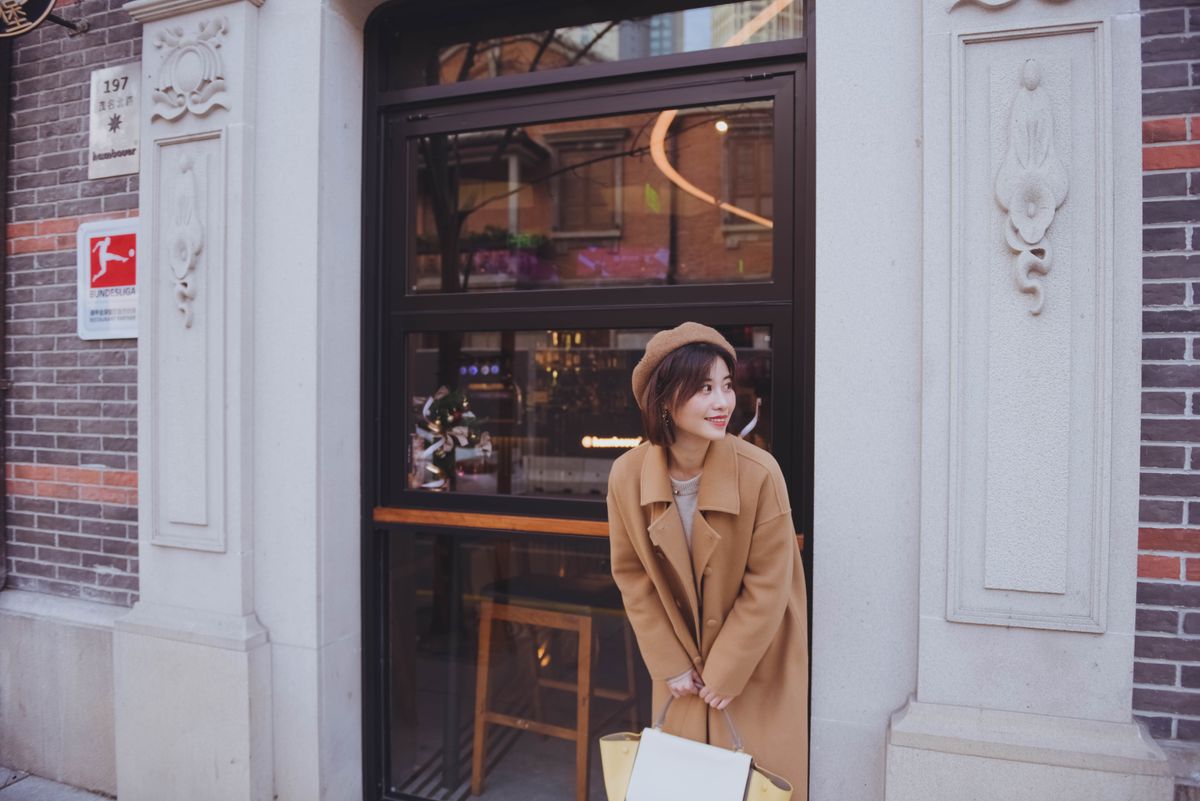
Woman in a coat standing outside a café storefront in a Chinese city
Staying in touch and emergency numbers
China blocks WhatsApp, Google (Maps, Gmail, Search), Instagram, and Facebook without a VPN, which matters more for a solo traveler than a group, since it's your main way to reach people back home or share your location. Buy or set up a VPN before you land (installing one after arrival is harder), and download offline maps in Maps.me or a China-specific app like Amap as backup. WeChat is the one app almost everyone uses locally, including for splitting a cab fare or messaging a hostel, and it's worth having even if you don't plan to use it much otherwise.
| Number | What it's for | Notes |
|---|---|---|
| 110 | Police | Chinese-language only in most cities; have your hotel name written in Chinese to show |
| 120 | Ambulance | Say "yiyuan" (hospital) if language fails |
| 119 | Fire | |
| 12308 | Ministry of Foreign Affairs consular protection hotline | 24/7, for passport loss, detention, or serious emergencies where you need your embassy involved |
Save your embassy's local number and address before you travel, not after you need it. Tell one person back home your rough day-to-day itinerary, city to city, so someone knows where you were supposed to be if you go quiet.
Common mistakes
- Assuming "safe" means "no precautions needed." Low violent-crime rates don't cancel out scams, so the tea-house invitation near the Forbidden City still isn't a friendly local, it's a scam script that's been running for years.
- Not writing down the hotel address in Chinese characters before leaving. Your phone's translation app dies at the worst time; a paper card from the front desk doesn't.
- Booking the cheapest hostel bed sight-unseen instead of checking for a locking dorm room and individual lockers.
- Skipping the VPN setup until after landing, then discovering you can't reach Google Maps, WhatsApp, or your usual banking app to sort it out.
- Traveling without any cash. Alipay and WeChat Pay dominate, but small towns and older taxi drivers sometimes want cash, and a dead phone shouldn't leave you stuck.
- Treating every solo-traveler safety concern as gendered. Overcharging taxis and tourist scams hit male backpackers too; don't over-index every interaction as being about your gender specifically.
Who this is for
This guide is for a woman planning to travel through China without a companion, whether that's a two-week trip through Beijing, Xi'an, and Shanghai, or a longer backpacking route through Yunnan and Sichuan. If you're traveling with a partner or in a group, most of this still applies but with less weight, since the specific frictions here (hostel dorm setup, solo night-train berths, being on your own if a scam attempt starts) matter most when there's no one else to double-check the situation with you. If you want the baseline picture on scams, transport safety, and health risks that apply to every traveler regardless of gender, read the general China safety guide first, then come back here for what changes when you're solo.
FAQ
Is Beijing safe for solo female travelers? Yes, by most measures it's one of the more comfortable major cities to be a solo woman in: heavy police presence, well-lit central districts, a subway that runs late with security screening, and hostels with women-only dorm options around Gulou and Sanlitun. The same tourist-scam risks (tea houses near the Forbidden City, unlicensed cabs at the airport) apply here as anywhere else in China.
Is China safe for female travelers generally, not just solo ones? Yes. The risk profile barely changes between traveling alone, with a partner, or in a group: violent crime against tourists is rare, and the main risks (scams, traffic, overcharging) are the same for everyone. Traveling alone mostly changes logistics, like who checks the map and who watches the bags, rather than the underlying safety level.
Is China safe to travel alone in general, for any traveler? Broadly yes. China's low gun-crime rate, extensive CCTV coverage, and visible policing make it one of the more straightforward countries in Asia for solo travel of any kind. The main friction points for any solo traveler are language barriers and app access (VPN, maps, payments), not personal safety.
How does China compare to other countries for solo female travel safety? On violent crime and street harassment, China compares favorably to Southeast Asian hubs like Thailand (86% catcalling rate in one survey) and to much of Latin America and parts of Europe. Where China falls behind more tourist-friendly countries like Japan or New Zealand is app/internet access (the VPN requirement) and language support outside major cities, both logistics issues rather than safety ones.
What should I do if I feel unsafe or targeted while traveling alone in China? Move toward a staffed, well-lit location (a hotel lobby, a subway station, a convenience store) rather than confronting the situation directly. Call 110 for police if there's immediate danger, or 12308 for the Ministry of Foreign Affairs consular hotline if you need help involving your embassy. Keep your hotel's address written in Chinese to show a taxi driver or police officer if you need to get back quickly.
Before you book anything, check the U.S. State Department's Women Travelers page for general safety tips that apply across countries, and the China Travel Advisory for the country-level risk rating and any current alerts before you fly.