China Business Etiquette: A Practical Guide for Meetings, Cards, and Dinners (2026)
You're standing outside a conference room on the 22nd floor of an office tower in Shanghai, business card holder in your jacket pocket, five minutes early because someone warned you punctuality matters here. The door opens. Six people file in, and you have no idea who to shake hands with first, how to hand over your card, or why everyone is waiting for one man near the window to sit down before anyone else moves. This scene plays out daily for foreign visitors doing business in China, and getting the first ninety seconds right sets the tone for everything that follows.
Chinese business culture runs on hierarchy, relationship-building (guanxi), and a concept called "face" (mianzi) that shapes almost every interaction, from how a card gets handed over to how a disagreement gets voiced. None of it is mysterious once you know the patterns. This guide covers the specific rituals of meetings, cards, gifts, and business dinners in China, not general table manners. For chopstick basics and everyday restaurant customs, see our Chinese dining etiquette guide; for how much and when to tip, see tipping in China.
Punctuality and dress: before you even sit down
Arrive 10 to 15 minutes early, not fashionably late. Being late to a Chinese business meeting reads as a lack of respect for the other side's time and seniority, and it can cost you credibility before you've said a word. If traffic or a delayed subway makes you late, call or message ahead rather than walking in unannounced.
Dress conservatively and a notch more formal than you might at home. Dark suits, ties, and closed shoes for men; tailored suits or conservative dresses in neutral tones for women, with minimal jewelry and low heels. Bright colors, casual blazers, or anything too revealing stand out for the wrong reasons in a first meeting, even in industries where China's own younger professionals dress more casually day to day. When in doubt, overdress for the first meeting and adjust once you see how your counterparts present themselves.
Who enters and sits first: the seating hierarchy
Line up your delegation by seniority before the door opens. Chinese counterparts will assume the person who walks in first is your team's leader and will direct most of the conversation to them, even if that's not how your company operates. If your most senior person hangs back and lets a junior colleague lead the way in, it creates real confusion about who holds decision-making authority.
Inside the room, seating is not first-come-first-served. The host or most senior local figure typically sits facing the door, in the seat that lets them see who enters. The guest of honor sits directly across or beside them, usually facing the door as well as a sign of respect. From there, rank descends the further a seat sits from the head of the table: the second-most senior person to the host's right, the third to the left, and so on. Don't sit down until someone gestures where to go, and don't take the head seat unless you're told to.

Asian businessman in a suit sitting at the head of a meeting table with colleagues
The business card ritual: mingpian etiquette
Business cards (mingpian, or name cards) still carry real weight in China, especially in manufacturing, government, legal, and traditional industries, even as WeChat QR codes have taken over casual networking. Treat the exchange as a small ceremony, not a formality to rush through.
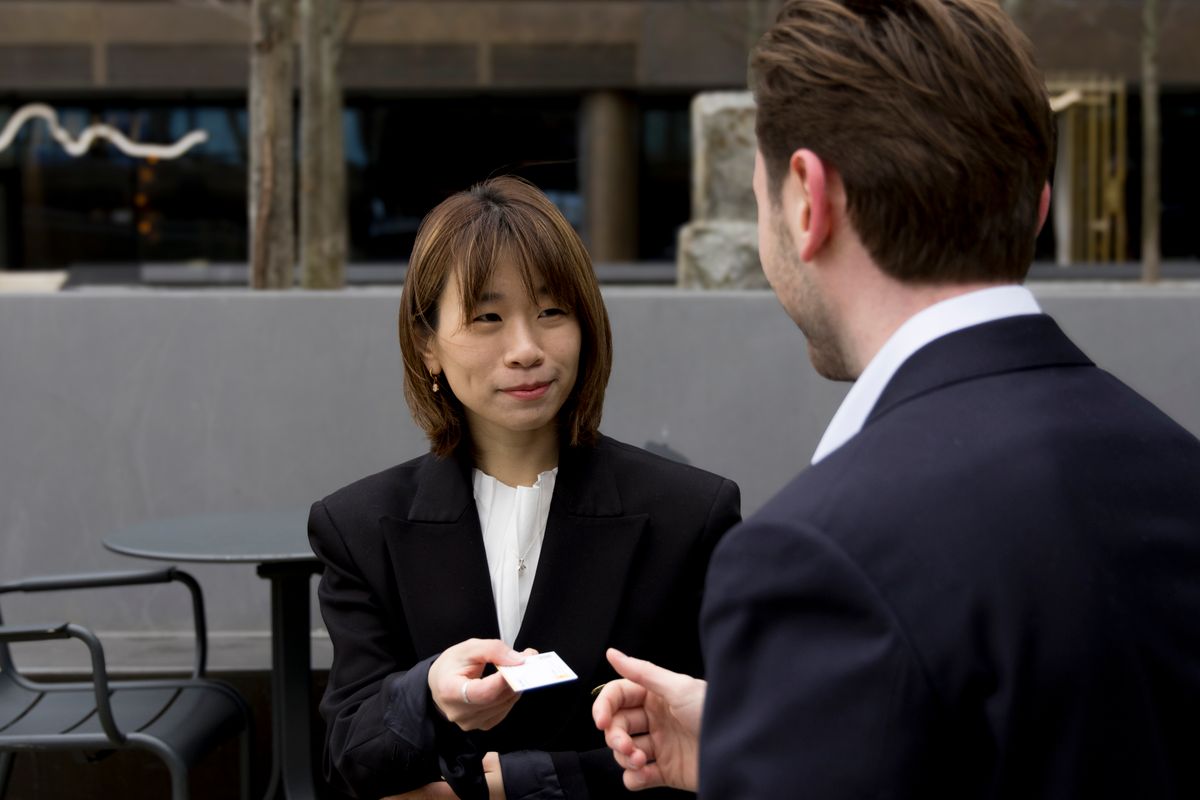
Business professional handing over a card with both hands during an outdoor meeting
- Bring enough cards. Pack more than you think you'll need. Running out mid-meeting looks unprepared.
- Get cards printed in Chinese. Simplified Chinese on one side, English on the other, with your title clearly shown, ideally before you land.
- Present with both hands. Hold the card by its top corners, Chinese side facing the recipient, and offer it with a slight nod. One-handed handoffs read as careless.
- Receive with both hands too. When someone hands you their card, take it with both hands, look at it for a few seconds, and comment on their title or company if you can. Don't just pocket it immediately.
- Set it on the table during the meeting. Place received cards face-up in front of you, roughly in the seating order of their owners. Never write on a card, fold it, or stuff it in a back pocket while the giver can see you.
- Work top-down. If you're meeting several people, exchange cards with the most senior person first.
Gift-giving: what works and what backfires
Bringing a modest gift for your host, especially on a first visit or during a festival period, is a normal and appreciated gesture in Chinese business culture. The trap is less about whether to give a gift and more about what you choose, since several common Western gift ideas carry bad associations in Chinese culture.
| Do give | Avoid giving |
|---|---|
| Something from your home country or region (local specialty food, regional crafts) | Clocks or watches (sounds like "attending a funeral," song zhong) |
| Items in pairs or sets of six or eight (auspicious numbers) | Sets of four (four sounds like "death," si) |
| Quality tea, spirits, or a nice pen | Sharp objects: knives, scissors, letter openers (symbolize "cutting" the relationship) |
| Gifts wrapped in red or gold paper | White or black wrapping paper (funeral colors) |
| A small gift for the whole team plus something slightly nicer for the senior host | Anything overly expensive, which can create an awkward sense of obligation |
Present gifts with both hands, the same way as business cards, and expect your host to initially decline once or twice before accepting, a polite formality rather than genuine refusal. Don't be surprised if your counterpart sets the gift aside without opening it in front of you; opening a gift immediately can look greedy in Chinese custom, unlike in many Western settings where it's expected on the spot.
The business dinner: toasts, baijiu, and banquet order
Business in China often gets settled, or at least warmed up, over a meal. If you've read our dining etiquette guide you already know the chopstick basics; a business banquet adds a layer of protocol on top of that.
Wait for your host to direct you to a seat, follow the same facing-the-door hierarchy described above, and let the host order first, or at least take their lead before you start picking dishes. The host typically opens the meal with a toast to the partnership, and you shouldn't eat or drink before that happens.
Baijiu, the strong grain spirit that shows up at many formal dinners, is central to toasting culture. A toast usually ends with someone calling out "ganbei," meaning "dry the glass." If you do not drink alcohol, state your preference and take part in the toast with water, tea, or another non-alcoholic drink instead. When someone toasts you specifically, join the gesture with the drink you have chosen. Later in the meal, people may get up and toast individually around the table; you can continue to participate without alcohol.
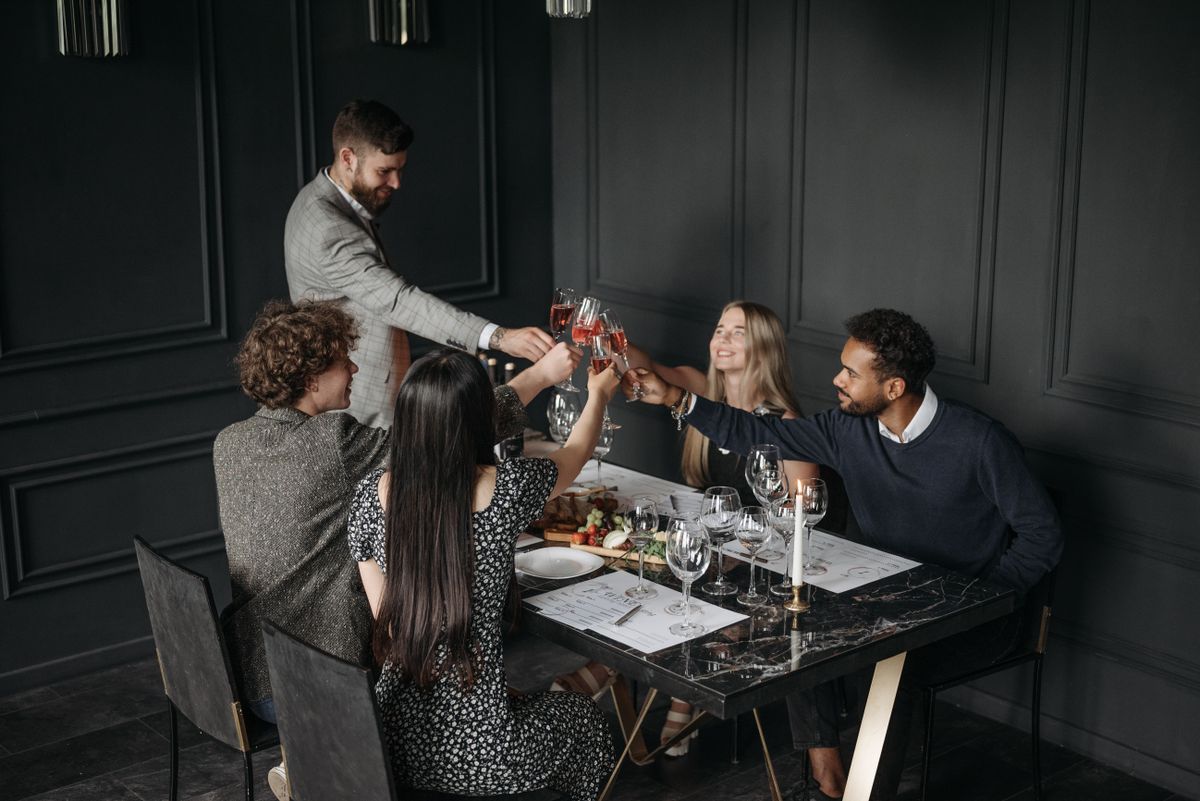
Group of colleagues toasting with glasses at a formal dinner table
Mianzi: the "face" concept behind every interaction
Mianzi, usually translated as "face," is the reputation and standing a person holds in front of others, and protecting it (for yourself and for the people you're dealing with) shapes how business gets discussed in China far more than most first-time visitors expect.
In practice, this shows up in a few consistent ways. Direct public criticism, correcting someone in front of their team, or forcing a blunt "no" out of a counterparty can damage a relationship in a way that's hard to repair, even if the underlying business issue was minor. Chinese counterparts will often avoid a flat refusal and instead say something like "this could be difficult" or "we'll need to study this further," which functions as a soft no. Learn to read those phrases rather than pushing for a yes-or-no answer on the spot.
Giving face works the other way too: publicly acknowledging someone's expertise before a meeting starts, directing credit toward your counterpart's team rather than claiming it for yourself, and treating senior figures with visible formality in front of their staff all build goodwill that pays off later in a negotiation. If a mistake or disagreement needs to be raised, do it privately rather than in the group setting.
Common mistakes to avoid
- Handing over a business card with one hand or while seated and distracted. It reads as dismissive even if that's not the intent.
- Sitting down before being shown a seat. Wait for direction, especially at a business dinner with an unfamiliar table.
- Giving a clock, a set of four items, or anything wrapped in white. These are the three gift mistakes that come up most often with foreign visitors.
- Pushing for a direct yes or no answer in a meeting. Vague or delayed responses are often a polite way of saying no; pressing harder rarely helps.
- Assuming you need to drink alcohol to take part in a toast. State your preference and join with water, tea, or another non-alcoholic drink.
- Correcting or contradicting someone in front of their colleagues. Save disagreements for a private conversation.
Putting it together
None of this requires memorizing a script. Arrive early, dress a step more formal than usual, let seniority guide who enters and sits first, exchange cards with both hands, choose a gift that avoids the four common taboos, follow your host's lead at dinner, and pay attention to how directly people are answering you. Get the first meeting right and the rest of the relationship, including the parts that involve negotiating terms, tends to go a lot smoother.
FAQ
What is the proper way to exchange business cards in China? Present and receive cards with both hands, Chinese side facing the recipient when you hand yours over. Take a moment to read a card you've received before setting it on the table in front of you; never pocket it immediately or write on it during the meeting.
What gifts should you avoid giving in Chinese business settings? Skip clocks or watches, sharp objects like knives or scissors, anything in a set of four, and white or black gift wrap. All of these carry associations with death or severed relationships in Chinese culture.
Do you have to drink baijiu at a Chinese business dinner? No. You can state that you do not drink alcohol and participate in a toast with water, tea, or another non-alcoholic drink.
Who should enter a meeting room first in China? The most senior member of your delegation should lead the way in. Chinese counterparts typically assume whoever enters first is the head of the group and will direct the conversation to that person.
What does "face" (mianzi) mean in a Chinese business context? Mianzi is a person's social standing and reputation in front of others. Public criticism, forcing a blunt refusal, or embarrassing someone in front of their team can damage a business relationship even when the underlying issue is small, so disagreements are usually best raised privately.
Sources
- China - Business Travel · International Trade Administration, U.S. Department of Commerce
- Business Etiquette in China · Trade Commissioner Service, Government of Canada