Chinese Tea Culture: A Traveler's Guide to Teahouses, Types and Etiquette
Prop the lid of your gaiwan half-open on its saucer and, within a minute or two, someone will refill your hot water without a word exchanged. That small piece of silent choreography is a good entry point into Chinese tea culture: tea here is less a drink than a social language, poured to welcome guests, seal a deal, or apologize, and read through gestures as much as through words. Understanding a little of it turns an ordinary cup into a window onto thousands of years of history, and helps you avoid a few small missteps along the way.
A short history of tea in China
Legend credits the mythical emperor Shennong with discovering tea around 2700 BCE, when leaves blew into his pot of boiling water. By the Tang dynasty (618-907), tea had become a refined art: the scholar Lu Yu wrote The Classic of Tea (Cha Jing), the world's first known book devoted entirely to the subject. Tea later fueled the Tea Horse Road, a network of trade routes that carried pressed tea bricks from Yunnan and Sichuan deep into Tibet and beyond. That long heritage lives on in everything from roadside thermoses to elegant tasting rooms, and travelers can step into it almost anywhere they go.
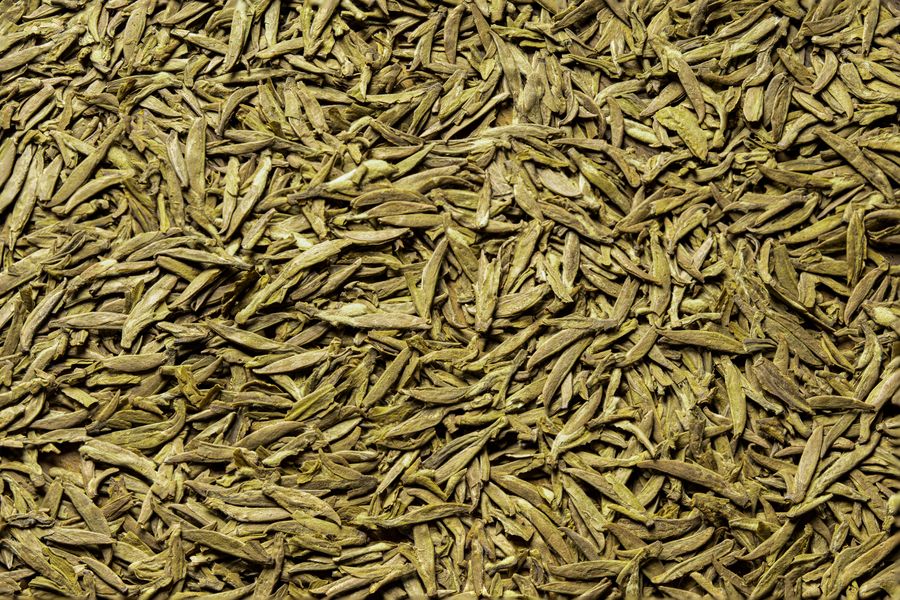
Flat-pressed Longjing (Dragon Well) green tea leaves
The six types of Chinese tea
The Chinese classify tea not by region but by how the leaves are processed and oxidized:
- Green tea (lǜchá): unoxidized and fresh, the most popular style in China. Try Longjing (Dragon Well) from Hangzhou.
- Yellow tea (huángchá): rare and mellow, lightly fermented.
- White tea (báichá): barely processed, delicate and subtly sweet.
- Oolong (wūlóng): partially oxidized, ranging from floral Tieguanyin to the roasted Da Hong Pao of the Wuyi Mountains.
- Black tea (hóngchá, "red tea"): fully oxidized; Keemun and Yunnan's Dianhong are the best known.
- Dark tea (hēichá): post-fermented and aged. The best known is Pu'er from Yunnan, sold in pressed cakes that improve with age.
Gongfu cha: the art of brewing
The brewing style you will see across teahouses is gongfu cha ("making tea with skill"). Instead of one large mug, the server uses a small gaiwan (a lidded bowl) or a clay Yixing teapot and pours many short infusions from the same leaves, so the flavor shifts and opens up cup after cup. Watching the unhurried ritual (the rinse of the first infusion, the high pour, the row of thumbnail-sized tasting cups) is part of the pleasure, and nobody minds if you just watch the first round before joining in.
How to order, and the silent signals staff use
You do not need to know tea names to sit down at a Chengdu-style teahouse. A server brings a short paper or laminated list of loose-leaf teas (jasmine and green teas are the safe, popular choices), you point at one, and that is the whole transaction: what you pay covers the leaf and, classically, hot-water refills for as long as you keep your seat. Tables get used for hours this way, for mahjong, card games or just conversation.
Refills themselves are often silent. Chengdu servers still walk the floor with long-spouted copper kettles, a Sichuan tradition that started as a practical fix (the long spout let a server top up a cup without leaning over a crowded table) and has grown into a showmanship pour at some teahouses, arcing the water in from a distance. Between refills, the lid of your gaiwan does the talking: tilt or crack it open and a server will come top up your water; leave something small on top of it (sunglasses, a phone, a snack) and you are telling the room "I have stepped away, this seat and cup are still mine"; turn the lid upside down inside the bowl and it means you are finished and the table can be cleared.
Payment has mostly gone digital. Many teahouses today lean toward Alipay or WeChat Pay over cash, so it is worth setting one up before you travel (see our guide to paying in China for how); a little cash as backup still helps in smaller towns.
Manners at the table
- Tap two fingers to say thanks. When someone pours for you, a light double-tap of the index and middle finger on the table is a silent, gracious thank-you. One well-known legend traces it to the Qing dynasty Emperor Qianlong, who poured tea for his servants while traveling incognito; unable to kowtow without blowing his cover, they tapped bent fingers on the table instead. As a visitor, the two-finger tap works as a safe, universal version.
- Pour for others before your own cup. Filling other cups first is a basic courtesy.
- Keep the spout pointed away from people. Aiming it at someone, even by accident, reads as impolite.
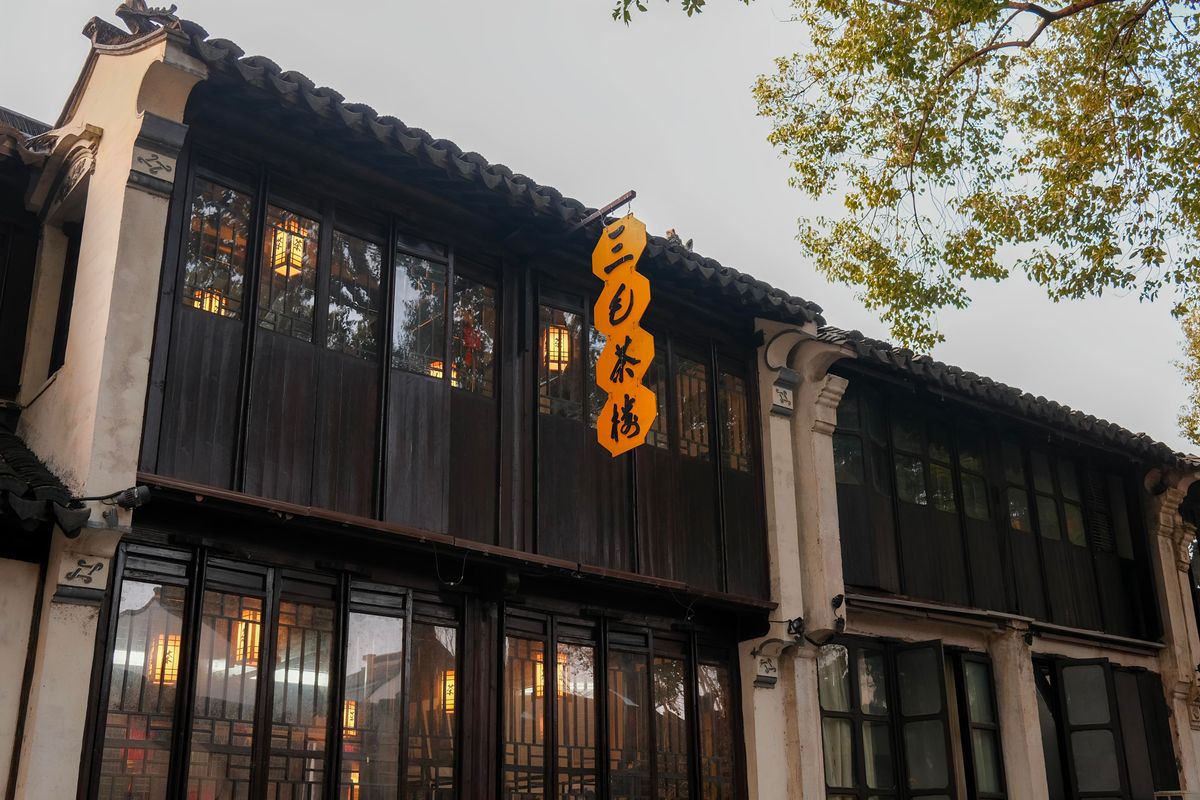
A traditional wooden Chinese teahouse
Where to experience tea culture
- Chengdu: the spiritual home of relaxed teahouse culture. The open-air teahouse in People's Park (Heming Teahouse) lets you sit in a bamboo chair with bottomless green tea for hours.
- Hangzhou: visit the Longjing tea villages (Meijiawu, Longjing Village) to see the terraced gardens and taste the tea at the source.
- Beijing: the Lao She Teahouse pairs tea with Peking opera and folk performances. Shows are ticketed and can sell out on popular nights, so it is worth booking ahead through Klook or the venue directly.
- Fujian: the heartland of oolong, from Anxi (Tieguanyin) to the Wuyi cliffs (Da Hong Pao).
What to buy and how
Tea makes a light, easy souvenir. Buy loose-leaf rather than bagged, ask to smell and even taste before you buy, and look for vacuum-sealed packs that travel well. Large tea markets such as Beijing's Maliandao, still the biggest tea trading hub in northern China, offer huge selection, but a reputable shop or a tea village is friendlier for first-timers. Prices vary wildly with grade, so do not assume the most expensive is "best" for your taste; sample first.
Quick takeaways
- Sit down, point at a tea on the menu, and the price covers the leaf and the hot-water refills for as long as you stay.
- Crack the gaiwan lid open for a refill, rest something small on it to hold your seat, or turn it upside down when you are finished.
- Tap two fingers on the table when someone pours for you; it is the standard silent thank-you.
- No tip is expected at a teahouse; a polite thank-you is enough.
- Buy loose-leaf tea, not bags, and ask to smell or taste it before you commit.
Frequently Asked Questions
Is it rude to refuse tea in China? Not at all, but accepting even a small cup is a warm gesture. If you do not want more, leaving your cup full is a polite signal that you have had enough.
Do you tip at a teahouse in China? No. Tipping is not customary in mainland China, including teahouses and restaurants. A simple thank you is all that is expected.
Do I need to speak Chinese to order tea at a teahouse? No. Most teahouses hand you a short list of loose-leaf teas to point at, and paying once for the leaf and the seat needs no language at all. The trickiest part for visitors is usually the silent lid signals, not the ordering.
What is the most famous Chinese tea? Longjing (Dragon Well) green tea from Hangzhou is arguably the most celebrated, followed by Pu'er, Tieguanyin oolong, and Da Hong Pao.
Can I bring Chinese tea home through customs? Dried, commercially packed tea is allowed into most countries, but rules vary; check your home country's customs limits on agricultural products before you fly.
What is gongfu tea? It is a traditional brewing method using small vessels and many short steepings to draw out a tea's evolving flavor, not a type of tea, but a way of preparing it.