Vegetarian and Vegan Food in China: Phrases, Dishes, and Cities to Know (2026)
A plate of stir-fried green beans looks like the safest order on the menu. In most restaurants in China, it isn't. Cooks add a spoonful of ground pork for flavor, then plate it so the meat blends into the color of the beans. Ask the same question about the "vegetable" soup and you'll often get lard, chicken bouillon, or fish stock as the base. This is the actual problem vegetarian and vegan travelers run into in China: the label on the menu tells you what the dish is built around, not what's hiding inside it.
The fix isn't avoiding Chinese food. It's knowing which phrases work, which dishes are vegetarian by tradition rather than by accident, and where the hidden traps sit.
Why "vegetable" on the menu doesn't mean vegetarian
Four ingredients cause almost every accidental non-vegetarian meal:
- Lard (zhūyóu): still the default cooking fat in many home-style and regional kitchens because it browns vegetables faster and adds richness. A stir-fry with zero meat in it can still be cooked in lard.
- Chicken bouillon (jījīng): a powdered stock added to soups, sauces, and stir-fries the way salt is added elsewhere. It goes into dishes that read as fully plant-based.
- Oyster sauce (háoyóu): the base of many glossy brown sauces on vegetable dishes and tofu.
- Fish sauce or dried shrimp: common in Cantonese and some Sichuan preparations to round out umami, often in sauces that look like plain soy.
There's also the garnish problem: small pieces of ground meat or diced ham scattered through a dish are frequently treated by kitchen staff as seasoning, not as "meat" in the sense a customer means when they ask for a meat-free dish. That's a cultural gap, not dishonesty, and it's exactly why a general "no meat" request gets misread more often than a specific one.
Say this before you order
Keep these phrases on your phone in Latin-script Mandarin. The table gives the English meaning and pronunciation; Chinese characters are intentionally omitted so the wording stays easy to read and compare across both language versions.
| English | Mandarin in Latin script | Pronunciation |
|---|---|---|
| I'm vegetarian | Wǒ chī sù | woh chir soo |
| I'm vegan, with no eggs or dairy | Wǒ chī chún sù | woh chir chwen soo |
| I don't eat meat | Wǒ bù chī ròu | woh boo chir roh |
| No meat, no fish, no eggs | Bú yào ròu, bú yào yú, bú yào jīdàn | boo yow roh, boo yow yoo, boo yow jee-dan |
| Does this have lard in it? | Zhège yǒu zhūyóu ma? | juh-guh yo joo-yo ma |
| Does this have chicken stock or bouillon? | Zhège yǒu jītāng huò jījīng ma? | juh-guh yo jee-tang hwoh jee-jing ma |
| Does this have oyster sauce or fish sauce? | Zhège yǒu háoyóu huò yúlù ma? | juh-guh yo how-yo hwoh yoo-loo ma |
| Can you make it without meat or animal fat? | Kěyǐ bú fàng ròu hé hūnyóu ma? | kuh-yee boo fahng roh huh hwoon-yo ma |
| No chicken bouillon or MSG; vegetable stock is fine | Bú yào fàng jījīng, yòng sù tāng jiù hǎo | boo yow fahng jee-jing, yong soo tang joe how |
One trick that consistently gets faster, more careful compliance from kitchen staff: framing it as an allergy. Saying Wǒ duì ròu guòmǐn ("I'm allergic to meat") triggers a different level of caution than a stated preference, because allergies are taken as a health and liability issue. It's a small exaggeration that solves a real communication gap, and long-term vegans in China commonly recommend it for exactly that reason.
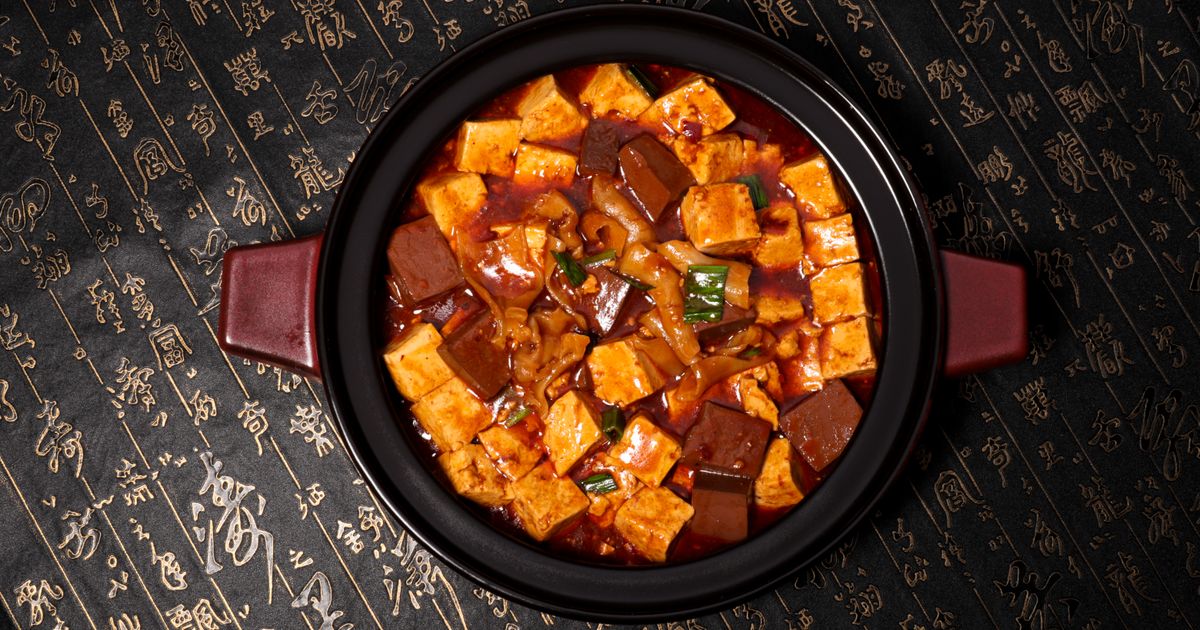
Chinese spicy tofu claypot dish
Dishes that are vegetarian by tradition, not by luck
Chinese cuisine has an entire branch built around meat-free eating long before "vegan" was a marketing word: sùshí, Buddhist temple cuisine, developed over centuries of monastic cooking. Temples in most major cities run their own canteens or attached restaurants, and the food is prepared meat-free as a baseline, not as a special order.
Reliable places to look:
- Beijing: Gong De Lin (Gōng Dé Lín), founded in 1922, is the city's oldest dedicated vegetarian restaurant and still serves classic mock-meat dishes made from wheat gluten, tofu skin, and mushroom. Temple canteens near Yonghe Lama Temple and Fayuan Temple also serve public vegetarian meals.
- Shanghai: the restaurant attached to Jade Buddha Temple (Yùfó Chánsì) serves a full vegetarian menu to visitors, not just monks.
- Chengdu: Wenshu Monastery (Wénshū Yuàn) runs an affordable vegetarian buffet inside the temple grounds, and nearby Mi Xun Teahouse serves refined Sichuan-style vegetarian dishes.
Outside temple food, these dishes are safe starting points in most regional kitchens, though it still pays to confirm no lard or animal stock:
- dòufu in any form: silken tofu with soy sauce and scallion, braised tofu, or grilled skewered tofu.
- sùjī, literally "vegetarian chicken": pressed and seasoned tofu skin, a texture substitute, not an ingredient trap.
- luóhàn zhāi, Buddha's Delight: a mixed stew of tofu, mushroom, wood ear fungus, and vegetables, standard on temple and home-style menus.
- dì sān xiān: a northeastern stir-fry of potato, eggplant, and green pepper.
- liángbàn huángguā: smashed cucumber salad with garlic and vinegar, almost always meat-free by default.
Order sù mápó dòufu, the vegetarian version of mapo tofu, by name. The standard version is built on ground pork, and just asking for "mapo tofu without meat" sometimes gets you a dish with the pork simply picked out rather than left out of the cooking process.
Where it's easy and where it's hard
Chengdu and Xi'an are among the more forgiving cities: both have long-standing Buddhist temple dining traditions and a strong home-style vegetable-dish culture, and Chengdu in particular has a growing scene of dedicated modern vegan restaurants layered on top of its temple food. Shanghai and Beijing, as the largest and most internationally connected cities, have the widest range of dedicated vegetarian and vegan restaurants, so you can eat out without negotiating a menu at all.
Rural areas and smaller cities are the hard mode. Restaurants there are less likely to have English menus, less likely to have staff used to substitution requests, and more likely to treat lard and animal stock as non-negotiable house style. Hot pot is a specific trap everywhere, not just in small towns: the shared broth base, unless you specifically order a vegetable or mushroom broth, is usually built on beef tallow or bone stock even when the vegetables and tofu you dip into it are completely plant-based.
Apps that catch what conversation misses
A phrasebook only helps with what you say out loud. For reading a printed menu, camera-based translation is faster and catches ingredient words you wouldn't think to ask about. Our translation app guide covers which apps work offline and which handle character recognition best, which matters here because a menu photo scan will surface words like háoyóu or zhūyóu that a spoken phrase might not.
For finding restaurants in the first place, Dàzhòng Diǎnpíng (Dianping) is the local equivalent of a review site and lets you filter or search directly for sùshí (vegetarian) listings in a city, something international apps rarely cover well for China. Delivery apps like Meituan and Ele.me also let you filter by "sùshí" or search dish names directly, useful for ordering to a hotel room without a face-to-face conversation. None of these require a Chinese phone number to browse, only to pay, so pair them with the payment setup covered in our Alipay for foreigners guide.
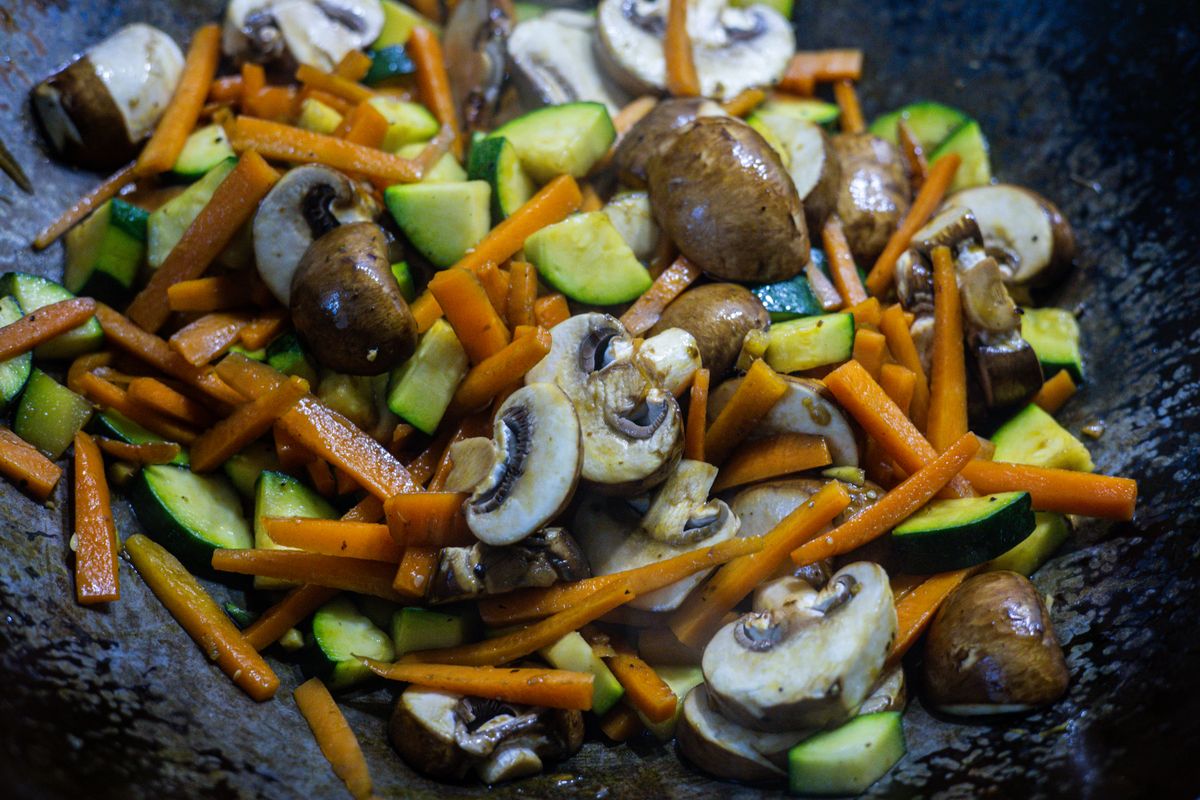
Vegetable and mushroom stir-fry in a wok
Before you sit down
- Learn Wǒ chī sù and Wǒ chī chún sù before you learn anything else; they set the right expectation faster than any longer sentence.
- Ask about lard, chicken bouillon, oyster sauce, and fish sauce specifically. A general "no meat" question misses all four.
- Default to tofu and mushroom dishes, temple food, and named vegetarian versions of classic dishes rather than hoping a vegetable dish is automatically safe.
- Treat hot pot broth as guilty until proven innocent: order the vegetable or mushroom base, not the shared pot.
- Use Dianping or a delivery app to search "sùshí" directly instead of scanning a full menu blind.
- In smaller towns, confirm before ordering, not after the dish arrives. Staff there are less likely to volunteer the lard-and-stock information on their own.
Frequently asked questions
Is it hard to be vegetarian in China? It's manageable with preparation and hard without it. The difficulty isn't a shortage of plant-based dishes, it's those dishes being cooked with animal fat or stock by default. Asking the specific questions above closes most of that gap.
Is Chinese food generally vegan? No. Most Chinese cooking uses animal-derived seasonings, lard, or stock even in dishes that look plant-based, so "vegan" needs to be stated and confirmed, not assumed from the dish description.
What is sùshí and is it the same as vegan? sùshí means vegetarian in the traditional, often Buddhist sense, and can still include dairy or eggs depending on the cook. It is not automatically vegan. Use chún sù specifically when you need a strict, animal-product-free meal.
Do Chinese restaurants understand "vegan"? Many staff in major cities recognize chún sù now, but smaller or older-generation restaurants may not. Pairing the word with a plain statement like "no meat, no eggs, no dairy, no oil from animals" covers the gap.
Are there vegetarian restaurants near Buddhist temples? Yes, and they're some of the most reliable options in the country. Temples in Beijing, Shanghai, and Chengdu run public vegetarian canteens or attached restaurants where every dish on the menu is meat-free by default, no negotiation required.
Sources
- Shanghai Jade Buddha Temple — English Official Site · Shanghai Jade Buddha Temple
- Longhua Temple vegetarian cuisine · Shanghai Municipal Government
- Jiuhua vegetarian cuisine craftsmanship · Jiuhua Mountain UNESCO Global Geopark
- Vegetarian and vegan in China · China Visit Guide
- Buddha’s delight · Wikipedia
- Dianping app listing · Google Play