Where to Stay in Xiamen: Gulangyu Island vs. Zhongshan Road (2026 Guide)
Two things decide where you should sleep in Xiamen: do you want to wake up on Gulangyu Island itself, and are you arriving by plane or by high-speed train. Get those two right and the rest of the city sorts itself out fast, because Xiamen is compact enough that almost everywhere useful sits within a 20-minute ferry or taxi ride of Zhongshan Road. For general background on the city before you book, see our Xiamen destination guide.
Book Xiamen hotels on Trip.com
Free cancellation on most stays · compare neighborhoods
Some links are affiliate links; we may earn a commission at no extra cost to you.
Before you book, it's worth skimming our guide to hotel booking rules and police registration in China, which covers the site-wide basics that apply no matter which city you're headed to.
Gulangyu Island or the mainland side: the real decision
Gulangyu is a 1.88-square-kilometer island a five-minute ferry ride from downtown Xiamen, packed with early-1900s colonial villas built when it was a shared foreign settlement. No cars or scooters are allowed anywhere on it; the only wheeled traffic is electric luggage carts and the occasional maintenance vehicle. That single rule shapes everything about staying there.
If you book a guesthouse on Gulangyu, expect to walk the last stretch, sometimes uphill on cobblestone lanes, with your own bags. Some of the better boutique hotels send a porter to meet you at the pier, but confirm this when you book rather than assuming it. The payoff is real: once the day-trip crowds clear out around 17:00-18:00, the island turns quiet, piano music drifts out of practice rooms (Gulangyu has more pianos per resident than almost anywhere in China), and you get Longtou Road and Sunlight Rock to yourself in the early morning before the first ferries land. Rooms in restored villas run roughly ¥400-1,200 ($55-165) a night depending on season and how much sea view you're paying for.
Stay on the mainland side instead, in Siming District around Zhongshan Road, and you trade that overnight quiet for convenience: your hotel is a five-to-ten-minute walk from a ferry terminal, you have far more restaurant and hotel choice, and you're not hauling suitcases over cobblestones. Budget hotels here start around ¥180-280 ($25-38), with mid-range 3-4 star options in the ¥350-650 ($48-90) range and boutique or harbor-view properties pushing ¥700-1,000+ ($95-140).
Why the ferry schedule decides where you should sleep
This is the part most guides skip, and it's the reason Zhongshan Road keeps coming up as the safe default. Xiamen runs two separate ferry systems to Gulangyu, not one.
During the day, tourists board at the Dongdu/Xiagu International Cruise Terminal, a larger facility set apart from the old downtown pier, roughly 7:10 to 17:30 in the October-May low season and until about 18:30 from June to September. You book this route in advance (passport required for foreign visitors) through the "Xiamen Ferry Plus" WeChat mini-program, and it isn't a walk-up service.
Once daytime service ends, everything switches to the Lundu Ferry Terminal on Lujiang Road, right at the foot of Zhongshan Road, which then runs tourist ferries roughly on the hour through the night to Sanqiutian Pier on Gulangyu. That's a different pier, a different terminal building, and a route locals use during the day when tourists can't. If you're staying near Zhongshan Road, this switch is a non-event, you're already standing next to the terminal that handles it. If you're staying somewhere else on the mainland, say near the airport or out toward Jimei, you're now looking at a taxi ride to a specific terminal at a specific time, with a schedule that shifts by season. Confirm the current cutoff times before you travel since the port authority adjusts them without much notice.
Practical takeaway: if your itinerary has you island-hopping to Gulangyu more than once, or coming back late from dinner, book a hotel within walking distance of Zhongshan Road and Lundu terminal. It removes the ferry timetable as a source of stress entirely.
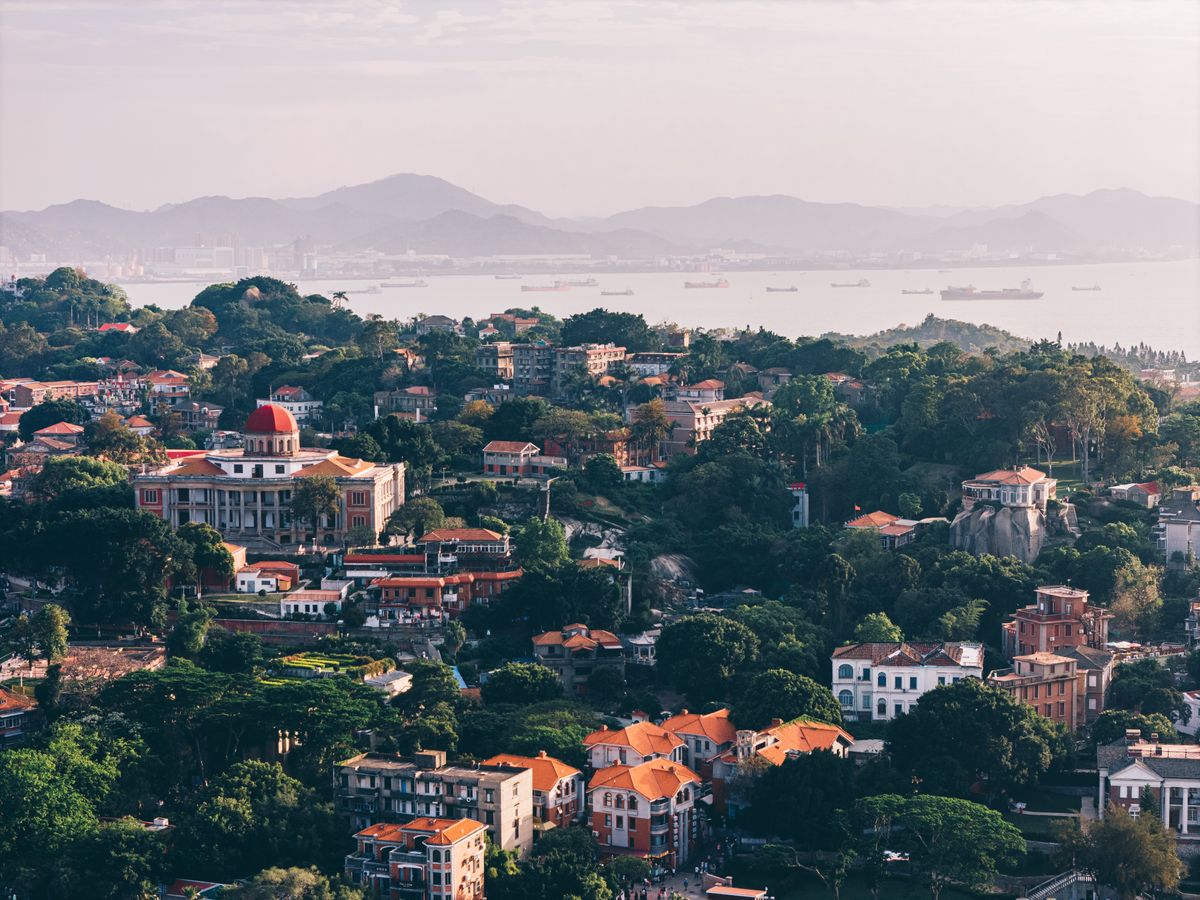
Aerial view of Gulangyu Island's red-roofed colonial architecture and harbor in Xiamen
Airport or Xiamen North Railway Station: pick your neighborhood accordingly
Xiamen Gaoqi International Airport (XMN) sits on the north side of Xiamen Island itself, about 10-12 km from Zhongshan Road. A taxi downtown takes roughly 20 minutes and costs ¥30-45; Metro Line 2 also connects the airport to the island's core. If your whole trip is contained within Xiamen, or you're catching domestic flights rather than trains to other Fujian cities, the airport side of things barely factors into your hotel choice, since it's a short, predictable hop to almost any downtown neighborhood.
Xiamen North Railway Station is a different story. It's out in Jimei District, roughly 25-28 km from downtown, and it's the station that handles most high-speed G-series trains to Fuzhou, Quanzhou, Shenzhen, Hangzhou, Shanghai, Nanjing, and Beijing. Getting there from Zhongshan Road takes 45-60 minutes by Metro Line 1 or a ¥60-90 taxi ride, longer in rush-hour traffic. Before you book a hotel near the station "to be safe," check your ticket carefully: some regional and D-series trains, including routes up the coast to Fuzhou, still use the original Xiamen Railway Station in Siming District, which is a short ride from downtown, not the North station. Only plan a stay near Xiamen North if you have an early departure or late arrival on a G-series train and want to skip the cross-city transfer; otherwise it's a poor base for sightseeing, with limited restaurants and no beach or old-town character nearby.
Neighborhoods at a glance
| Area | Best for | Typical price/night | Distance to Gulangyu ferry |
|---|---|---|---|
| Zhongshan Road / Siming (downtown) | First-timers, ferry access, shopping and food | ¥180-650 ($25-90) | 5-10 min walk |
| Gulangyu Island | Quiet evenings, architecture, slower pace | ¥400-1,200 ($55-165) | You're already there |
| Xiamen University / Shonan Peninsula | Beach walks, campus views, a calmer base | ¥250-550 ($34-75) | 15-25 min by taxi or bus |
| Near Xiamen North Railway Station (Jimei) | Early/late G-train connections only | ¥150-300 ($20-40) | 45-60 min by metro |
The Xiamen University and Shonan area, around Baicheng Beach and Huandao Road, is worth a specific mention. It's home to one of China's most photographed campuses (the Qunxian building's red-tiled roofline is a local landmark) and a quieter stretch of coastline for morning walks, while still being close enough to downtown for a 15-20 minute taxi to the ferry. It suits travelers who want a break from the pedestrian-street crowds without giving up easy access to the rest of the city.
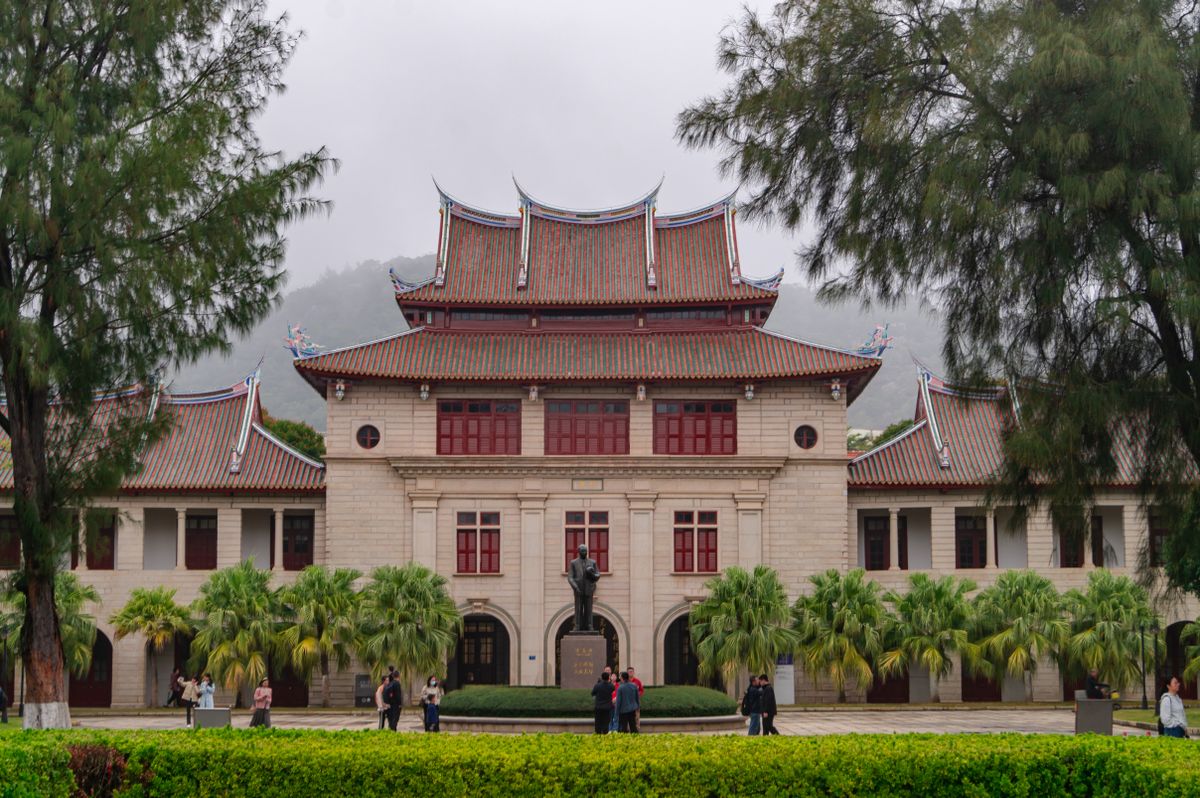
Xiamen University's Qunxian building with its distinctive red-tiled roof
What locals book, and why Zhongshan Road wins by default
Ask a Xiamen local where to put visiting relatives and most will say the same thing: somewhere within walking distance of Zhongshan Road Pedestrian Street. It's not the most atmospheric choice, the street itself is touristy and crowded by midday, but it solves three problems at once: proximity to the ferry (both the daytime and nighttime terminals), a dense cluster of restaurants covering everything from Fujianese oyster omelets to hot pot, and easy taxi or metro access to the airport, the train stations, and Xiamen University. Side streets just off Zhongshan Road and Siming Nan Lu, one block back from the main pedestrian strip, offer the same convenience with noticeably less noise at night.
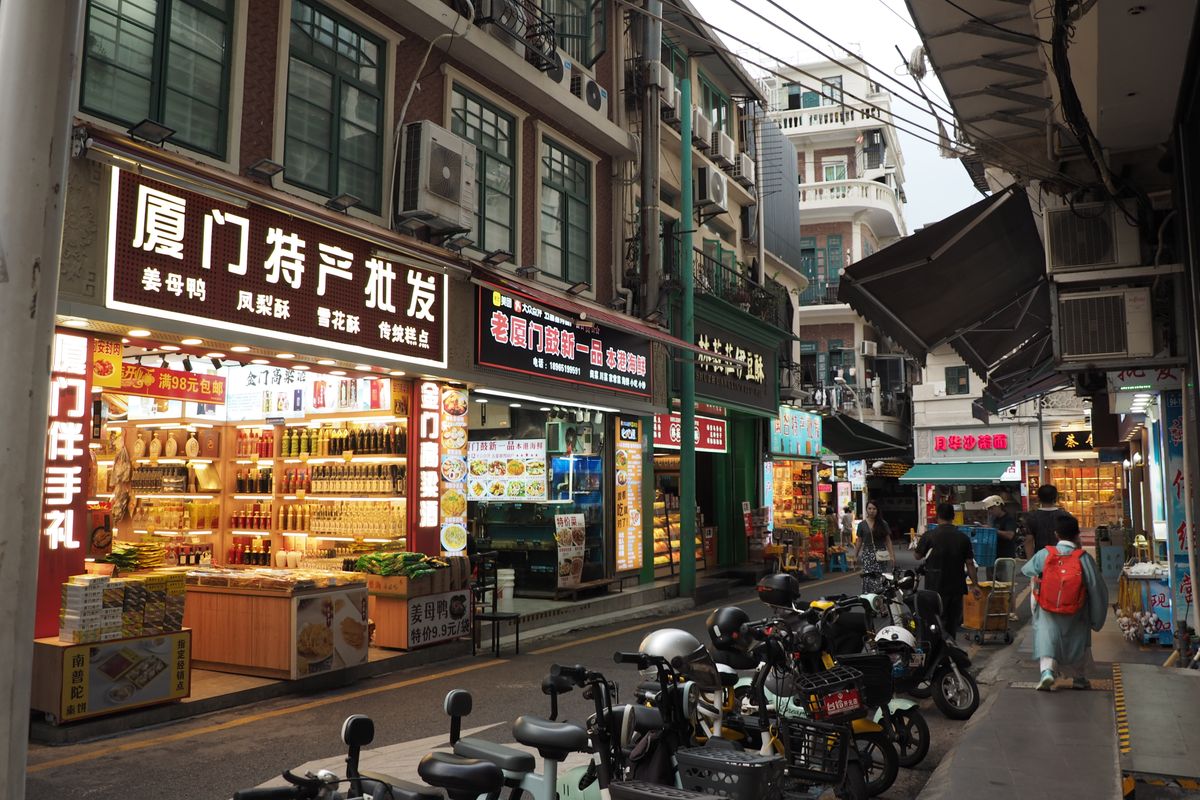
Street-level shops and scooters on a downtown Xiamen shopping street
Booking tips before you commit
- Search listings by "Zhongshan Road" or "Siming District" rather than just "Xiamen" to filter out hotels that are technically in the city but 40 minutes from anything useful.
- If a Gulangyu listing doesn't mention luggage assistance, email the hotel and ask; the walk from Neicuoao or Sanqiutian pier to some villas is 10-15 minutes uphill.
- Check whether your train ticket says "Xiamen Zhan" (Xiamen Zhan, downtown) or "Xiamen Bei Zhan" (Xiamen Bei Zhan, North station, Jimei) before choosing a hotel for train-day convenience.
- Book Gulangyu ferry tickets through the official WeChat channel a day or two ahead in peak season (summer, national holidays); walk-up capacity is limited and foreign passport slots sell out first on busy weekends.
- If you're combining Xiamen with other Fujian stops like Fuzhou or Quanzhou by high-speed rail, staying near a Metro Line 1 station (rather than deep in Siming's old lanes) shaves real time off the North Station run.
- Planning more than one Chinese city on this trip? Our where to stay in Suzhou guide covers a similar old-town-versus-new-district trade-off, and the general where to stay in China guide is a useful starting point for cities you haven't researched yet.
FAQ
Is it worth staying on Gulangyu Island overnight? Yes, if you value quiet evenings and don't mind carrying your own bags over car-free, sometimes hilly, cobblestone lanes. The island empties out after the last day-trip ferries around 17:00-18:00, and mornings before 8:30 are close to peaceful. If you'd rather have restaurant variety and a five-minute walk to the ferry, stay on the mainland side instead.
How do I get from Xiamen airport to Zhongshan Road? A taxi takes about 20 minutes and costs roughly ¥30-45. Metro Line 2 also runs from the airport into the island's core, with a change to reach the immediate Zhongshan Road area; budget 35-45 minutes door to door on the metro versus a taxi.
What time is the last ferry to and from Gulangyu Island? Daytime tourist ferries from the Dongdu/Xiagu terminal generally run until around 17:30 (October-May) or 18:30 (June-September). After that, service shifts to the Lundu terminal near Zhongshan Road, which runs roughly hourly through the night to Sanqiutian Pier. Times shift by season and are adjusted without much warning, so check the current schedule the day you travel.
Should I book a hotel near Xiamen North Railway Station? Only if you have an early or late high-speed train connection and want to avoid the 45-60 minute cross-city transfer. For sightseeing, shopping, or beach time, it's a poor base since it sits about 25-28 km from downtown with little around it besides the station itself.
Do I need to book Gulangyu ferry tickets in advance? Yes. Daytime tourist ferries require advance booking through the "Xiamen Ferry Plus" WeChat mini-program, with passport registration for foreign visitors. It isn't a walk-up ticket window system, so book at least a few hours ahead, and a day or two ahead during summer and national holidays.
Sources
- Kulangsu, a Historic International Settlement · UNESCO World Heritage Centre
- Gulangyu welcomes 340,000 visitors during National Day holiday · Xiamen Foreign Affairs Office
- First Wharf–Songyu Wharf City Ferry · Xiamen Port Administration
- Xiamen Municipal People’s Government Travel Tips · Xiamen Municipal People’s Government
- Public Service Domain English Translation Standard · Xiamen Municipal Administration for Market Regulation
- Xiamen Railway Station · TravelChinaGuide
- Xiamen North Railway Station · TravelChinaGuide