Beijing
Temple of Heaven, Beijing
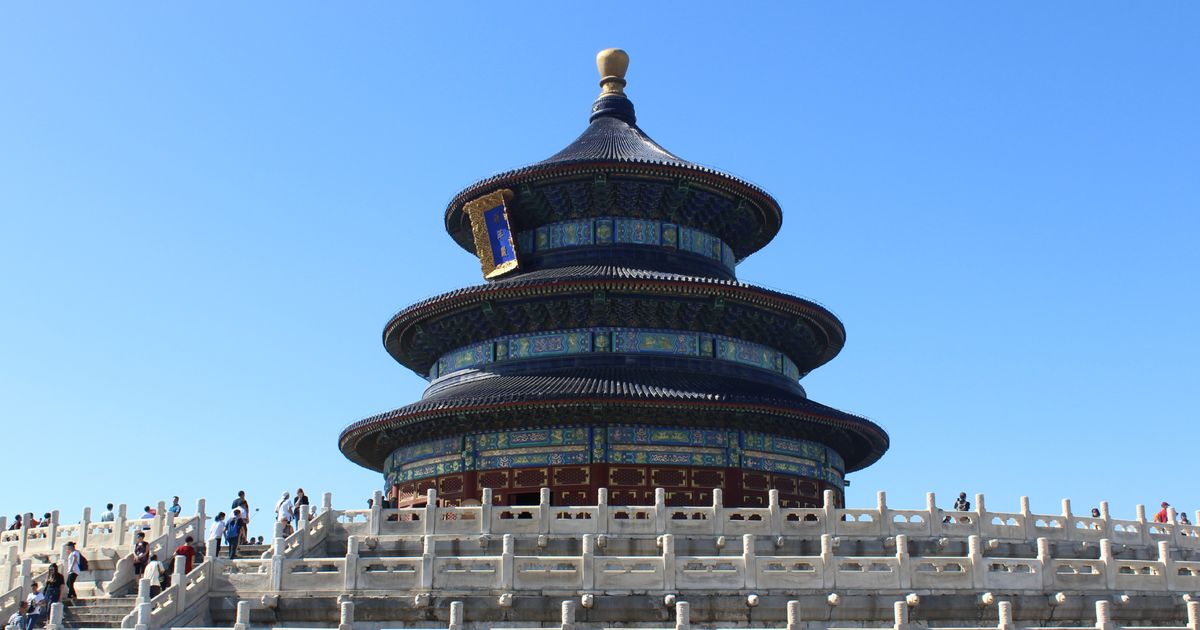
The Hall of Prayer for Good Harvests rising above its white marble terrace at the Temple of Heaven in Beijing
Arrive at the Temple of Heaven when the gates open and you will share it with Beijingers, not tour groups: tai chi circles under the old cypresses, choirs rehearsing in the Long Corridor, card games on the stone benches. The ticketed monuments stay shut until 8:00, so the first two hours belong to the park, which is how locals have always treated it. The monuments are the reason to come back at eight. Built in 1420 under the Ming Yongle Emperor and inscribed by UNESCO in 1998, this is where emperors of the Ming and Qing dynasties came each winter solstice to pray for good harvests.
The layout is half the meaning
The complex runs along a north-south axis that maps the relationship between Heaven and Earth. The southern altars are square (symbolising Earth), the northern halls round (symbolising Heaven), and the whole site is wrapped in a double wall rounded at the north and squared at the south. Add the deep blue roof tiles chosen to mirror the sky, and the Temple of Heaven reads unlike any palace or temple in the city. Walking south to north, from Earth toward Heaven, follows the original ceremonial order.
The three monuments
The icon is the Hall of Prayer for Good Harvests (Qinian Dian), a triple-eaved circular hall over 38 metres tall, built entirely of wood without a single nail and supported by 28 pillars representing the seasons, months, and hours of the day. To its south, the Imperial Vault of Heaven is a smaller round hall ringed by the Echo Wall, where a whisper can carry along the curved surface to the far side (it works best early, before the crowds drown it out). Furthest south lies the Circular Mound Altar (Yuanqiu), a three-tiered open marble platform whose central stone was believed to be the point where the emperor stood closest to Heaven.
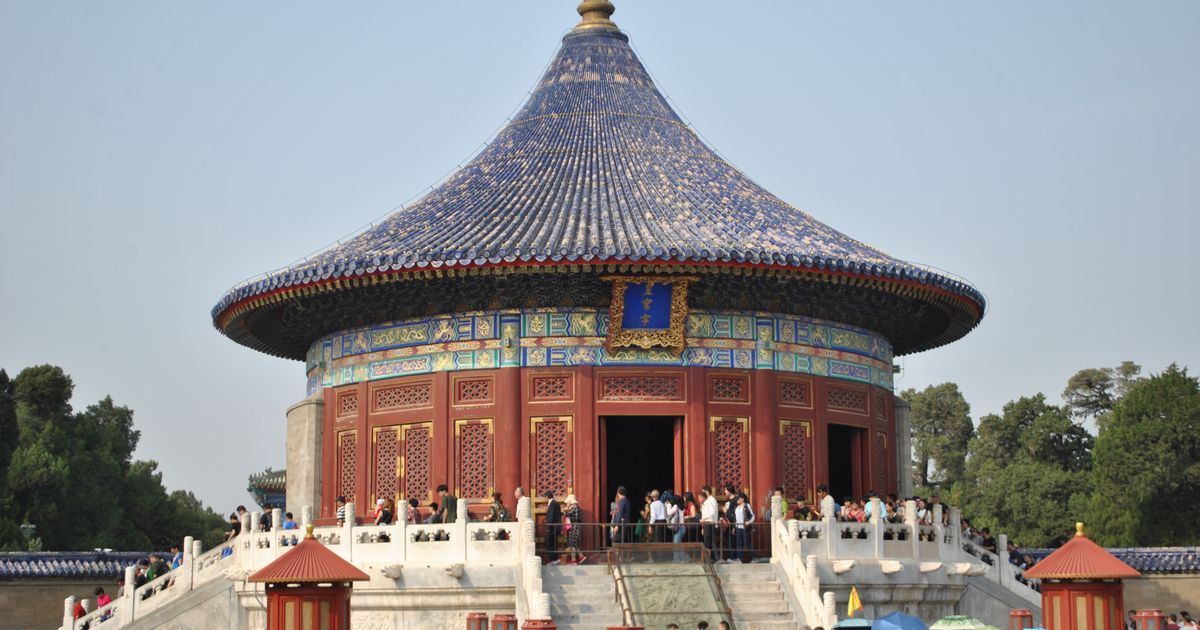
Worshippers and visitors gathered around the round Imperial Vault of Heaven inside the Temple of Heaven complex
Hours, and the Monday catch
The park keeps long hours: gates open at 6:00 in high season (April through October) and 6:30 in winter, closing at 22:00 with last entry around 21:00. The paid monuments run a shorter day, roughly 8:00 to 17:30 in high season and 8:00 to 17:00 from November to March, with last entry about 30 minutes before closing. The catch that trips up first-time visitors: the monuments are closed on Mondays (public holidays excepted) even though the park stays open. Details current as of July 2026; check the park's official channels before a special trip.
Tickets
Admission comes in two layers. A park-only ticket is cheap and covers the grounds; the through-ticket (liantong piao) costs a little more and adds all three major monuments, and it is the one most travellers want. Prices are modest and vary by season, so treat the gate price as current. You can usually buy at the gate, but in peak periods it is worth reserving a day ahead through the park's official WeChat mini-program, which links tickets to your passport number. If you would rather have it arranged in English, platforms such as Klook sell Temple of Heaven admission, often bundled with a guided walk.
Getting there
Take Beijing Subway Line 5 to Tiantan East Gate (Tiantandongmen); the exit puts you at the east entrance. Lines 7 and 8 stop within walking distance, and buses serve all four gates. From the city centre allow 20-30 minutes, plus honest walking time inside: the park is vast and the central halls sit a good ten to fifteen minutes from any gate.
When to go
Spring (April-May) and autumn (September-October) bring mild weather and the rose and cypress gardens at their best. Summer is hot and busy. Winter is cold, quiet, and true to the site's purpose: the solstice rites took place in the depths of winter. Whatever the month, mornings beat afternoons.
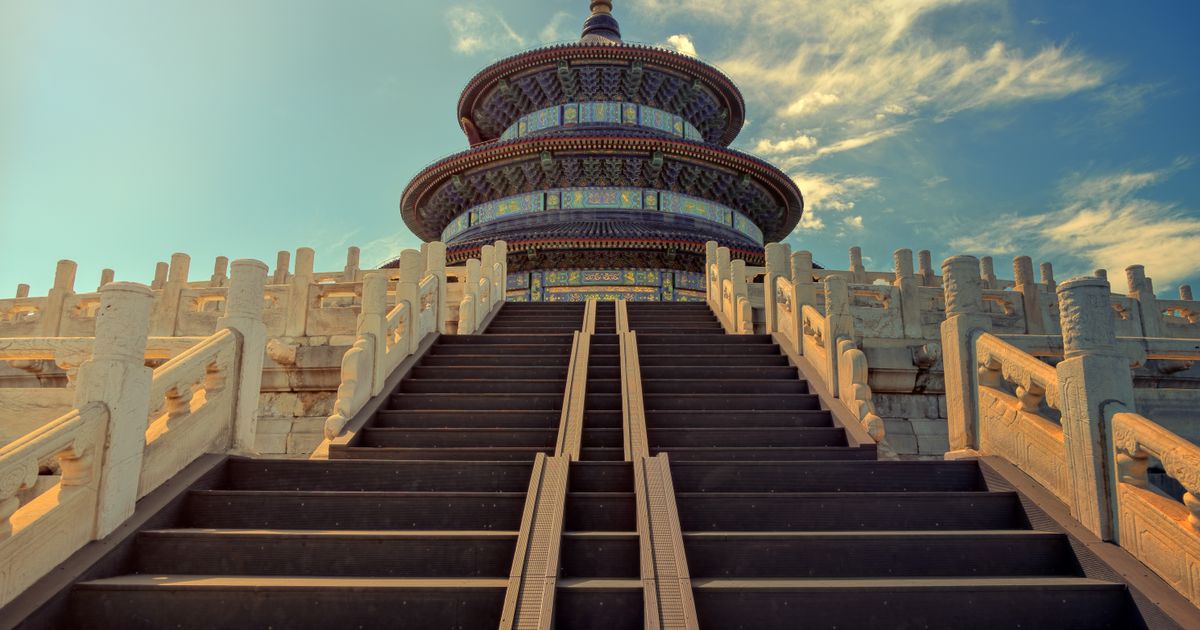
A long marble stairway leading up to the Temple of Heaven, framed by carved stone balustrades
Give it two to three hours: enter from the south gate, climb the Circular Mound Altar, test the Echo Wall, and finish at the Hall of Prayer for Good Harvests, saving the best for last.
Highlights
- Hall of Prayer for Good Harvests: a 38m triple-eaved wooden hall built without a single nail
- Echo Wall around the Imperial Vault of Heaven, where whispers carry along the curved surface
- Circular Mound Altar, the open marble platform where emperors stood closest to Heaven
- Deep-blue roof tiles and Heaven-and-Earth geometry of the whole UNESCO World Heritage site
- A vast cypress park where locals practise tai chi, calligraphy, and group dancing each morning
Travel Tips
Buy the through-ticket
The park-only ticket excludes the famous halls. The through-ticket costs only a little more and covers all three major monuments; treat the gate price as current.
Enter from the south gate
Start at the Circular Mound Altar and walk north to follow the original ceremonial axis from Earth toward Heaven.
Come early for local life
Arrive when the park opens (6:00 in high season, 6:30 in winter) to see Beijingers doing tai chi and dancing before the monuments open at 8:00.
Skip Monday for the halls
The three ticketed monuments close on Mondays except public holidays, though the park itself stays open.