Nanjing
Zhonghua Gate (Nanjing City Wall)
Most city gates are simply a way in. Zhonghua Gate was built to be a trap. The southern gate of Nanjing's Ming wall, and the largest castle-style gate still standing in China, it stacks three barbican courtyards one behind the next, so an attacker who smashed through the outer arch only found himself boxed inside a stone pen with defenders firing down from every side. Its original name was Jubao Gate, from the era when Nanjing served as the first Ming capital.
A killing box, not a doorway
The heart of the gate is the wengcheng, a set of three successive walled courtyards linked by arched passages that could each be sealed with a heavy drop-gate and timber doors. Cut into the thick walls are 27 vaulted chambers, the cangbingdong, used to store supplies and hide soldiers out of sight. By some accounts the gate could conceal as many as three thousand troops, ready to spring an ambush on anyone trapped in the courtyards. Walking the tunnels and climbing the horse ramps, where mounted soldiers once rode straight up to the ramparts, you get a sharp sense of how seriously the Ming took the defence of their capital.
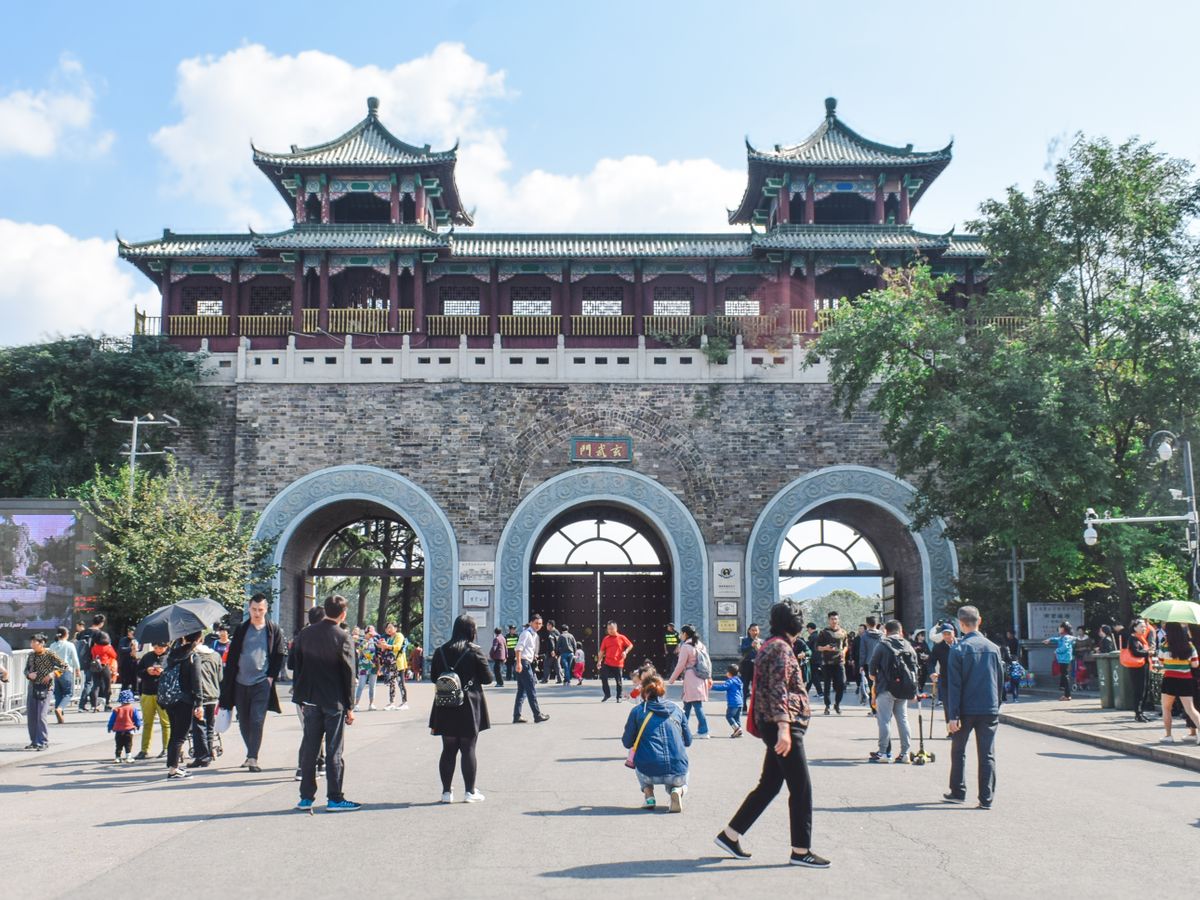
A monumental gate tower along the Nanjing Ming city wall
Onto the longest surviving city wall
Zhonghua Gate is also one of the best points to climb onto the wall itself. Nanjing's Ming wall ran more than 35 km when it was finished; the roughly 25 km that survive make it the longest existing city wall in the world. From the top you look over the moat, the modern skyline and the green ridges beyond. Take a close look at the bricks: most of the wall's nearly 100 million bricks were stamped with the kiln, the supervising official and the maker, so a faulty brick could be traced straight back to whoever was responsible. Many of those inscriptions are still legible today.
What to look for
Give yourself time to hunt for the inscribed bricks, to walk the ramps, and to stand inside one of the hidden chambers and picture the troops once packed in there. The mortar is worth knowing about too: Ming builders bound the brickwork with lime mixed with glutinous-rice water and tung oil, a recipe tough enough that long stretches have held for more than six hundred years while many other ancient walls crumbled.
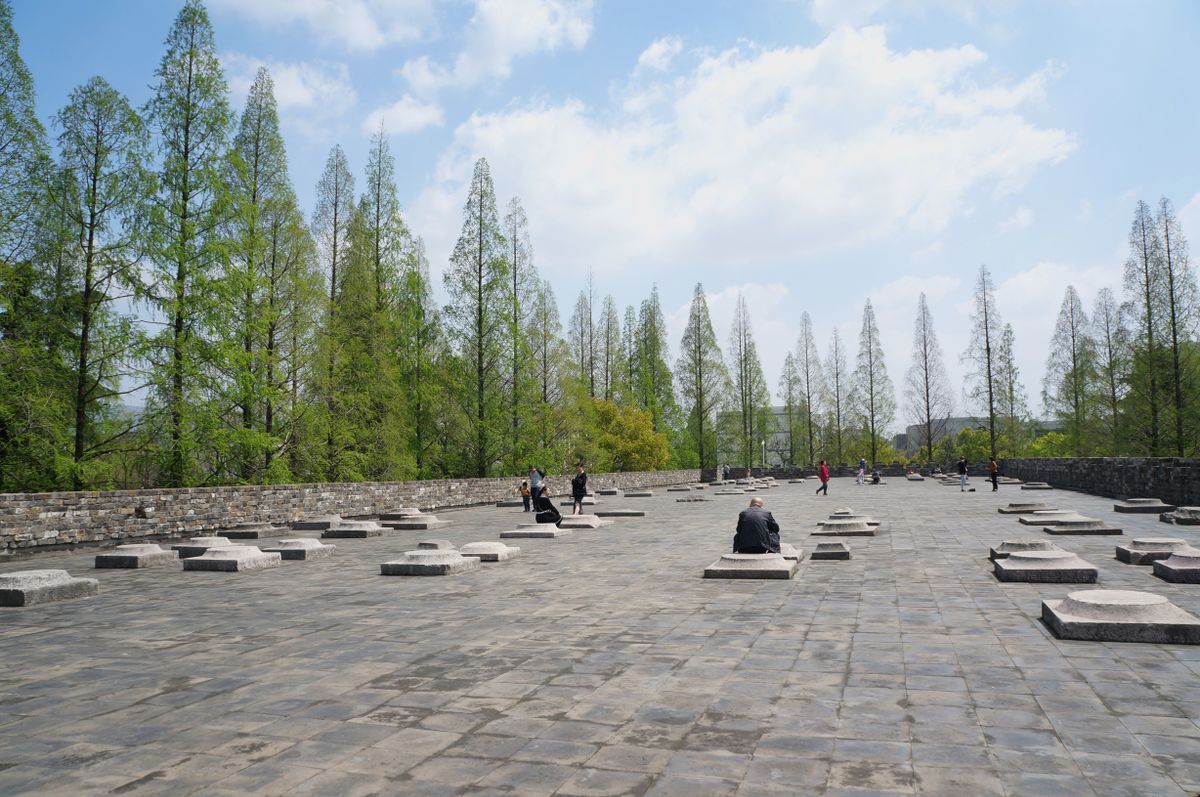
Ancient grey city wall and stone plaza under a blue sky
Visiting, hours and the night lights
The Zhonghua Gate and its wall section charge a modest entrance fee, usually bought on arrival. The gate opens through the day and, at its northern sections, stays lit into the evening, so you can see the ramparts glowing after dark. It is rarely as crowded as the Confucius Temple quarter nearby, which means you can explore at your own pace. Wear sturdy shoes, as the ramps and steps are steep and uneven, and carry water in summer, when the grey stone throws off heat.
Getting there and combining it
Metro Line 1 stops at Zhonghua Gate station, a short walk from the entrance. Allow an hour or two to do the fortress justice, more if you plan to walk a longer stretch of the wall. The Qinhuai River quarter and the Confucius Temple sit just to the north, so it is easy to fold the gate into a half day through the old south of Nanjing.
Highlights
- China's largest surviving castle-style city gate, once called Jubao Gate
- A three-courtyard barbican (wengcheng) with 27 hidden troop chambers
- Built 1360-1386 under the Ming founder, the Hongwu Emperor
- Climbs onto the world's longest surviving city wall, with moat and skyline views
- Nearly 100 million bricks stamped with their makers' names, an early quality-control system
- Ming mortar of lime, glutinous-rice water and tung oil that has held for 600+ years
Travel Tips
Hunt for the inscribed bricks
Many Ming bricks carry the names of the kiln, official and maker who produced them. Looking for legible ones turns a quick stop into a real exploration.
Come for the evening lights
The northern sections stay lit after dark, and the gate is far quieter than the nearby Confucius Temple quarter.
Wear sturdy shoes
The horse ramps and steps are steep and uneven. Bring water in summer, when the grey stone radiates heat.