How to Ride China's High-Speed Trains: E-Tickets, Boarding & Stations (2026)
Quick answer: On China's high-speed trains your passport is your ticket, so there is nothing to print and no machine to queue at. Arrive 30-45 minutes early for airport-style security, then scan the same passport you booked with to enter the gate, board, and exit.
First-time riders usually brace for the wrong problem: hunting down a ticket machine, fighting a queue in Chinese, fumbling with a paper stub at the gate. None of that happens. China's high-speed network is fully paperless, so your booking exists only as a record tied to your passport number, and that same passport gets you through the station door, onto the platform, and off at the other end. What catches people out is the station around the train, not the train itself: airport-style security, a wall of bilingual departure boards, and gates that only open once they have scanned you.
This guide walks the whole journey end to end: how the e-ticket system works, clearing security, finding your gate and seat, and what happens on board and on arrival, so your first ride feels routine.
How China's E-Ticket System Works
China's high-speed and intercity network has been fully paperless since 2019, running on what the railway calls a real-name system: every ticket is a database record tied to the exact passport number you booked with, not a physical object. When you buy through the official 12306 app or a third-party agent like Trip.com, the system links your reservation to that passport. There is nothing to print and no barcode to have ready on your phone.
Two things follow from this. First, you must travel on the same passport you booked with, matching the number exactly, a renewed or second passport will not open the gate. Second, it is worth saving a screenshot of your booking confirmation (train number, date, car and seat), because it tells you where to stand on the platform and gives staff something to check if a scanner ever misreads your passport.
If you have not booked yet, start with our full guide to booking China's high-speed trains, and if you plan to use the official app, see how to use 12306 in English.
Getting Into the Station and Through Security
Chinese rail stations run on airport-style security, so arrive early: budget 30 to 45 minutes at major hubs like Beijing South or Shanghai Hongqiao, and more during the Spring Festival and October Golden Week crowds, when lines grow well beyond the usual.
The flow is usually:
- Entrance ID check. At the door, show or tap your passport at the real-name verification lane; a guard may glance at your face against the photo.
- Security screening. Bags go through an X-ray and you walk through a metal detector, much like at an airport, though usually with less need to remove shoes or belts. Leave oversized power banks, lighters and knives at home.
- Into the concourse. You emerge into a large waiting hall lined with shops, with a big departure board overhead.
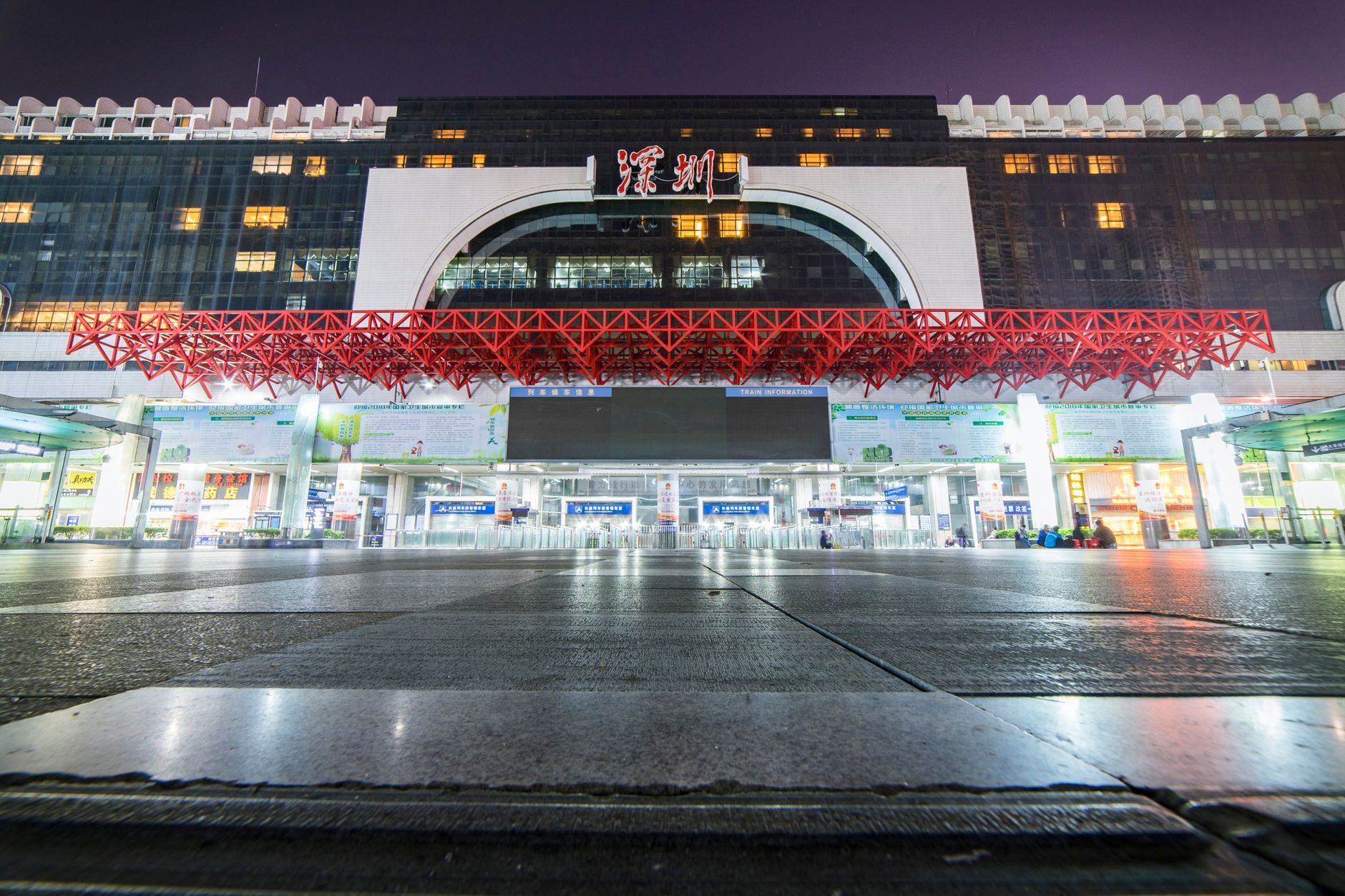
Shenzhen Railway Station lit up at night
Finding Your Gate, Platform, and Seat
Look up at the departure board (it alternates between Chinese and English): find your train number, a letter plus digits like G103, and read across for the gate or waiting area (ticket-check gate) and its status. "Check-in" or a flashing gate number means boarding is open.
- Boarding typically opens 15 to 20 minutes before departure and the gate stops checking passengers a few minutes early, often around 3 to 5 minutes before the scheduled time; high-speed trains leave exactly on time, so do not wander far once your gate is called.
- At the gate, place your passport photo-page-down on the reader and it opens automatically. Most stations still route foreign passport holders to a staffed manual lane (usually at one end of the gate line) rather than the facial-recognition gate built for Chinese ID cards, though a growing number of major hubs now also have a passport-reader lane built into the automatic gate. Either way, an attendant can wave you through in under a minute if the scanner does not cooperate.
- Walk down to the platform, match the car number painted on the train to the number marked on the platform floor, and board. Your car and seat are on your booking, for example "Car 7, 14F", where the letter tells you window versus aisle (our seat classes guide breaks down what each letter means).
Seats come in Second, First and Business class; if you are unsure which to pick, that same guide compares comfort and space across all of them.

Soaring glass roof of the Tianjin West Railway Station concourse
On Board and Arriving
Stow large luggage on the racks at the end of each car and smaller bags overhead; there are power outlets at most seats and a hot-water dispenser in every carriage for tea and instant noodles. Onboard Wi-Fi exists on many trains, but it usually needs a Chinese-language app and a mainland phone number to activate, so treat it as a bonus rather than a plan; bring your own data if you need to stay connected. Screens and announcements give the next stop in Chinese and English, but it is worth counting stations yourself, since dwell times at intermediate stops are short, commonly just 2 to 5 minutes depending on the station.
When your stop is announced, gather your things and move toward the doors early. At the destination you exit by scanning the same passport at the arrival gates, or via the manual lane. That is it: no ticket to surrender and no extra step.
A quick first-ride checklist:
- Arrive 30 to 45 minutes early; more on holidays.
- Carry the exact passport you booked with.
- Note your train number, gate, car, and seat before security.
- Be at the gate when boarding opens; it stops checking a few minutes before departure.
Wondering how soon you can buy these tickets? See how far in advance to book China train tickets.
Frequently Asked Questions
Do I need to print my China train ticket or collect it from a machine? No. China's high-speed rail has been fully paperless since 2019. Your ticket is a database record linked to the passport you booked with, so there is nothing to print and no machine to queue at on the day. Bring that same passport, optionally save a screenshot of your booking, and scan the passport at the gate to get in and out.
How early should I arrive at the station? Plan for 30 to 45 minutes at major stations, since you clear airport-style security (a bag X-ray and an ID check) before reaching the waiting hall and gates. During the Spring Festival travel rush and October Golden Week, arrive earlier still, as lines and crowds grow significantly. Boarding usually opens 15 to 20 minutes before departure and stops a few minutes early.
What if the passport scanner at the gate does not work? Stations keep a staffed manual lane, usually at one end of the gate line, for when an automated gate cannot read a foreign passport. Walk over, hand your passport to the attendant, and they verify your booking and let you through, normally in under a minute.
How do I find my train and platform inside the station? Look at the large overhead departure board, which alternates between Chinese and English. Find your train number (such as G103), then read across to your gate or waiting area and its status. When it shows check-in, head to that gate, scan your passport, and walk down to the platform, matching the car number on the train to the number marked on the platform floor.
Is my passport all I need to board? Yes. The passport you booked with is your ticket, your station entry pass and your boarding credential all in one, thanks to the real-name ticketing system. Carry it (the number must match your booking exactly), plus optionally a screenshot of your e-ticket. You do not need a paper ticket or a phone barcode to ride.
Common mistakes
- Booking with one passport and traveling on another. The ticket is tied to the exact passport number you booked with, so a renewed or second passport will not open the gate. Always carry the same document.
- Arriving too late for security. Stations run airport-style screening; cutting it to 15 minutes at a hub like Beijing South or Shanghai Hongqiao, especially during Spring Festival or Golden Week, can mean missing a train that leaves exactly on time.
- Wandering off after boarding opens. The gate stops checking passengers a few minutes before departure, not at departure. Be at your gate when it opens 15-20 minutes out.
- Counting on onboard Wi-Fi. It often needs a Chinese-language app and a local phone number to activate, so it is not a reliable fallback if you need to be online.
Who this is for
This guide is for first-time visitors taking a Chinese high-speed train on a foreign passport who want to know exactly what happens at the station, security, gates, seats, before they go. It is most useful if you have already booked, or are about to, and feel unsure about the in-station steps.
You can skip it if you are a frequent China rail traveler who already navigates 12306 and the gates with ease, or if you have not yet decided whether to book at all, in that case, start with our booking guide first.
Compare travel options
Check current availability and terms
Some links are affiliate links; we may earn a commission at no extra cost to you.
Sources
- China Railway 12306 (official online ticketing, English) · China State Railway Group (12306)