How to Book China's High-Speed Trains (12306 & Trip.com): 2026 Guide
Quick answer: Foreigners can book China's high-speed trains either on the official China Railway 12306 app/site (no fee, but requires a passport identity-verification step first) or on Trip.com (small service fee, no separate verification). Your passport is your ticket: China rail is fully paperless.
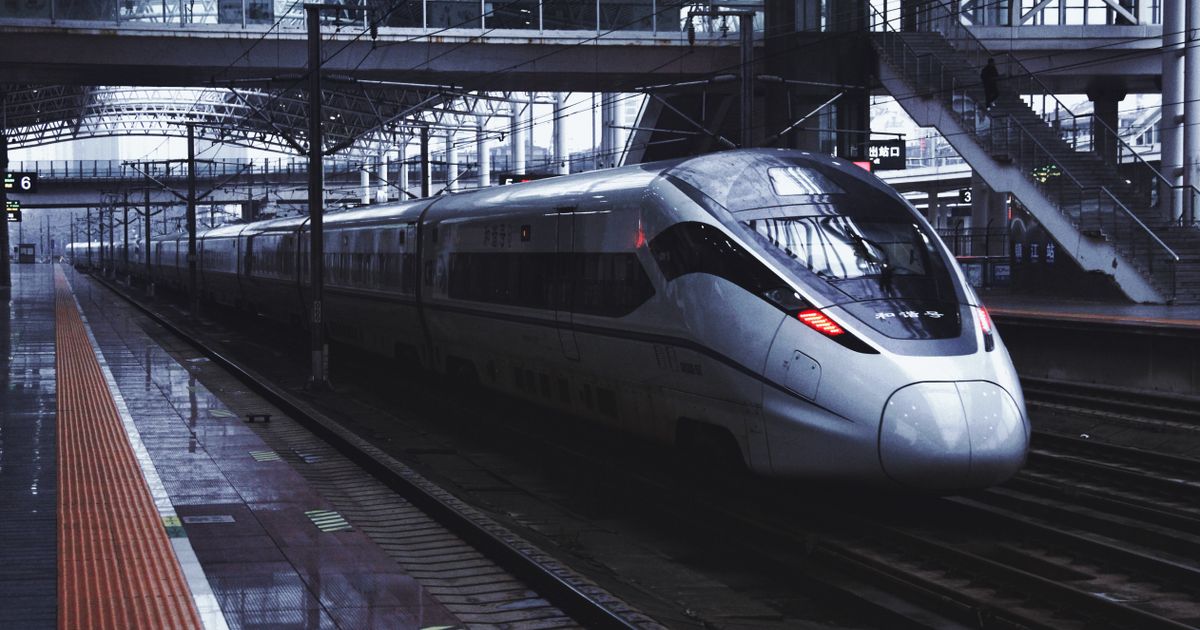
Two things surprise first-time visitors booking a Chinese train: how fast the network is, and how little paperwork it takes. A Fuxing or CRH bullet train covers Beijing to Shanghai, roughly 1,300 km, in about four and a half hours at speeds topping 350 km/h. And once you have booked, there is nothing to print: no paper ticket, no QR code, just your passport, which doubles as your boarding pass all the way from purchase to platform.
This guide walks you through the two ways to book, what to expect at the station, how seat classes and refunds work, and a final checklist so you can buy with confidence.
Sleek silver Chinese high-speed train waiting at a covered station platform
Two Ways to Book: 12306 vs Trip.com
There are two realistic options for foreign travelers, and the right choice depends on how much time you have before your trip.
China Railway 12306 is the official platform run by the national rail operator. Register on the English site or app at 12306.cn/en with your passport details; it asks for an email address rather than a mainland Chinese phone number, which is the detail that trips up travelers who start on the Chinese-language version instead. Registration itself is free and you pay the exact official fare, with foreign Visa, Mastercard, and Amex cards accepted (Alipay and WeChat Pay too, if you already have them set up).
The catch is identity verification, and it runs one of two ways. Most entries clear automatically within minutes once the system cross-checks your name, nationality, and passport number. If that automatic match fails, which happens often because foreign names get formatted inconsistently, you drop into manual review: upload a photo of your passport's bio page plus a selfie of yourself holding that same passport, and a staff member checks it by hand. China State Railway has said manual review normally takes three to five working days, sometimes closer to two weeks in busy periods, since mismatched foreign-name entries are what slow the automatic check down. You cannot buy a ticket while verification is pending, so register as soon as you know your travel dates, not the week you fly.
Trip.com is a third-party travel site with a polished, fully English experience and 24/7 customer support. It books on your behalf through an official channel, so there is no separate verification queue, and it accepts international cards directly in your home currency. The trade-off is a small per-ticket service fee, generally a tens-of-yuan amount shown before you confirm, well under the price of the seat itself. For first-timers, short trips, or anyone who wants a no-friction experience, this is often the easier route.
| Feature | China Railway 12306 | Trip.com |
|---|---|---|
| Language | English mode (Chinese-first defaults) | Fully English-first |
| Booking fee | None (official fare only) | Small fee, shown at checkout |
| Payment | Visa, Mastercard, Amex; Alipay/WeChat | International cards, home currency |
| Identity check | Passport upload + verification first | Handled for you, no separate review |
| Ease for first-timers | Moderate; some rough edges | Easiest, with English support |
| Best for | Long stays, frequent travel, zero fees | Quick trips, first-timers, convenience |
Whichever you choose, you will need the official 12306 app eventually if you ever change or refund a ticket yourself. To get the booking apps set up before you fly, see our guide to the essential apps for China.
Book trains on Trip.com
English app · foreign Visa/Mastercard · 24/7 support · small per-ticket fee
Some links are affiliate links; we may earn a commission at no extra cost to you.
Your Passport Is Your Ticket
Since China moved fully paperless, there is no printed ticket and no QR code to scan from your phone. When you book, your reservation is digitally linked to your passport number. That is the only document you need at the station.
Vast modern Chinese railway station concourse with a sweeping arched glass roof
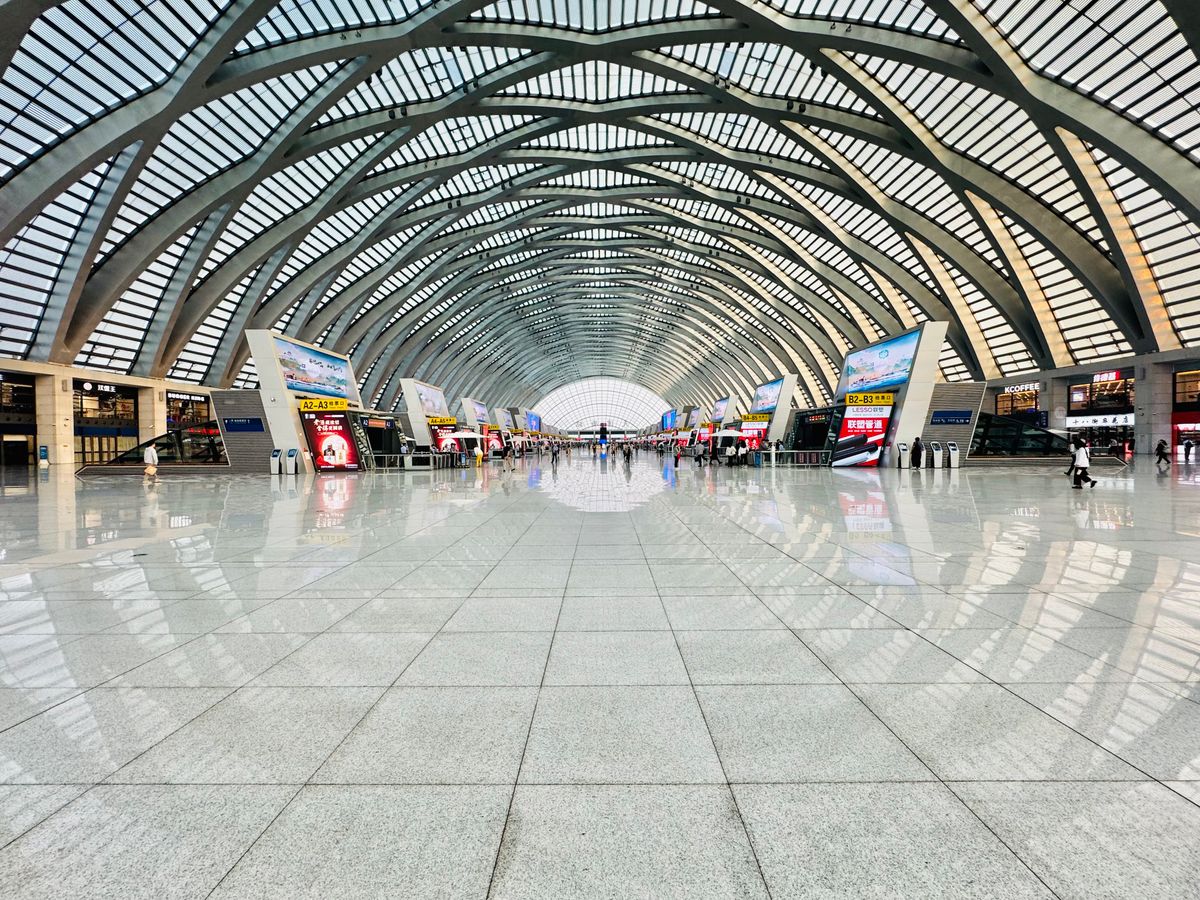
At the gate, foreign passport holders usually use a dedicated passport reader at one end of the gate line: place the photo page face-down on the scanner and the gate opens. Automated facial-recognition gates often struggle with foreign passports, so most stations also keep a staffed manual lane (typically at the far left or right). If the reader does not work, walk to the manual booth, show your passport, and an attendant will verify your booking and wave you through. It usually adds no more than a minute.
A few practical notes:
- Carry the same passport you booked with; the number must match exactly.
- Keep a screenshot of your booking confirmation handy in case staff want to cross-check.
- At big hubs like Beijing South or Shanghai Hongqiao, allow extra time for the manual lane.
Booking Window, Seat Classes, and the Network
Booking window. Tickets typically go on sale about 15 days before departure, with the exact daily release time varying by departure station (for example Shanghai at 14:30, Guangzhou at 11:00), so check your station's sale start time. Some short intercity (C) routes may open a little later and certain sleeper services a little earlier, so check your specific train. Popular corridors sell out fast, and during the Spring Festival travel rush and the October Golden Week holiday, seats can vanish within minutes of release. If you are travelling around those dates, set a reminder and book the moment the window opens.
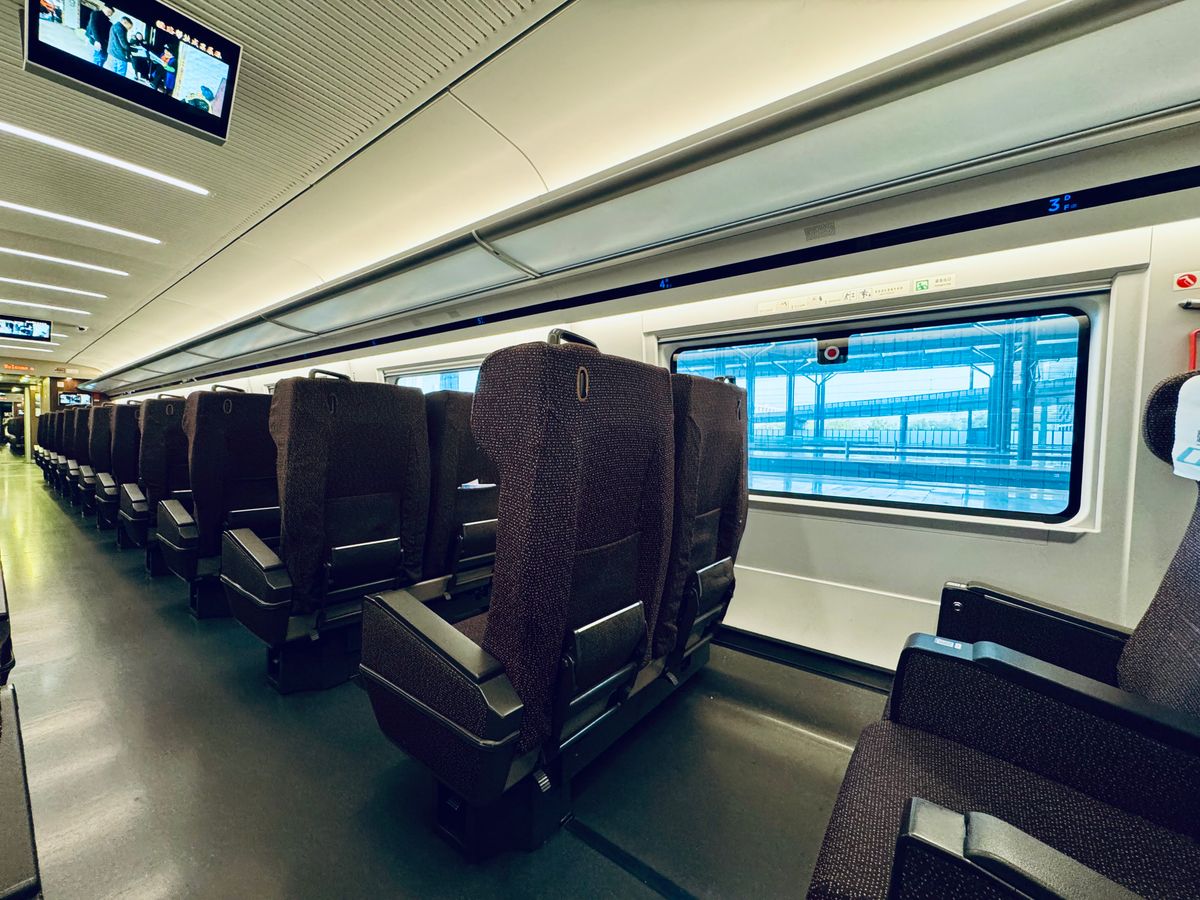
Seat classes. Most high-speed trains offer three tiers:
- Second Class - the standard, great-value option, arranged in a 3+2 layout with power outlets and ample legroom.
- First Class - roomier 2+2 seating with a bit more recline and quieter carriages.
- Business Class - the premium tier, with wide seats that recline almost flat, plus extra amenities; on some Fuxing services a "Premium First Class" sits between First and Business.
Interior of a modern Chinese high-speed train with rows of reclining seats beside a large window
The network. The high-speed fleet is branded Fuxing (the newest domestically designed trains) and CRH (Harmony). Flagship routes include Beijing-Shanghai, Beijing-Guangzhou, Shanghai-Xi'an, and the Guangzhou-Shenzhen-Hong Kong line. Trains are numbered by letter: G (fastest), D (fast), and C (intercity).
Refunds, Changes, and Arriving at the Station
Plans change, and the rules are reasonable. As a general guide, cancelling with about a week or more still on the clock is free. Cancel inside that final week and a modest fee applies, one that climbs the closer you get to departure and tops out at a small share of the fare, well under half, inside the last 24 hours. Rebooking a ticket onto a new date that falls inside the Spring Festival rush is charged at that top rate no matter how early you make the change. Changes usually carry a small fee, and a ticket can normally only be changed once, so choose the new date carefully. Fee schedules are adjusted periodically, so always confirm the current numbers in your booking app before you commit.
When you travel, arrive early. Stations run airport-style security with bag X-ray and an ID check before you even reach the gates. Budget 30-45 minutes at major hubs, more during holidays. Once inside, find your platform on the departure board and head down when boarding opens, usually around 15-20 minutes before departure. Gates close a few minutes before the train leaves, and high-speed trains depart exactly on time.
For paying for snacks, taxis, and everything else on your trip, read our guide to paying in China.
Your China Train Booking Checklist
- Pick your platform. Short trip or first-timer? Use Trip.com. Longer stay or want zero fees? Register on 12306 early.
- Verify in advance. On 12306, complete passport verification well before you need to buy.
- Watch the window. Tickets open about 15 days out (release time varies by station); book holidays the second they release.
- Choose your seat. Second Class is the sweet spot; upgrade to First or Business for long hauls.
- Book with the right passport. The number must match the one you will travel on.
- Save your confirmation. Screenshot it for the manual lane.
- Arrive 30-45 minutes early. Clear security, find the gate, scan your passport, and enjoy the ride.
With a little preparation, China's high-speed trains are one of the most effortless parts of any trip - fast, punctual, and remarkably easy once you know the drill.
Related Train Guides
Plan the rest of your rail trip with these companion guides:
- How to use 12306 in English - register and buy on the official app step by step.
- How far in advance to book China train tickets - the 15-day booking window and daily release times.
- How to ride China's high-speed trains - e-tickets, security, and boarding from station to seat.
- China train seat classes explained - Second, First, Business, and sleepers compared.
- China high-speed train types (G, D, C) explained - what the letters mean and how fast each is.
- What to do when China train tickets are sold out - standby and backup tactics for peak dates.
- China Rail Pass for Foreigners - why an all-you-can-ride China rail pass doesn't exist, and what to book instead.
- China Train Luggage Allowance - weight and size limits for carry-on bags on Chinese trains.
- China Train Network Map - how to read the high-speed network and plan a multi-city route.
- China Train Wifi - real on-board wifi speeds and a backup connectivity plan.
- Fastest Train in China - the Fuxing's 350 km/h record and where it runs.
- Shanghai Maglev Train - speed, price, and whether the airport maglev is worth riding.
- Trip.com vs 12306 - a head-to-head on which platform to book with.
Popular routes:
- Beijing to Chengdu Train
- Beijing to Datong Train
- Beijing to Guilin Train
- Beijing to Hangzhou Train
- Beijing to Harbin Train
- Beijing to Lhasa Train
- Beijing to Pingyao Train
- Beijing to Qingdao Train
- Beijing to Shanghai Train
- Beijing to Shenyang Train
- Beijing to Tianjin Train
- Beijing to Xi'an Train
- Changsha to Zhangjiajie Train
- Chengdu to Chongqing Train
- Chengdu to Leshan Train
- Chengdu to Lhasa Train
- Dali to Lijiang Train
- Guangzhou to Guilin Train
- Guangzhou to Hong Kong Train
- Guangzhou to Lhasa Train
- Guangzhou to Shenzhen Train
- Guangzhou to Xiamen Train
- Guangzhou to Zhangjiajie Train
- Guilin to Yangshuo Train
- Hangzhou to Suzhou Train
- Hong Kong to Guilin Train
- Kunming to Dali Train
- Kunming to Lijiang Train
- Nanjing to Suzhou Train
- Shanghai to Chengdu Train
- Shanghai to Guilin Train
- Shanghai to Hangzhou Train
- Shanghai to Huangshan Train
- Shanghai to Lhasa Train
- Shanghai to Nanjing Train
- Shanghai to Qingdao Train
- Shanghai to Suzhou Train
- Shanghai to Wuxi Train
- Shanghai to Xiamen Train
- Shanghai to Zhangjiajie Train
- Shenzhen to Hong Kong Train
- Xi'an to Chengdu Train
- Xi'an to Lanzhou Train
- Xi'an to Zhangjiajie Train
- Xining to Lhasa Train
Common mistakes
- Leaving 12306 identity verification to the last minute. Automatic checks clear in minutes, but manual review (needed when the automatic match fails) normally takes three to five working days and can stretch toward two weeks in busy periods. You cannot buy a ticket while it is pending, so register the moment you decide to go.
- Assuming you can book the same day on a peak route. Tickets open about 15 days out and Spring Festival / Golden Week corridors sell out within minutes of release; missing the daily release time (it varies by station) often means no seats.
- Travelling on a different passport than the one you booked with. The booking is digitally linked to that exact passport number; a renewed or second passport will fail at the gate.
- Arriving like it's a metro. Stations run airport-style security and ID checks; budget 30–45 minutes at major hubs, and remember gates close a few minutes before departure and trains leave exactly on time.
- Heading straight for the facial-recognition gate. Those auto-gates often reject foreign passports; use the dedicated passport reader or the staffed manual lane instead.
Who this is for
This guide is for international visitors planning intercity travel in China who want to book high-speed (G/D/C) trains themselves and understand fares, seat classes, and refunds before they go. It is especially useful if you are deciding between the official 12306 platform and Trip.com, or travelling during peak holiday periods.
Skip this if… you are only riding city metros or buses (no advance booking needed), you are booking through a tour operator or hotel concierge who handles tickets for you, or you already have a verified 12306 account and have booked Chinese trains before.
Frequently Asked Questions
Can foreigners book China train tickets on 12306? Yes. Register on the English site or app (12306.cn/en) with an email address; a mainland Chinese phone number is not required there, and there is no booking fee. Most passport details verify automatically within minutes; if the automatic check fails, which is common with foreign names, you move to manual review (a passport photo plus a selfie holding it), which China State Railway says normally takes three to five working days and can run closer to two weeks when volumes are high. You cannot buy until verification clears, so register well before you need tickets. If you would rather skip the queue, Trip.com books on your behalf through an official channel for a small service fee.
How far in advance can I book China high-speed train tickets? Tickets typically go on sale about 15 days before departure, with the exact daily release time varying by departure station (for example Shanghai at 14:30, Guangzhou at 11:00). Some short intercity (C) routes may open a little later and certain sleeper services a little earlier, so check your specific train. Popular routes and holiday periods like the Spring Festival rush and October Golden Week can sell out within minutes, so book the moment the window opens.
Do I need a printed ticket, or is my passport enough? Your passport is your ticket. China is fully paperless, so there is no printed ticket and no QR code to scan; your reservation is digitally linked to your passport number. At the gate you scan that same passport at a dedicated reader, or use a staffed manual lane if the reader struggles. Always carry the exact passport you booked with, since the number must match.
What is the difference between the China train seat classes? Most high-speed trains offer three tiers. Second Class is the standard, great-value option in a 3+2 layout with power outlets and ample legroom; First Class has roomier 2+2 seating with more recline and quieter carriages; and Business Class is the premium tier with wide, nearly flat-reclining seats and extra amenities. On some Fuxing services a "Premium First Class" sits between First and Business.
What is the refund and change policy for China train tickets? As a general guide, cancelling with about a week or more before departure is free. Cancel inside that final week and a modest fee applies that climbs the closer you get, topping out at a small share of the fare inside the last 24 hours. Rebooking onto a date inside the Spring Festival rush is charged at that top rate no matter how early you make the change. Changes usually carry a small fee and a ticket can normally only be changed once, so always confirm the current numbers in your booking app, as fee schedules are adjusted periodically.
Sources
- 12306 China Railway (official ticketing portal) · China Railway (China State Railway Group)