Chongqing
Dazu Rock Carvings
Cliff carvings at the Dazu Rock Carvings
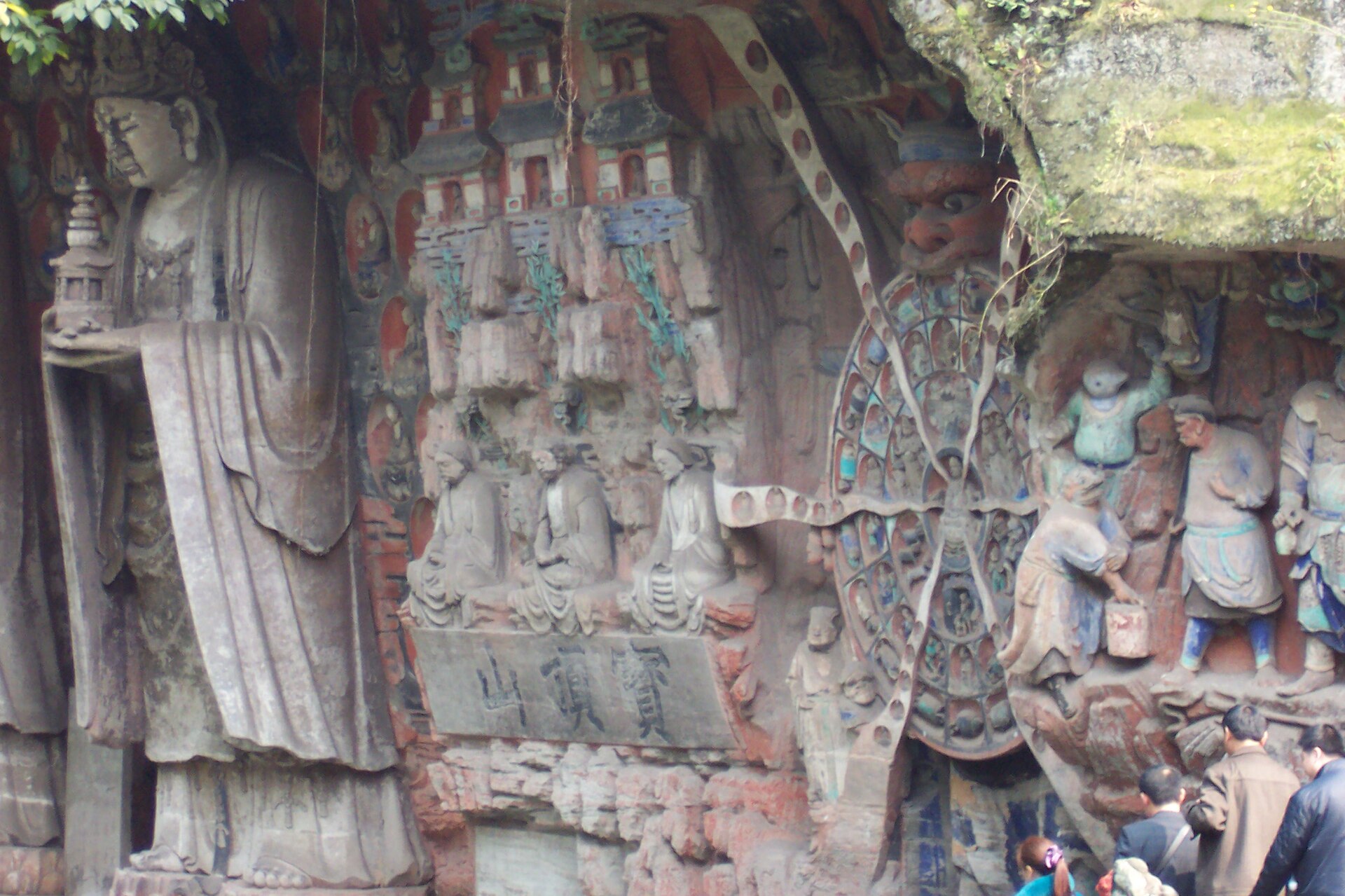
Most of China's famous cliff shrines, at Yungang or Longmen, are austere rows of Buddhas cut a thousand years earlier. Dazu is the opposite. The carvings here are later, mostly 9th to 13th century, crowded with characters and openly meant to teach. More than 50,000 figures cover the sandstone cliffs of Dazu District, roughly 1.5 to 2 hours west of central Chongqing (Dazu Rock Carvings), and plenty still hold flecks of their original paint. UNESCO listed them in 1999, singling out the mix of Buddhist, Daoist and Confucian imagery in one place, which is unusual anywhere in China.
Baodingshan, and why it's the one cluster to see
If you visit only one part, make it Baodingshan (Baoding Mountain), a horseshoe gorge whose walls the monk Zhao Zhifeng planned as a single illustrated sermon over roughly 70 years. The centrepiece is the gilded Thousand-Hand Guanyin: 1,007 individually carved arms, an eye set in each palm, sheathed in gold leaf. It came through an eight-year restoration that finished in 2015, so what you see is close to its intended state rather than a weathered ruin. Nearby a 31-metre reclining Sleeping Buddha stretches along the cliff, while a "Wheel of Life" and tableaux of heaven and hell read like folk theatre carved in rock.
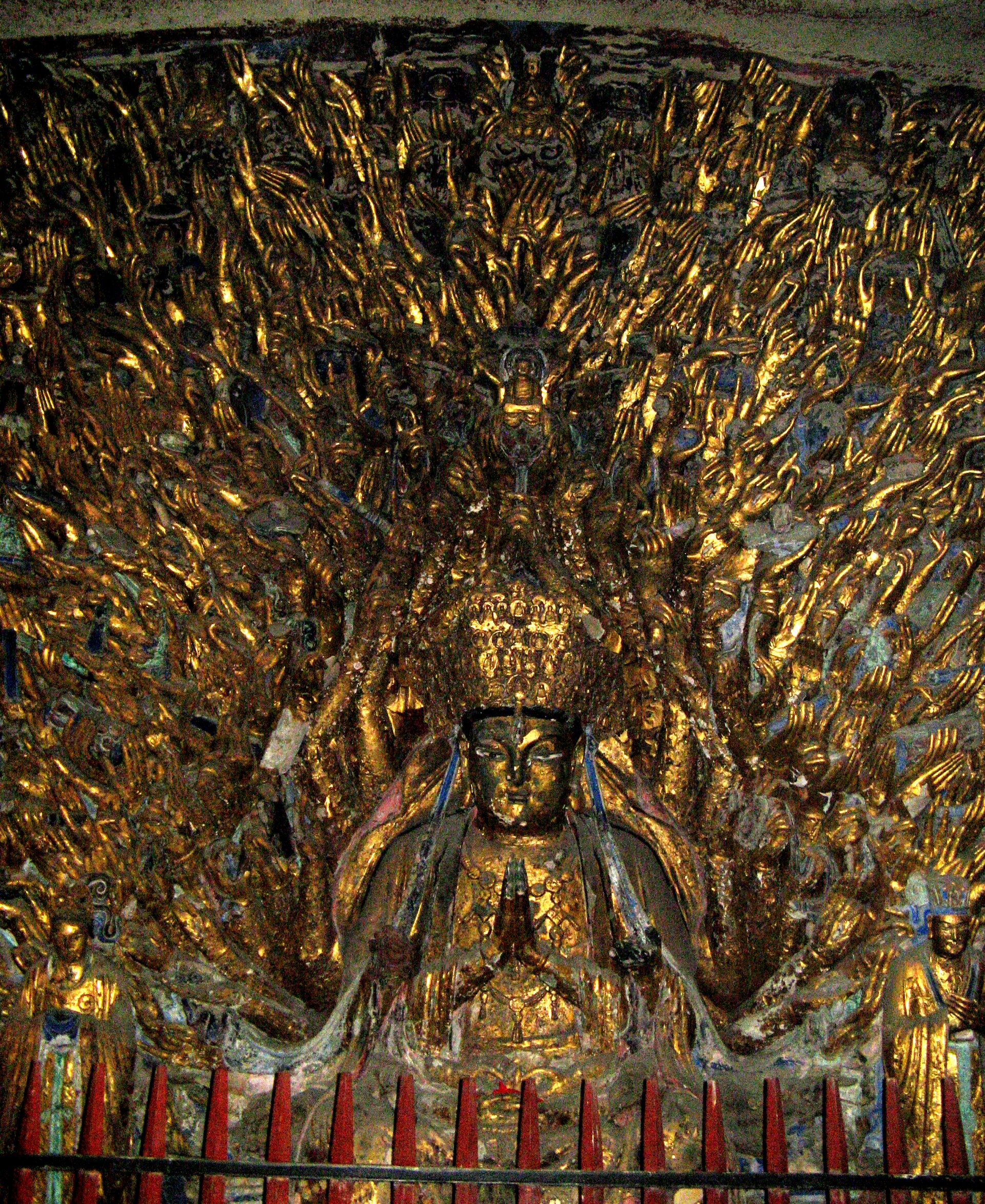
The gilded Thousand-Hand Guanyin at Dazu
Beishan, the quieter counterpoint
With more time, Beishan (North Hill) rewards a look. It's older than Baodingshan in parts, carved across roughly the late Tang through Southern Song dynasties (late 800s to mid-1100s), and packs nearly 10,000 figures into a walkable stretch of niches centred on Dafowan, with smaller clusters at Guanyin Slope, Buddha Ear Rock and the North Tower Temple site nearby. The carving here is finer-grained and more intimate than Baodingshan's big theatrical scenes: elegant Song-dynasty bodhisattvas, delicate drapery, less crowded galleries. A walk through takes about an hour, so budget one to two hours total including the approach. Nanshan and Shimenshan, further out, fill in the story but are usually skipped on a day trip. Most visitors give their hours to Baodingshan and Beishan and leave it there.
Getting there, and the catch nobody mentions
High-speed trains from Chongqing West or North reach Dazu South in around half an hour, which sounds easy until you learn the station sits far from the carvings, on the order of 40 km out. From Dazu South, a tourist shuttle bus to Baodingshan runs roughly every 50 minutes between around 6:30am and 6pm, with the ride itself taking about 40 minutes; a taxi covers the same leg in roughly 30 minutes if the shuttle timing doesn't line up. Direct long-distance buses from Chongqing's Caiyuanba and other terminals drop you closer to Dazu town instead. Because of that gap, a round-trip day tour from Chongqing is a reasonable call if you would rather not stitch the legs together yourself.
Dazu day trips from Chongqing
Round-trip transport plus a guide to decode the carvings
Some links are affiliate links; we may earn a commission at no extra cost to you.
Hours, tickets and when to go
Baodingshan opens in the morning and stops admitting new visitors in the mid-to-late afternoon, and the exact cutoff and hours shift with the season, so confirm the day you plan to go. The separate Dazu Rock Carvings Museum closes on Mondays. Tickets run higher in the peak months (roughly March to November) and drop in winter, and a combined Baoding-plus-Beishan ticket is sold; treat any price you see quoted online as indicative and check at the gate or on the official booking channel. Booking online a day or two ahead is increasingly the normal way to secure a slot, especially in peak season, and it also lets you skip the on-site ticket queue. Set aside two to three hours for Baodingshan alone.
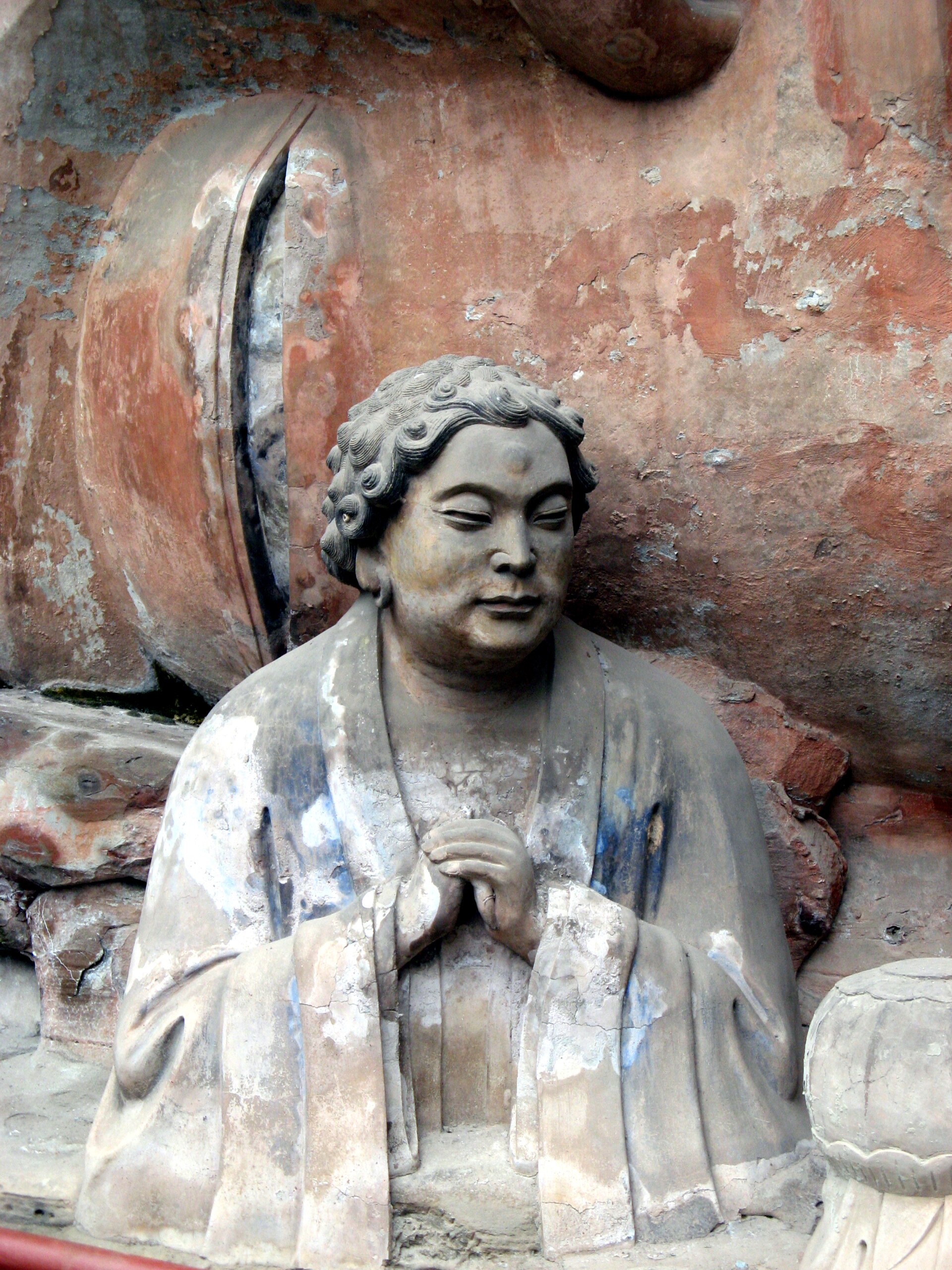
Detailed stone figure among the Dazu carvings
Practical tips
Take a guide or an audio guide. The carvings are dense with stories, karma tales, filial-piety scenes, punishments in hell, that you will walk straight past otherwise. Come in the morning for cooler air and thinner crowds; the gorge holds shade in summer. Photography is fine, but tripods and flash may be restricted beside the most fragile painted figures. If you're combining sites, the Baoding-Beishan combined ticket is worth checking before you buy two separate ones. Pair Dazu with a night or two in Chongqing rather than forcing both into one long day.
Highlights
- Over 50,000 cliff figures, mostly carved 9th to 13th century, UNESCO-listed since 1999
- Baodingshan's gilded Thousand-Hand Guanyin: 1,007 arms, restored over eight years to 2015
- A 31-metre reclining Sleeping Buddha and a 'Wheel of Life' told like folk theatre
- Beishan's nearly 10,000 finer-grained figures across five niche clusters, late Tang to Southern Song
- Buddhist, Daoist and Confucian imagery side by side, rare in Chinese rock art
Travel Tips
Make Baodingshan the priority
On a single day, Baoding Mountain alone, the Thousand-Hand Guanyin and the reclining Buddha, justifies the trip; add Beishan only if you have an extra hour or two.
Get the stories decoded
A guide or audio guide turns rows of statues into readable narratives; the karma and hell scenes are the point, and easy to miss on your own.
Mind the station gap
Dazu South high-speed station sits roughly 40 km from the carvings; the tourist shuttle to Baodingshan runs about every 50 minutes (6:30am-6pm) and takes 40 minutes, or a taxi covers it in about 30.
Go early, book ahead
Baodingshan stops admitting visitors in the mid-to-late afternoon and the on-site museum closes Mondays; mornings are cooler and less crowded, and booking online a day ahead skips the queue in peak season.