Chinese New Year Traditions: Customs, Food, and Superstitions Explained
On February 6, 2027, China enters the Year of the Fire Goat, and for about two weeks around that date the entire country runs on a different schedule than the rest of the year. Factories stop, most shops close for at least three days, and an estimated 9 billion trips get made as people travel home for one dinner. If you learn about only one Chinese holiday before you visit, make it this one: Spring Festival (chunjie, the formal name for what's known internationally as Chinese New Year) explains more about family structure, luck, and daily habits than any other single event on the calendar. This piece goes deep on that one festival: what happens, why, and what a visitor should expect if a trip overlaps with it. For a wider survey of China's other festivals and public holidays, see our guide to Chinese festivals and holidays.
Red Envelopes (Hongbao): How Much to Give and Who Gets One
The red envelope, hongbao in Mandarin or lai see in Cantonese, is cash tucked into a small red paper packet and handed to children, unmarried relatives, and sometimes junior staff at a company. The color and the money are both doing symbolic work: red wards off bad luck, and the cash is meant to carry good fortune, not just buy something.
Amounts vary by region and relationship, but a few patterns hold across China:
- Grandparents to grandchildren: often ¥200-800, sometimes more in wealthier families.
- Parents to unmarried children (of any age): commonly ¥200-500.
- Aunts, uncles, and family friends to kids: typically ¥50-200.
- Cantonese-speaking regions (Guangdong, Hong Kong, Macau): lai see is often symbolic, ¥10-50, since the custom there is about the gesture more than the sum.
- Bosses to junior employees, especially in Guangdong: small amounts, often ¥10-100, given at the first day back at work.
Numbers matter as much as amounts. 6 and 8 are lucky (8 sounds like "fortune," fa, in Cantonese), so ¥600 or ¥800 read better than an odd number. 4 is avoided everywhere because it sounds like "death" (si) in Mandarin. Married couples are expected to give hongbao; unmarried adults, no matter their age, are still allowed to receive them, which is why some 30-somethings joke about not wanting to get married so the money keeps coming. If you are a foreign visitor staying with a Chinese family, you may be handed a hongbao too. Accept it with both hands; it is impolite to open it in front of the giver.
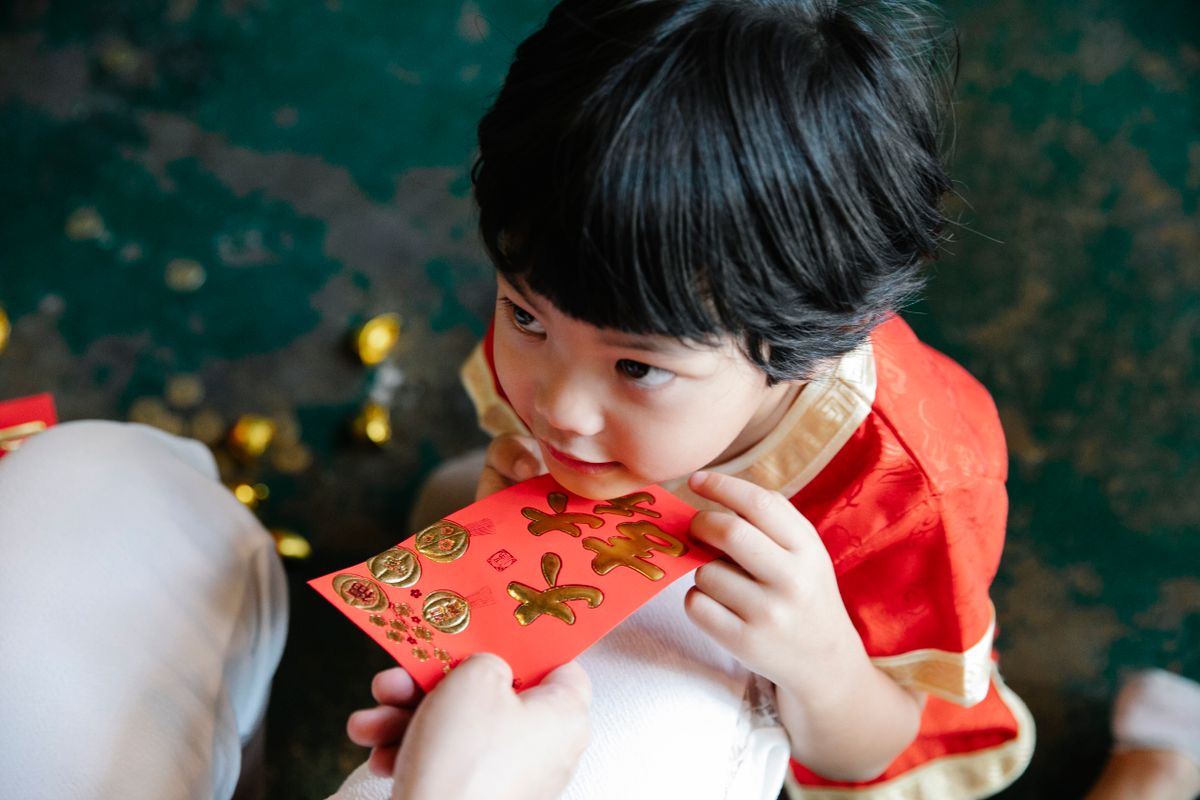
A child holds a red envelope decorated with gold characters during a Chinese New Year celebration
The Reunion Dinner: What's on the Table and Why
The reunion dinner, nianyefan, happens on New Year's Eve, February 5, 2027, and it is the one meal in the Chinese calendar that people will travel across the entire country to attend. Everyone who can gets to the table; the meal typically runs 8-12 dishes, and almost every dish is on the menu because of what it sounds like or looks like, not just because it tastes good.
| Dish | Chinese name | Symbolism |
|---|---|---|
| Whole fish | yu | "Yu" sounds like "surplus"; the fish is traditionally left partly uneaten so abundance carries into the new year |
| Dumplings | jiaozi | Shaped like ancient gold ingots; a northern Chinese staple for wealth |
| Sticky rice cake | niangao | "Gao" sounds like "tall/high"; eating it means rising higher each year, in career or income |
| Spring rolls | chunjuan | Shaped like gold bars, another wealth symbol, common in eastern and southern China |
| Glutinous rice balls | tangyuan | Round shape and "yuan" sound both signal family reunion and completeness |
| Long noodles | changshou mian | Left uncut on purpose; cutting them is thought to cut short the eater's life |
| Whole chicken | ji | Served with head and feet on to represent a complete, unified family |
Regional variation is real: dumplings dominate reunion dinners in Beijing, Xi'an, and the rest of northern China, while rice cakes and eight-treasure rice show up more in Shanghai and the Yangtze Delta, and Cantonese tables lean toward whole roasted meats and a specific type of dried oyster and black moss dish (ho see fa cai) whose name is a pun on "good business, growing wealth." If you're hosted for this meal, expect to be pushed to eat more than feels reasonable; refusing food outright can read as refusing the host's good wishes, so pace yourself across the first few dishes.
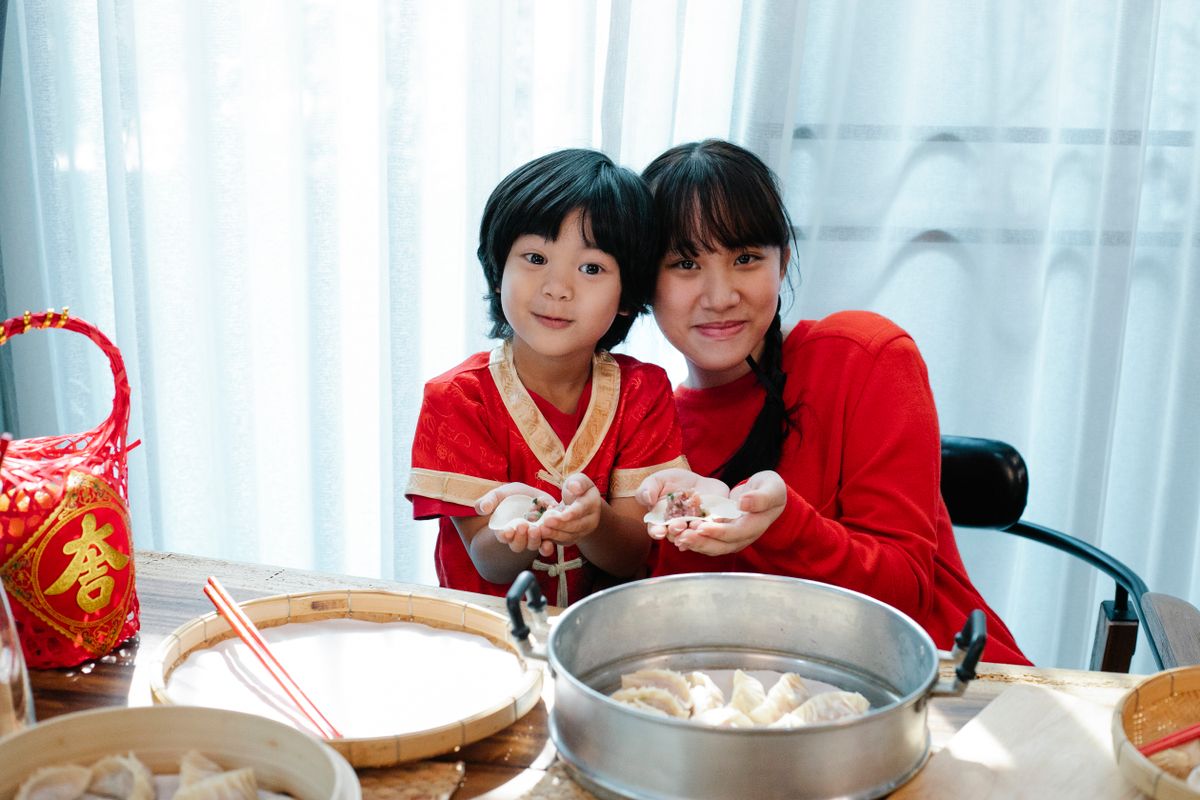
Two children in red clothing help fold dumplings on a table set with steamers for a Chinese New Year meal
Firecrackers and the Legend of Nian
The reason China sets off so much noise around New Year's traces back to a specific monster story. Nian, which is also the word for "year," was a beast said to emerge on New Year's Eve to attack villages, eat livestock, and occasionally take people. Villagers discovered Nian was afraid of three things: loud noise, bright light, and the color red. So they started hanging red paper, lighting bonfires, and burning bamboo stalks, which pop loudly when heated, to drive it off before dawn. That's the origin of baozhu, literally "exploding bamboo," the precursor to modern firecrackers, and it's why red decorations and loud noise are still paired at New Year rather than either one alone.
In practice, expect fireworks to be heavily restricted in the exact way this plays out today. Most major cities, including central Beijing, Shanghai, and Guangzhou, ban personal fireworks within city limits for air quality and fire-safety reasons, though some districts open designated firing zones for a few nights around New Year's Eve, and rules shift year to year, so check locally if you want to see them set off legally. Rural areas and smaller towns are looser about enforcement. Where fireworks are restricted, public firework or laser-light shows organized by the city fill the same role, and temple fairs often run continuous strings of small firecrackers at their entrances through the first week.
Clean Before, Not During: Taboos People Still Follow
Households do a full deep clean, dasaochu, in the days before New Year's Eve: sweeping every room, washing bedding, clearing out clutter, the works. The idea is to physically remove the past year's bad luck before the new year arrives. Once the new year starts, the same broom becomes off-limits.
- No sweeping on the first day (and in many households, the first three days): the belief is that you'll sweep away the good fortune that just arrived along with any dust. If sweeping is unavoidable, tradition says to sweep inward toward the center of the room, then pile the dust in a corner rather than carrying it out the door, until the taboo period passes.
- No hair-washing on the first day: this one is a pun. "Hair" is fa and it's a near-homophone of fa in facai, "to get rich." Washing your hair on day one is read as washing away the wealth that's supposed to flow in for the year, so many people wash and blow-dry their hair on New Year's Eve instead and skip it the next morning.
- No using scissors or knives on the first day: cutting is associated with severing luck or relationships, so food prep for day one is usually done the night before.
- No unlucky words: saying "death," "ghost," or "broken" out loud, or the number 4, is avoided at the table.
- Broken dishes get a save: if a plate or bowl shatters, the standard fix is to say "sui sui ping an," "peace every year," since "sui," meaning broken, sounds like "sui," meaning year, turning the accident into an accidental blessing.
- No debt collecting or repaying: money is meant to flow toward the household during New Year, not away from it, so people settle debts before New Year's Eve rather than during the holiday.
Red Decorations, Door Couplets, and Your Zodiac Year
Chunlian, rhyming couplets written in black or gold ink on red paper, get pasted on either side of the front door, with a shorter horizontal strip above the doorframe. They're custom-written or bought pre-printed, and they typically wish for prosperity, health, or a good harvest in the year ahead. The character fu, meaning "fortune" or "blessing," gets pasted on doors too, often upside down on purpose: dao means "upside down," and it's a homophone for dao, "arrived," so an upside-down fu reads as "fortune has arrived."
Every Spring Festival also belongs to one of the twelve zodiac animals, and 2027 belongs to the Goat (also translated as Sheep or Ram, since the Chinese word yang covers all three in English). People born in a Goat year are said to be gentle, creative, and a little indecisive under Chinese zodiac tradition, though nobody expects visitors to take any of that as more than a conversation topic. One belief that does get taken seriously: your own zodiac year, benmingnian, which comes around every 12 years, is considered a turbulent one for you specifically, so people born in Goat years wear red underwear, socks, or a red string bracelet through 2027 for protection, regardless of what they otherwise think about the superstition.
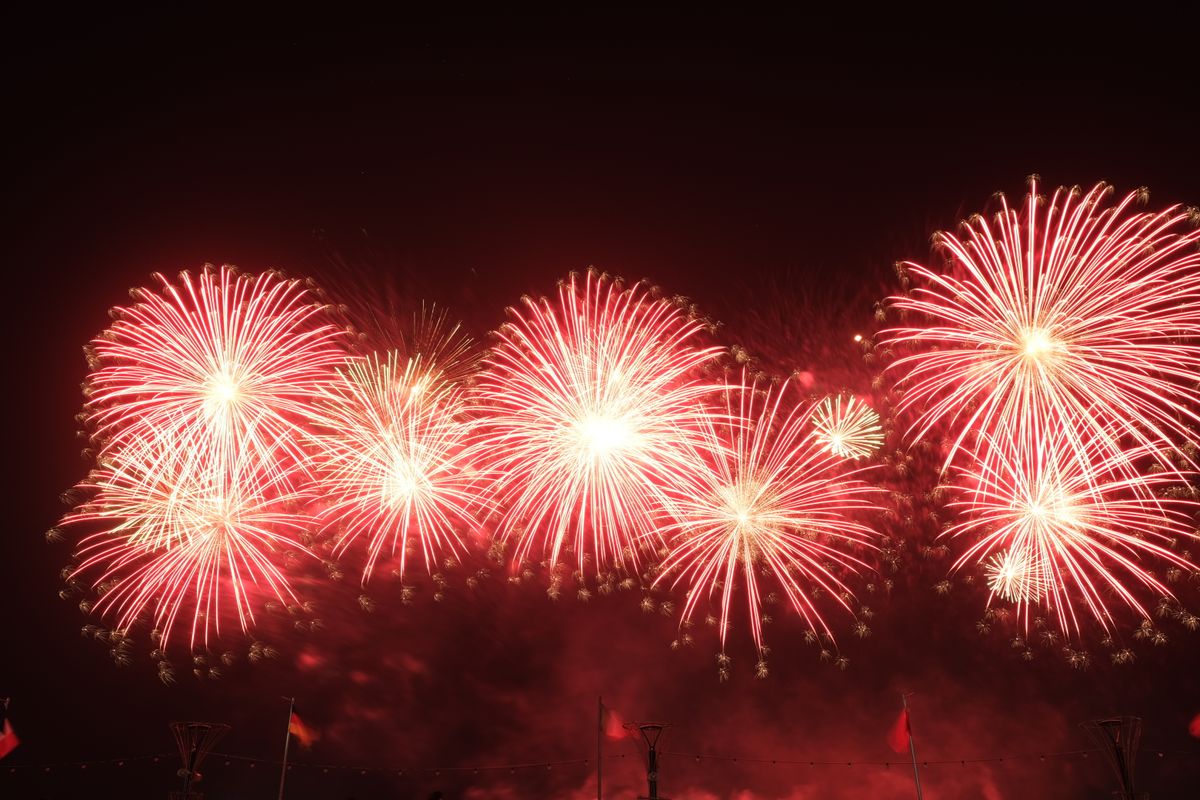
Fireworks explode in red and gold against a dark night sky during a festival celebration
Chunyun: The World's Largest Human Migration
The 40-day travel window around Spring Festival, chunyun, is officially described by Chinese state media as the largest annual human migration on the planet, and the scale backs that up: China's transport ministry has projected passenger trips in the billions across rail, road, air, and water for the chunyun period in recent years, counting every leg of every journey. Train tickets for the days immediately before New Year's Eve typically sell out within minutes of release on the 12306 booking system, released 15 days ahead of travel, and migrant workers, students, and anyone who moved cities for work all try to get home in the same short window.
If your trip to China overlaps with Spring Festival 2027 (roughly January 23 to February 21, with the public holiday itself running February 5-12), plan around it rather than through it:
- Book train tickets the moment they release, or use a travel agent or platform that can queue tickets for you; don't expect same-week bookings on popular routes like Beijing-Guangzhou or Shanghai-Chengdu.
- Expect many family-run restaurants, small shops, and some tourist-facing businesses to close for 3-7 days, especially outside major hotels and chain restaurants in first-tier cities.
- Major tourist sites (the Forbidden City, Terracotta Warriors, West Lake) stay open and get busy with domestic tourists doing their own holiday travel, so book timed-entry tickets in advance.
- Flights and hotels in your departure and destination cities cost more in the week around New Year's Eve; booking 2-3 months out helps.
- If you want to see the celebration itself rather than avoid the crowds, cities with strong Cantonese or overseas-Chinese populations, like Hong Kong, Macau, and Guangzhou, run public lion dances, temple fairs, and, where legal, fireworks displays that are easier for a visitor to watch than a private family dinner.
Lantern Festival: How Spring Festival Closes
Spring Festival doesn't end on New Year's Day; it runs 15 days, and the last one is Yuanxiao Jie, the Lantern Festival, which falls on February 20, 2027. Families eat tangyuan, sweet glutinous rice balls in soup, whose round shape again stands for family unity. Towns and temples hang lanterns and, in some places, run lantern-riddle games where solving a wordplay puzzle written on a lantern wins a small prize. Some southern cities, notably parts of Guangdong and Fujian, hold their own fireworks and dragon-dance processions on this night rather than New Year's Eve itself, so if you missed the main event, the Lantern Festival is a second chance to see the same spirit in public.
Visiting China During Spring Festival: What You Need to Know
If your dates land inside the chunyun window, three things determine whether the trip goes smoothly: transport booked early, a realistic expectation that small businesses will be shut for several days, and a plan for at least one big public celebration (a temple fair, a lantern display, or a lion dance) since you're unlikely to be invited to a private reunion dinner unless you already know a local family. None of that should discourage the trip. Spring Festival is also when China looks most like itself: decorated, loud in the ways that matter, and organized entirely around getting people home.
FAQ
What are Chinese New Year traditions around food? The centerpiece is the reunion dinner on New Year's Eve, built around dishes chosen for their symbolism: whole fish for surplus, dumplings for wealth, niangao (rice cake) for progress, and long noodles for longevity. Regional dishes vary (dumplings dominate in the north, rice cake and eight-treasure rice more common around Shanghai), but the pattern of "eat this because it sounds or looks like something lucky" holds nationwide.
What are Chinese New Year traditions for kids? Children get new clothes (often red), receive hongbao from parents, grandparents, and relatives, stay up late on New Year's Eve (a practice called shousui, "guarding the year," believed to add years to their parents' lives), and often help fold dumplings or hang decorations. Many wear a full red outfit if it happens to be their own zodiac year.
What Chinese New Year traditions bring good luck? Pasting red couplets and an upside-down fu character on the door, giving and receiving hongbao in amounts ending in 6 or 8, eating symbolic foods like fish and niangao, and wearing red (especially for anyone in their own zodiac year) are the main luck-focused customs. Fireworks and firecrackers, where still legal, are meant to scare off bad luck along with the Nian monster of legend.
Why do people avoid washing their hair during Chinese New Year? Because "hair" (fa) sounds almost identical to the fa in facai, "to get rich." Washing your hair on New Year's Day is seen as washing away incoming wealth, so many people wash their hair on New Year's Eve and then avoid it for the first day or few days of the new year.
Why do people avoid cleaning during Chinese New Year? The full house cleaning happens before New Year's Eve specifically so the year can start with the bad luck already swept out. Sweeping or cleaning during the first days of the new year is thought to sweep away the good fortune that just arrived with it, which is why brooms typically stay put until the taboo period, usually the first three days, passes.
Sources
- Spring Festival · The State Council of the People’s Republic of China
- Spring Festival, social practices of the Chinese people in celebration of traditional new year · UNESCO
- Chinese New Year · Encyclopaedia Britannica